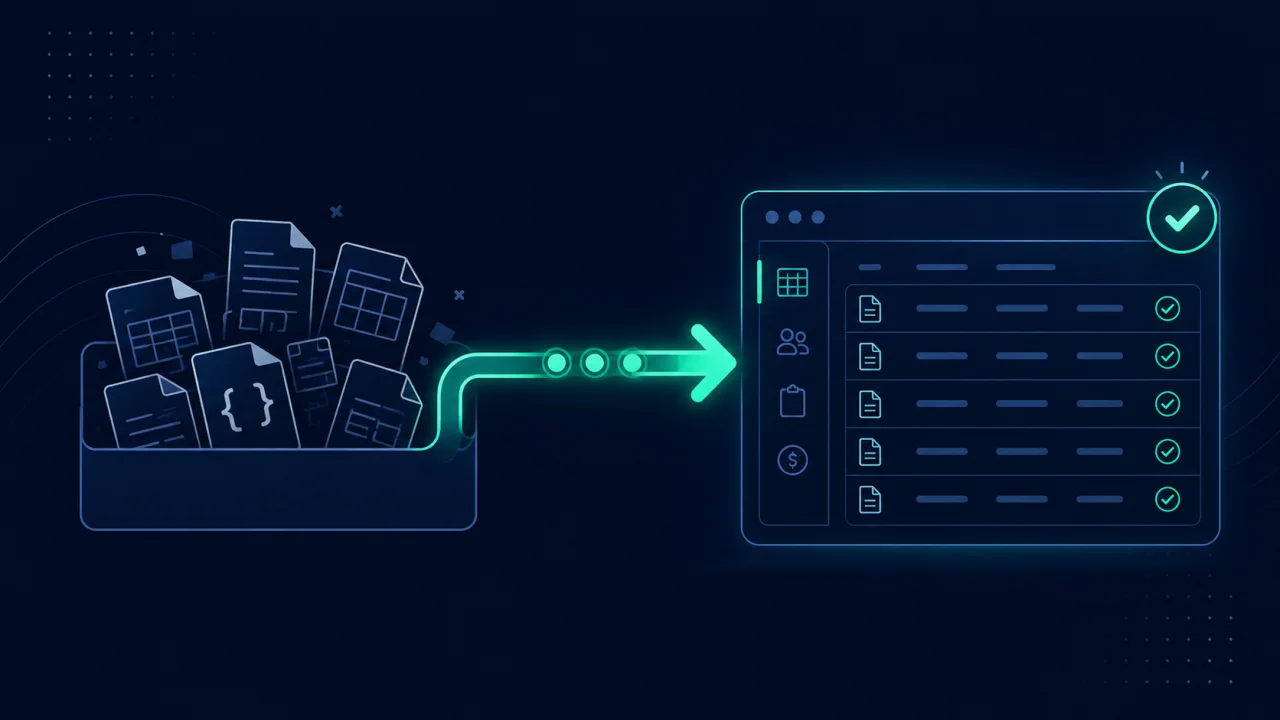
Can you migrate from Stocky to Shopify directly? Not fully. Shopify has no native record for suppliers, landed costs, or a purchase-order history, and its PO CSV import only creates a new draft that drops status, received quantities, supplier links, and costs. The working migration path is three steps. First, export from Stocky. Then convert the files into an import-ready format. Finally, import into Shopify plus a dedicated inventory app that can hold the history. If you would rather follow the exact clicks, the step-by-step Stocky migration guide walks each one in order.
Key takeaways
- Stocky closes August 31, 2026. Migrate before then or the data is unrecoverable.
- Shopify natively holds stock levels only; it has no supplier, cost, or purchase-order history record.
- Its native PO import makes a draft and drops status, received quantities, and suppliers.
- The reliable path is export, convert, import, not a direct Stocky-to-Shopify transfer.
- A converted PO file imports into an inventory app like EZStock with the full history intact.
Why can't Shopify import my Stocky purchase orders?
Because Shopify's core inventory was never built to store purchase-order history. It tracks how much stock you have right now, per location. That's it. There's no native object for a supplier, a landed cost, or a purchase order that's been sent, partly received, and closed. When you upload Stocky's PO CSV through Shopify's own import, all it can do is take the product line items and drop them into a new draft PO. The status, the received quantities, the supplier link, and the cost you actually paid have nowhere to go, so they're discarded.
This isn't Shopify removing a feature. The built-in inventory is simply thin, and it always has been. Stocky was Shopify's own bolt-on that filled the gap. With Stocky retiring, that gap is back, and you need somewhere for the history to live.
What actually transfers, and what doesn't
Before you migrate, it helps to know exactly which data is portable and which isn't. Here's the honest breakdown:
| Stocky data | Portable? | Where it goes |
|---|---|---|
| Current stock counts | Yes | Shopify Inventory import (SKU + available) |
| Purchase orders (status, received qty, costs) | Yes, after converting | Inventory app (EZStock) |
| Suppliers (name, lead time, contact) | Yes, after converting | Inventory app (EZStock) |
| Cost-per-item | Yes | Shopify cost field / inventory app |
| Supplier notes (free text) | No, copy by hand | Not in any Stocky export |
| Par / reorder-point settings | No, re-enter | Not in any Stocky export |
The three-step migration
1 Export everything from Stocky
Pull all four data types before the deadline: purchase orders, suppliers, stocktakes, and your SKU cost list. For purchase orders, use the Stocky API JSON (purchase_orders) if you can. It's the only source that carries the per-line supplier cost actually paid (supplier_cost_price) and the real receipt date (received_at). The CSV works too and is easier to get; it just omits those two fields. There's a full export checklist in how to export your Stocky data before the shutdown.
2 Convert the exports into import-ready files
A raw Stocky export won't import as history. Run each file through the free Stocky Export Converter. It auto-detects the type, consolidates Stocky's one-PO-at-a-time exports into a single file, and outputs two things per file: a Shopify-native CSV where Shopify supports it (inventory counts, cost-per-item), and an EZStock-ready file that keeps your full PO history, including status, received quantities, costs, dates, and suppliers. It runs in your browser, nothing uploaded. Rows Excel mangled (a long SKU shown as 7.5E+11) are listed for you, not silently dropped.
3 Import into Shopify and your inventory app
Import the converted stocktake file into Shopify's Inventory import to set your current on-hand counts. Then import the converted purchase-order and supplier files into a Shopify inventory app that has a place for them. EZStock imports the full PO history in one go (status, received quantities, costs, and suppliers), so you're not re-keying years of records. Finish by re-entering the two things no export carries: supplier notes and reorder points.
Start your migration with the free converter
Drop your Stocky exports into the free converter to get clean, import-ready files: a Shopify CSV and an EZStock-ready file that preserves your full purchase-order history. No signup, runs in your browser, nothing uploaded.
Convert my Stocky export free →Where should the history land after Stocky?
Shopify's built-in inventory holds your current stock, but not purchase orders, suppliers, or costs, so you need an app for the parts Stocky used to cover. EZStock is built as the Stocky replacement: it imports the converted PO history, tracks suppliers and lead times, forecasts demand with days-of-stock-left, sends low-stock alerts, and generates purchase orders. It has a free plan, so the migration doesn't force you onto a paid tier on day one. If you're weighing options, the best Stocky alternatives for 2026 and the guide to the best Stocky alternative apps compare the main choices side by side.
Frequently asked questions
How long does a Stocky migration take? For most stores, under an hour of active work: a few minutes to export each data type, a minute per file to convert, then the imports. The slow part is only re-entering supplier notes and reorder points, which don't come through any export.
Can I move my purchase-order history into Shopify itself? No. Shopify has no native purchase-order history record, so the history has to live in an inventory app. Shopify's own import creates a fresh draft PO and keeps only the line items.
Do I have to migrate everything, or just current stock? You can migrate just current stock via Shopify's Inventory import, but you'll lose your purchase-order history, supplier records, and cost basis. If those matter for reordering and margins, convert and import them into an inventory app.
What if I've already uninstalled Stocky? If the app is gone and it's past August 31, 2026, the data can't be recovered. If Stocky is still installed, export everything immediately before doing anything else.