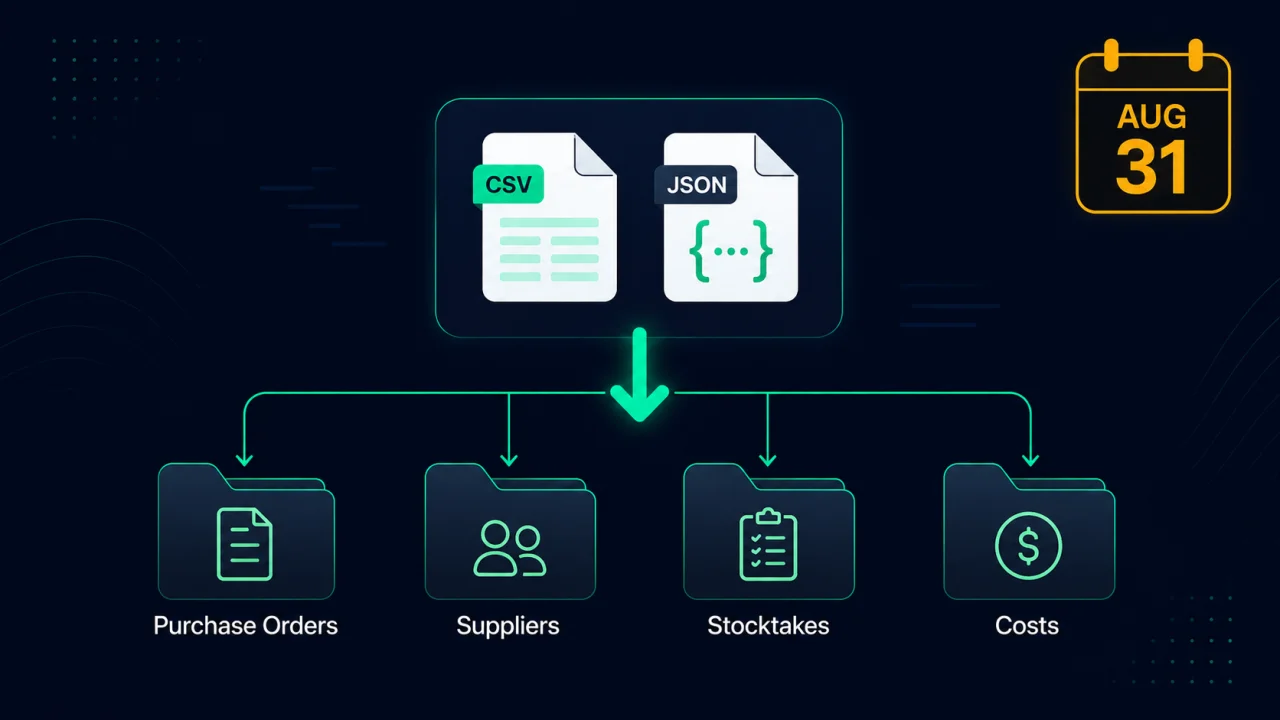
The short answer: before August 31, 2026, export four things from Stocky. Your purchase orders (use the API JSON if you can, not just the CSV), your suppliers, your stocktakes / current stock, and your SKU cost list. Then convert them into an import-ready format, because Shopify's own CSV import only creates a new draft PO and drops the status, received quantities, supplier links, and costs.
Key takeaways
- Stocky's export goes dark on August 31, 2026. After that, the data is gone.
- Export purchase orders, suppliers, stocktakes, and costs, not just products.
- Use the Stocky API JSON where you can: it carries per-line supplier costs and receipt dates the CSV leaves out.
- Shopify's native PO import can't restore history — it makes a draft and drops status, received quantities, and suppliers.
- Supplier notes and reorder-point settings aren't in any export, so copy those by hand.
Why can't I just leave my data in Stocky?
Because on August 31, 2026, the export button goes away with the app. Stocky's purchase-order history, supplier records, landed costs, and stocktakes live inside Stocky. They are not stored as Shopify records, so uninstalling Stocky (or the date passing) takes them with it. Anything you haven't pulled out by then can't be recovered afterward. The safe move is to export everything now, while you still can, and keep the files somewhere you control.
What exactly should I export from Stocky?
Most people export their product list and stop there. That's the one file Shopify handles fine on its own, and it's the least valuable to save. The data worth rescuing is the operational history: which purchase orders you placed, what you actually paid, what arrived and when, and who your suppliers are. Here's the full checklist, in order.
1 Export your purchase orders
In Stocky, open Purchase Orders and export them. You have two paths, and they are not equal:
- CSV export: the easy option, available from the interface. It covers most fields but leaves a couple out.
- Stocky API JSON (the
purchase_ordersendpoint): the more complete source. It's the only place that carries the per-line supplier cost actually paid (supplier_cost_price) and the real per-line receipt date (received_at), which you need for an accurate cost trail and true supplier lead times.
If you can pull the API JSON, do it. If not, the CSV still works for most stores. Either way, export it before the API shuts down on the same August 31 date.
How to pull the purchase-order JSON
Most people don't need this. The CSV export covers what a typical store needs, so if a terminal isn't your thing, use the CSV path and skip ahead. Reach for the JSON only when you specifically want the per-line supplier cost and exact receipt dates the CSV drops.
If you do want it, the JSON comes from Stocky's own API, and it's a small job for anyone comfortable with a command line (or a two-minute favor from a developer). Here's the whole thing:
- In Stocky, go to Preferences → API and copy your API key.
- Run this from a terminal, with your store domain and key filled in. It saves a
purchase_orders.jsonfile you drop straight into the converter:
# replace YOURSTORE and YOUR_API_KEY
curl "https://stocky.shopifyapps.com/api/v2/purchase_orders.json?limit=200" \
  -H "Store-Name: YOURSTORE.myshopify.com" \
  -H "Authorization: API KEY=YOUR_API_KEY" \
  -o purchase_orders.json
Big catalog? Stocky pages with since_id, not page numbers. Take the smallest PO id from the file you just got, add &since_id=THAT_ID to the URL, run it again into a second file, and repeat until a run comes back empty. The converter reads each file.
Then open the free Stocky Export Converter and drop the JSON in. It reads supplier_cost_price, received_at, and the inventory_item_id match key, so the full cost-and-receipt trail comes through. Do this before August 31, because the API goes dark with the app.
2 Export your suppliers
Export your supplier list: names, lead times, and contact details. This is data Stocky can't fully re-create anywhere else, and Shopify has no native supplier record to import it into, so if you lose it you're re-typing every vendor by hand.
One catch: free-text supplier notes are not included in Stocky's CSV or its API. If you keep notes per vendor (payment terms, minimums, the rep's name), copy those into a spreadsheet manually before the deadline. No tool can extract them for you.
3 Export your stocktakes and current stock
Export your stocktakes and current on-hand quantities. These become a Shopify Inventory import (SKU plus available quantity), which is the correct path now, since you can no longer set stock levels through the Products CSV. Getting the counts out cleanly means you can rebuild accurate inventory in your next app without a full physical re-count.
4 Export your SKU cost list
Export your cost-per-item list (SKU to unit cost). Your cost basis drives every margin report you'll ever run, and it's tedious to rebuild from invoices. Save it now as a clean SKU-to-cost file so you can re-apply cost-per-item in Shopify or your new inventory app.
5 Convert the files into an import-ready format
A raw Stocky export isn't something Shopify can ingest as history. Run each file through the free Stocky Export Converter. It detects the type, consolidates Stocky's one-PO-at-a-time exports into a single file, and gives you both a Shopify-native CSV and an EZStock-ready file that preserves PO status, received quantities, costs, dates, and supplier. It runs entirely in your browser; nothing is uploaded.
7.5E+11, Excel converted it to scientific notation and the real value is gone for good, and no tool can recover it. Open Stocky exports in Google Sheets, or format the SKU column as text before opening in Excel. The converter lists any mangled rows so you can catch them instead of importing bad data.
What does Shopify's native import actually keep?
This is the part that surprises people. You'd assume Shopify's own purchase-order CSV upload restores your Stocky POs. It doesn't. It only adds product line items to a new draft purchase order and drops everything that made the record useful. Here's the gap:
| Field | Shopify native PO import | After converting first |
|---|---|---|
| Product line items | Kept | Kept |
| PO status (sent / received) | Dropped (starts as draft) | Preserved |
| Received quantities | Dropped | Preserved |
| Supplier link | Dropped | Preserved |
| Cost paid per line | Dropped | Preserved (from API JSON) |
So exporting is only half the job. Exporting keeps the raw data; converting keeps the history, which is the whole reason you'd want it.
Convert your Stocky export free, before Aug 31
Drop your Stocky purchase orders, suppliers, stocktakes, or cost lists into the free converter and get clean, import-ready files: a Shopify CSV and an EZStock-ready file that keeps your full PO history. Runs in your browser, no signup, nothing uploaded.
Open the free Stocky converter →Once your files are converted, the next question is where the history actually lands. Shopify's built-in inventory is thin. It holds current stock levels but has no place for purchase orders, suppliers, or costs. EZStock is a Shopify inventory and purchase-order app built to be the Stocky replacement, and it imports the converted PO history (status, received quantities, costs, and suppliers) in one go. If you want the full migration path start to finish, read the Stocky to Shopify migration guide, or compare your options in the guide to the best Stocky alternative apps.
Frequently asked questions
When exactly does Stocky shut down? August 31, 2026. Both the app and its API stop working on that date, so any export, CSV or JSON, has to happen before then.
Can I export everything at once? No. Stocky exports each data type separately (purchase orders, suppliers, stocktakes, costs), so run through the checklist above and pull each one. Then you can convert them together.
Should I use the CSV or the API JSON? Use the API JSON if you're able to. It's the only source with per-line supplier costs and real receipt dates. The CSV is fine for most stores and is easier to get; it just leaves those two fields out.
How do I actually export the JSON? Copy your API key from Stocky's Preferences → API page, then call https://stocky.shopifyapps.com/api/v2/purchase_orders.json with two headers: Store-Name (your .myshopify.com domain) and Authorization: API KEY=your-key. The curl command in step 1 does exactly this. It's a quick job on a command line, or a two-minute favor from any developer. Large catalogs page with since_id, not page numbers.
What can't be recovered no matter what? Supplier free-text notes and par / reorder-point settings aren't in Stocky's CSV or its API, so no converter can extract them. Copy those manually before August 31. Everything else (POs, line costs, received dates, suppliers, stocktakes) comes through.