What these three apps actually are
The first thing to understand is that these are not direct substitutes for each other. They overlap in some features but are built around fundamentally different value propositions:
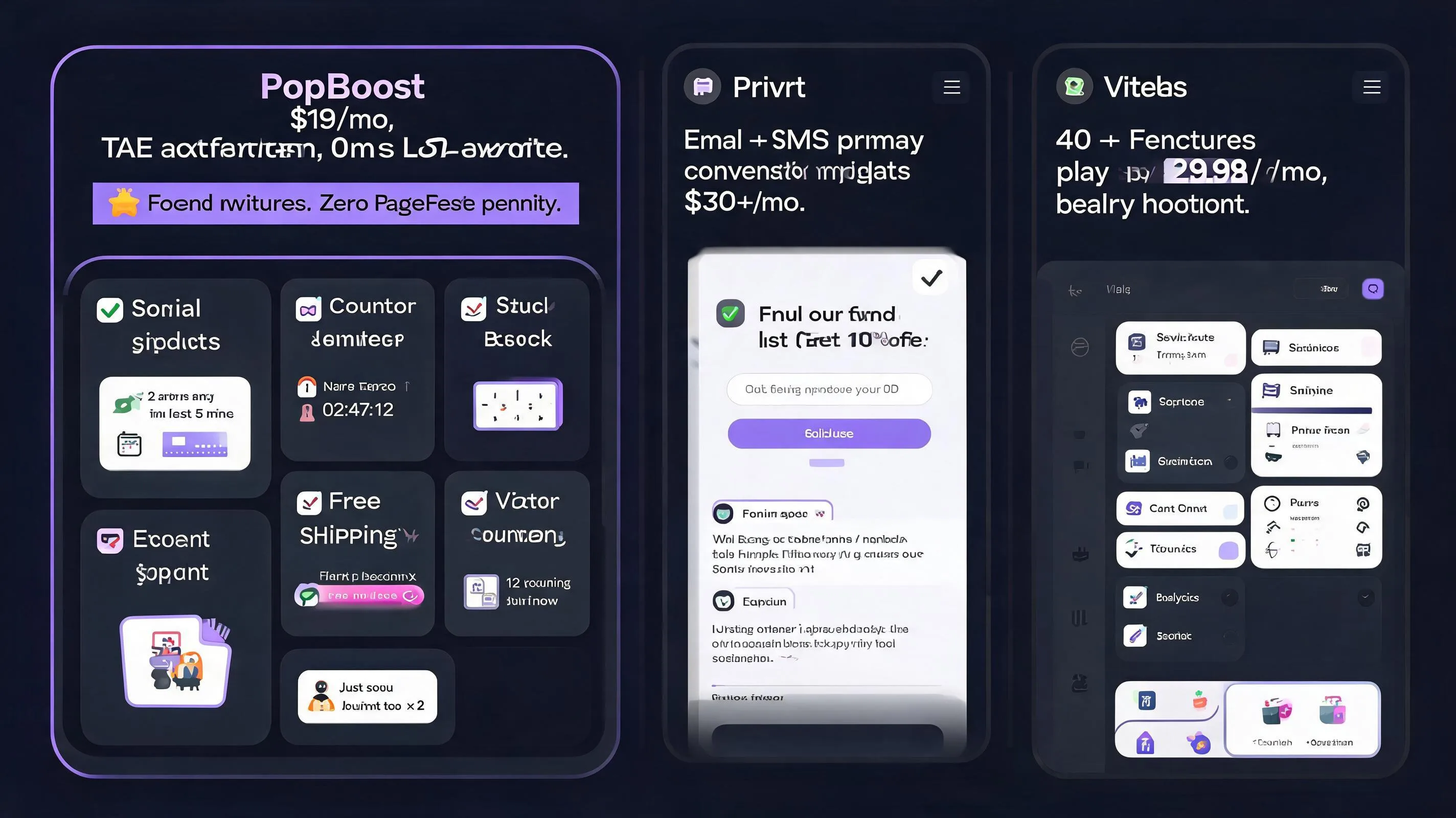
- Privy is primarily an email marketing platform for Shopify. Its popups and conversion widgets exist to capture email addresses for Privy's email automation features. If you think of Privy as a "popup app," you're using it for maybe 30% of what you're paying for.
- Vitals is a bundled "all-in-one" app that packs 40+ features — reviews, bundles, product bundles, currency converter, cookie consent, age verifier, and conversion widgets — into a single monthly fee. The value is breadth: one bill instead of five.
- PopBoost is a focused conversion widget app. It does 7 things specifically: social proof popup, countdown timer, exit intent popup, free shipping bar, product badges, announcement bar, and stock countdown. That's the entire feature set — nothing more.
Which one is right for you depends entirely on which of those profiles matches your needs. Most comparison guides skip this distinction and rank all three by generic criteria. This one doesn't.
Just need conversion widgets? No email platform, no 40-feature bundle?
PopBoost gives you 7 focused conversion widgets — social proof, countdown timers, exit intent, shipping bars, product badges — for $19/month. Theme App Extension, async loading, no bloat.
Install PopBoost free →$19/month Pro plan · 14-day free trial · works with any Shopify OS 2.0 theme
App-by-app overview
Privy
Privy started as a popup tool and evolved into a full email marketing platform for Shopify. It's best known for its spin-to-win wheels, exit intent popups, and email capture overlays — but its current core offering is the email platform those popups feed into. If you already pay for Klaviyo or another email platform, you're buying Privy's email infrastructure twice.
- Email campaigns, automations, and abandoned cart flows
- Exit intent popups, announcement bars, spin-to-win
- A/B testing on popup forms and displays
- List segmentation and email analytics
- Pricing scales by contact count — can get expensive quickly for large lists
Vitals
Vitals bundles over 40 Shopify features into one app at a fixed price. Its pitch is app consolidation: instead of paying for Judge.me (reviews), a currency converter, a bundle builder, a sticky add-to-cart, social proof popups, and countdown timers separately, you pay one bill for all of them. The value is real for merchants who use most of those features. The tradeoff is that the conversion-specific widgets aren't as deep as dedicated tools.
- Product reviews and UGC collection
- Currency converter and geolocation
- Social proof notifications, countdown timers, stock countdown
- Bundle builder, sticky cart, trust badges
- Age verifier, cookie consent, GDPR tools
- 40+ features total across categories
PopBoost
PopBoost is a conversion widget app with 7 Shopify App Blocks: social proof popup (real purchase notifications via app proxy), countdown timer (flip or progress bar style), exit intent popup (discount modal triggered on cursor leave), free shipping bar (animated progress toward threshold), product badges (SALE / NEW / LOW STOCK overlays), announcement bar (sticky top), and stock countdown (Liquid-only, reads real inventory). Nothing else — no email, no reviews, no currency converter. Each widget is configurable per product or globally, with a theme-matching palette that reads your store's active color scheme.
- 7 conversion-specific App Blocks (Theme App Extension)
- Real purchase data for social proof — reads actual Shopify orders via app proxy
- Stock countdown reads real Shopify inventory (no fabricated numbers)
- Theme color matching (reads your store's active palette automatically)
- Async loading — widgets don't block page render
- Single $19/month flat rate — no per-email or usage scaling
Feature comparison
| Feature | PopBoost | Privy | Vitals |
|---|---|---|---|
| Social proof popup (recent purchases) | ✓ (real orders) | Limited | ✓ |
| Countdown timer | ✓ (flip + bar) | ✓ | ✓ |
| Exit intent popup | ✓ (discount modal) | ✓ (core feature) | ✓ |
| Free shipping progress bar | ✓ | ✓ | ✓ |
| Product badges (Sale / New / Low Stock) | ✓ | ✗ | ✓ |
| Announcement bar | ✓ | ✓ | ✓ |
| Stock countdown ("Only N left") | ✓ (real inventory) | ✗ | ✓ |
| Email capture & list building | ✗ | ✓ (core feature) | Basic |
| Email automations / drip flows | ✗ | ✓ | ✗ |
| A/B testing | ✗ | ✓ | ✗ |
| Product reviews / UGC | ✗ | ✗ | ✓ |
| Currency converter | ✗ | ✗ | ✓ |
| Theme App Extension (async) | ✓ | Script | Partial |
| Theme color matching | ✓ (auto) | Manual | Manual |
| Price (monthly, base plan) | $19/month | ~$30+ (scales) | $29.99/month |
Head-to-head: conversion widget quality
The comparison table shows which features exist in each app. More important is the quality of each widget and whether the underlying data is real. Here's how the core conversion features compare in depth:
Social proof popups (recent purchase notifications)
All three apps show recent purchase notifications. The difference is in the data source:
PopBoost's social proof popup is powered by a Shopify app proxy endpoint that reads real order data from your store. It cycles through actual purchases from the last 24 hours during active sessions, falling back to recent-day purchases during slower periods. There's no shuffling or fabricating — the names and products shown were genuinely purchased by real customers.
Privy's social proof feature exists but is secondary to its popup and email focus — it's less configurable and documented compared to its lead capture tools.
Vitals's social proof notifications are solid and work well. For a store that already has Vitals installed for reviews or other features, there's no reason to add PopBoost just for this widget — Vitals handles it adequately.
Countdown timers
PopBoost offers two visual styles: a flip-card counter (the kind that draws the eye with the page-turning animation) and a progress bar timer. Both can be set to a specific end datetime or a per-session duration. The end datetime mode is ideal for real sale end dates; the per-session mode creates a "your session discount expires in" urgency that resets on each visit.
Privy offers countdown timers tied to popup rules, which is useful if you want the timer to appear only for visitors who haven't yet entered their email. This is a legitimate and effective combination: the email popup fires first, and the timer starts running after signup.
Vitals offers a countdown timer as one of its 40+ features. It's functional, but doesn't offer the flip-card animation style.
Exit intent popups
This is where Privy is genuinely better than the other two. Privy's exit intent system has been refined over many years and offers more targeting rules — specific page types, number of visits, time on site, device type — than PopBoost's implementation. If A/B testing your exit intent popup is part of your CRO strategy, Privy's testing tools are a real differentiator.
PopBoost's exit intent popup triggers a discount modal on cursor leave (desktop) and scroll-to-top behavior (mobile). It's effective for the standard use case — catching abandoning visitors with a first-order discount — but doesn't offer A/B testing or multi-step form sequences.
Vitals's exit intent works similarly to PopBoost's, covering the standard trigger without Privy's advanced targeting options.
Product badges
PopBoost and Vitals both offer product badges — SALE, NEW, and LOW STOCK overlays that display on product images in collection and product pages. Privy does not have product badges.
The distinction worth noting: PopBoost's LOW STOCK badge reads your actual Shopify inventory level and only displays when stock is below a configurable threshold. It hides automatically when stock is replenished above that threshold. This means the badge always reflects reality, which matters for both trust and conversions — a badge showing "low stock" on a product with 500 units undermines credibility.
Free shipping bar
All three apps offer a progress bar toward free shipping. The core mechanic is the same — cart value threshold, animated fill as items are added. The differences are in placement options (sticky top, inline, above cart), the copy when the threshold is met, and mobile behavior. PopBoost's version is a dedicated App Block with granular configuration; Vitals's is functionally similar.
Store speed and Core Web Vitals
This matters more than most merchants realize. The average Shopify store runs 12–15 third-party apps; third-party app JavaScript accounts for roughly 75% of average Shopify page load time. Any conversion app that loads synchronously — blocking page render while its script evaluates — has a real cost in Core Web Vitals scores that directly affects SEO rankings and paid ad Quality Scores.
PopBoost
All 7 of PopBoost's widgets are delivered as Shopify App Blocks via Theme App Extension. This means they're registered with Shopify's infrastructure and load asynchronously alongside your theme — they don't inject JavaScript into your theme's <head> or block the critical rendering path. The social proof popup uses an app proxy endpoint so the data fetch is non-blocking.
Privy
Privy loads via a JavaScript snippet that merchants paste into their theme or that the app adds to theme files. The snippet itself is relatively small, but depending on your popup rule configuration and how many active campaigns you're running, the evaluation overhead can accumulate. Privy has invested in load optimization over the years, but the architecture is fundamentally script-injected rather than Theme App Extension-based.
Vitals
Vitals has made significant improvements to its loading approach in recent versions and supports Theme App Extension for some of its features. With 40+ features potentially active, however, the JavaScript evaluation footprint is larger than a focused widget app. For stores that only activate 5–6 Vitals features, the impact is manageable. For stores trying to maximize Core Web Vitals scores, the breadth of Vitals's bundle is a consideration.
Pricing comparison
The pricing models are different enough that a per-feature price comparison is more useful than a headline number:
The pricing model matters more than the starting number:
- PopBoost: Fixed $19/month regardless of traffic, conversions, or store size. The price doesn't change as your store grows.
- Vitals: Fixed $29.99/month for all features. Good value if you use a significant portion of the 40+ features. Poor value if you only need 5–6 of them — you're paying $30 for 34 features you don't use.
- Privy: Starts low but scales with your email list. For stores with 20,000+ subscribers, Privy can cost $100–$300+/month. If you already pay for Klaviyo and are comparing Privy only for its popup widgets, the math rarely works out — you're paying Privy's list-based pricing for popup features that a $19/month focused app provides.
Already on Klaviyo? Stop paying for Privy's email features you don't need.
PopBoost gives you 7 best-in-class conversion widgets — the FOMO and urgency layer that sits on top of whatever email platform you're running — for $19/month. No list size limits, no scaling fees.
Install PopBoost free →$19/month Pro plan · 14-day free trial · no credit card required
Who each app is actually best for
Choose Privy if:
You don't have an email platform and want one subscription that covers both list-building popups and email automations (welcome series, abandoned cart, post-purchase). Privy's exit intent targeting and A/B testing are also genuinely useful if your traffic volume is high enough to run meaningful tests (typically 5,000+ monthly visitors per variant).
Don't choose Privy if you're already on Klaviyo, Omnisend, or another email platform. You'll be paying for email infrastructure you're not using. In that case, switch the email budget to Klaviyo and cover on-site widgets with a focused $19/month app instead.
Choose Vitals if:
You want to consolidate multiple app subscriptions — particularly if you need product reviews (replacing Loox or Judge.me), a currency converter, bundle discounts, and conversion widgets all from one billing line. For a store paying separately for 4–6 of the features Vitals bundles, $29.99/month is a significant savings.
Don't choose Vitals if you already have dedicated apps for reviews and email and only need conversion widgets. In that case, you'll be paying $30 for features you already have, and accepting more JavaScript overhead to get 7 conversion widgets you could get for $19 from a focused app.
Choose PopBoost if:
You're already on Klaviyo for email and Judge.me, Loox, or Yotpo for reviews — meaning you have the two biggest "other features" covered — and you specifically need the FOMO and urgency layer: social proof popups, countdown timers, exit intent, shipping bars, badges, and stock countdown. You get 7 well-built, focused widgets at the lowest price of the three, with Theme App Extension delivery and no list-based pricing.
Don't choose PopBoost if you need email marketing, A/B testing on popup forms, or a broad all-in-one feature set. PopBoost does one thing — conversion widget delivery — and nothing outside that scope.
The stack most Shopify merchants actually use
For context: most established Shopify stores use Klaviyo for email, a dedicated reviews app (Loox, Judge.me, or Yotpo) for UGC, and a separate conversion widget app for on-site urgency. The stack looks like this:
- Email: Klaviyo ($20–$150+/month depending on list)
- Reviews: Loox or Judge.me ($9–$15/month)
- Conversion widgets: PopBoost ($19/month) or Vitals ($30/month if replacing the above two)
- Bundles / AOV: EZBundle ($9–$19/month for fixed and mix-and-match bundles)
For a merchant who doesn't yet have any of these, Vitals can replace all four at $30/month — a genuine bargain at that stage. For a merchant who already has Klaviyo and a reviews app, adding Vitals means paying $30 for features they already have. In that case, a focused $19/month widget app is the rational choice.
Frequently asked questions
Which is better: PopBoost, Privy, or Vitals for Shopify?
The best answer depends on what you already have. If you're on Klaviyo and have a reviews app, choose PopBoost for conversion widgets at the lowest price. If you need email marketing included, choose Privy. If you want one subscription for 40+ features across reviews, currency, bundles, and conversion widgets, choose Vitals.
Does Privy slow down Shopify stores?
Privy loads via JavaScript injected into your storefront, which is a different architecture from Shopify's Theme App Extension system. The impact on Core Web Vitals depends on how many active popup rules you have and your store's baseline performance. Theme App Extension-based apps like PopBoost load asynchronously via Shopify's infrastructure and have a lower risk of affecting LCP and TBT scores.
Is Vitals worth it for small Shopify stores?
At $29.99/month with 40+ features, Vitals is genuinely cost-effective if you use most of those features. If you're a new store without Klaviyo, a reviews app, or a currency converter, Vitals covers all of those for less than the sum of parts. If you already have dedicated apps for those functions, you'd be paying for features you're duplicating.
Does PopBoost work with any Shopify theme?
Yes. PopBoost uses Shopify's Theme App Extension architecture — all 7 widgets are App Blocks that work with any Online Store 2.0 theme without modifying your theme's files. The blocks are added in the Shopify theme editor. PopBoost also includes automatic theme color matching that reads your store's active color palette and applies it to widget styling.
What does Privy do that PopBoost doesn't?
Privy's main differentiators are its email marketing platform (campaigns, automations, abandoned cart flows), A/B testing of popup forms, and list segmentation. PopBoost focuses exclusively on conversion widgets and does not include any email functionality or A/B testing.
For a deeper look at individual widgets in PopBoost's lineup, the Shopify social proof guide covers the psychology and implementation of recent purchase notifications. If you're running product drops alongside your conversion stack, see how EZDrop pairs with PopBoost — the launch-day announcement bar and countdown timer are particularly effective when combined with a waitlist release. For the broader CRO picture before installing any widget, the Shopify CRO checklist covers which site elements to fix before adding urgency layers.
7 focused conversion widgets. $19/month. No email bloat.
PopBoost installs via Theme App Extension — no theme code changes, async loading, real Shopify order data for social proof. Try it free for 7 days.
Install PopBoost free →$19/month Pro plan · 14-day free trial · cancel anytime · works with any Shopify plan
