What Shopify's native tools actually cover (and what's missing)
Before evaluating apps, it's worth being precise about what Shopify already provides so you know what gap you're actually filling:
- Stock level tracking — Shopify tracks inventory per variant per location. This works well and needs no supplement.
- Basic inventory adjustments — You can add or remove stock manually, set a reason, and view an adjustment history.
- Native Purchase Orders — Added after the retirement of built-in inventory tools, Shopify's native PO tool lets you create and receive purchase orders. It doesn't generate PDFs, email suppliers, or tell you what to order.
- Low stock threshold display — You can set a low-stock threshold per variant that shows a label in the admin. There are no automated alerts or reorder suggestions.
The gaps: demand forecasting, reorder point suggestions based on sales velocity, a supplier database with lead times, PDF purchase orders, and direct email to suppliers. These are the features merchants built built-in inventory tool workflows around — and the features this list covers.
Already know what you need? Skip straight to EZStock.
EZStock covers every gap in Shopify's native tools: demand-based reorder suggestions, supplier database, PO generation, PDF export, email to suppliers, multi-location inventory, and low-stock email alerts. It also imports directly from Stocky. Free plan available.
Install EZStock free →Starter from $19/month · free plan available · 14-day trial on paid plans
The best Shopify inventory management apps in 2026
1. EZStock — Demand Forecasting + Purchase Orders
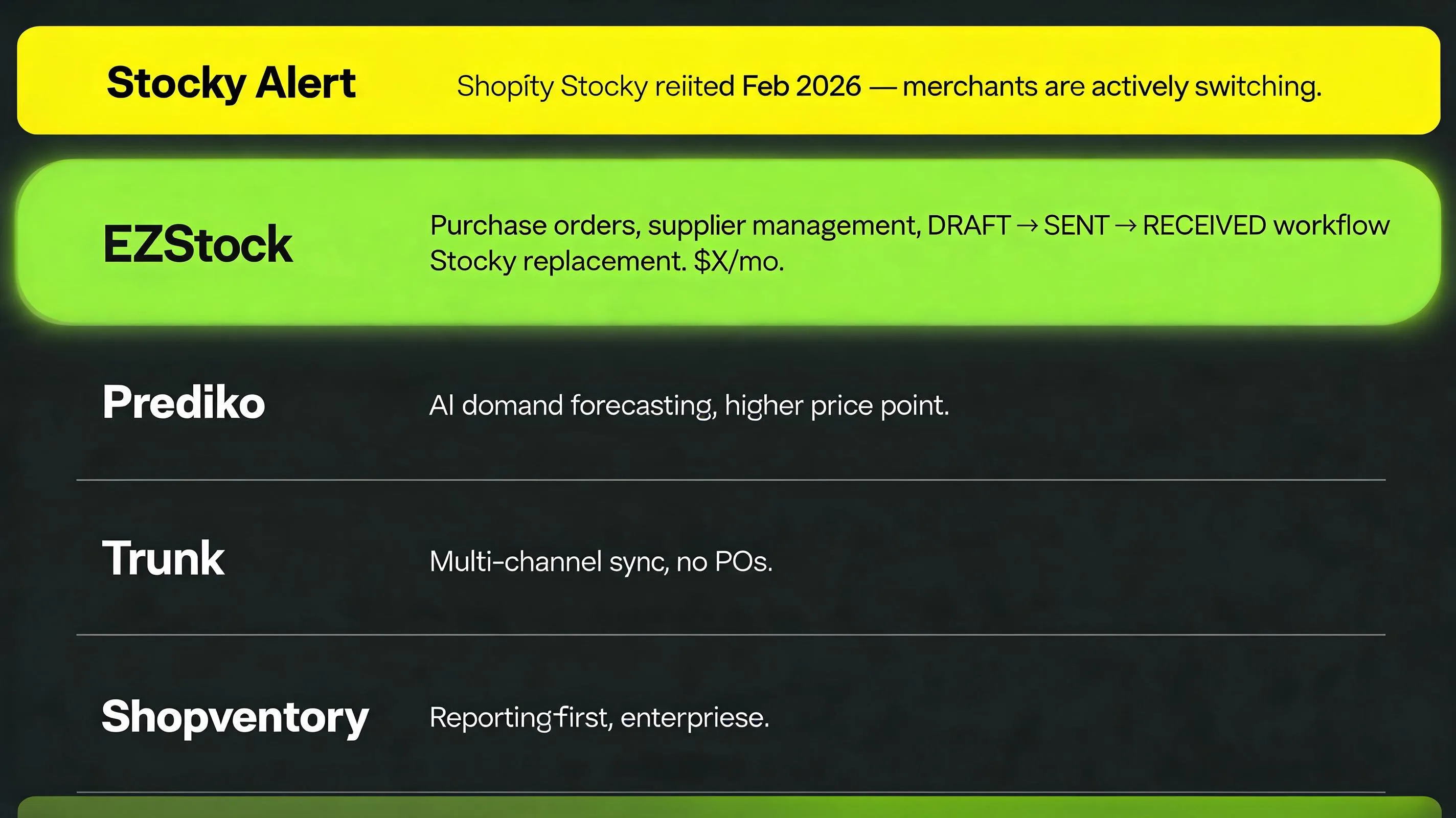
EZStock is built specifically for Shopify merchants who need the inventory intelligence layer that Shopify's native tools don't provide: demand-based reorder suggestions, a structured supplier database, and a professional purchase order workflow. It's the most direct inventory management for Shopify available, and it covers everything the old built-in inventory tool did while adding PDF generation and email delivery it never supported. For merchants leaving Stocky, EZStock imports Stocky's supplier and purchase-order exports directly, so migration takes minutes instead of a rebuild.
- Demand dashboard: Calculates rolling sales velocity per variant using your actual Shopify order data. Surfaces which products are approaching their reorder point before they stock out — not after.
- Supplier database: Store name, email, phone, lead time, currency, and notes per supplier. Associate product variants with specific suppliers so PO creation pre-fills the correct contact and unit costs automatically.
- Purchase order workflow: DRAFT → SENT → PARTIAL → RECEIVED → CANCELLED. Full lifecycle tracking. Create a PO, EZStock generates a PDF and emails it to the supplier in one click. Mark items as received; Shopify inventory updates automatically.
- Partial receiving: When a supplier ships 40 of a 50-unit order, mark the 40 as received. EZStock holds the PO open and tracks the outstanding 10 until the balance arrives.
- PO number sequencing: Auto-incrementing PO numbers per shop for clean cross-referencing with supplier invoices and accounting records.
- Stocky migration: A built-in importer reads Stocky's own supplier and purchase-order exports (JSON or CSV) and rebuilds your open POs and suppliers, so moving off Stocky takes minutes.
- Multi-location inventory: View stock per location and receive purchase orders into a specific location, so stores running more than one location see the right numbers instead of a single blended total.
- Low-stock email alerts: Opt in to a scheduled digest that emails you one summary of every variant at or below its reorder point, with a CSV of exactly what to reorder. No per-item spam.
- Barcode stocktakes: Run stocktakes with a connected barcode scanner. Scan an item and EZStock matches it and bumps the count, so full-store counts go faster and stay accurate.
Who it's not right for: merchants with complex multi-warehouse manufacturing inputs or omnichannel (Amazon + Shopify + wholesale) inventory sync requirements. For those use cases, see Inventory Planner below.
2. Prediko — AI-Powered Demand Planning
Prediko applies machine learning to demand forecasting instead of simple trailing averages. Where EZStock's demand signals are based on a rolling sales velocity, Prediko models seasonal curves, promotional uplift, and trend detection to generate more accurate forward-looking forecasts. For stores with strong seasonality — holiday-driven categories, back-to-school, summer products — the additional forecasting accuracy is worth the price difference.
- AI demand forecasting with seasonal and trend modeling
- Supplier management and purchase order creation
- Replenishment recommendations with adjustable confidence intervals
- No free plan — minimum $39/month
For a store with stable, predictable demand and 50–200 SKUs, Prediko's AI layer doesn't add proportionate value over velocity-based suggestions. For a store where demand swings 300% in Q4, it does.
3. Inventory Planner by Sage — Multi-Channel Planning
Inventory Planner (now owned by Sage, the accounting software company) is built for merchants with complex operations: multiple warehouses, omnichannel selling across Shopify and marketplaces, or manufacturing workflows with bill-of-materials components. It integrates with Shopify, Amazon, Walmart, and wholesale channels simultaneously and syncs with accounting platforms. It's the most powerful tool on this list — and the least appropriate for a standard single-location Shopify store.
- Advanced demand forecasting across multiple sales channels
- Multi-location and multi-warehouse inventory planning
- Integration with Amazon, Walmart, and wholesale channels
- Accounting system integration
- Starts at $99/month — scales with order volume
4. StockBot — Low-Stock Email Alerts
StockBot is a focused, minimal app that sends email alerts when products fall below a configurable stock threshold. It doesn't create purchase orders, manage suppliers, or suggest what to order — it just notifies you. For merchants who mainly need a signal to check Shopify's native PO tool or call their supplier manually, StockBot is a lightweight option.
- Email alerts when stock falls below threshold
- No purchase order creation or supplier management
- No demand forecasting or reorder suggestions
- Inexpensive entry point for very simple use cases
5. Shopify Native Purchase Orders
After retiring built-in inventory tools, Shopify built basic purchase order creation into the admin. You can create POs, add line items, and mark receipt — no app required. The significant limitation is that none of the intelligence layer exists: there's no demand forecasting, no reorder suggestions, no supplier lead time records, no PDF export, and no way to email a PO directly to a supplier from within Shopify.
- Create and track purchase orders in Shopify admin
- No demand forecasting or reorder point suggestions
- No supplier database or lead time tracking
- No PDF export or email to supplier
Side-by-side feature comparison
| Feature | EZStock | Prediko | Inv. Planner | StockBot | Shopify Native |
|---|---|---|---|---|---|
| Free plan | ✓ | ✗ | ✗ | ✓ | ✓ |
| Starting price | $19/mo | $39/mo | $99/mo | $9/mo | Free |
| Demand forecasting | ✓ (velocity) | ✓ (AI) | ✓ (advanced) | ✗ | ✗ |
| Reorder point alerts | ✓ | ✓ | ✓ | Threshold only | ✗ |
| Low-stock email alerts | ✓ | ✓ | ✓ | ✓ | ✗ |
| Supplier database | ✓ | ✓ | ✓ | ✗ | ✗ |
| Lead time tracking | ✓ | ✓ | ✓ | ✗ | ✗ |
| Purchase order creation | ✓ | ✓ | ✓ | ✗ | Basic |
| PDF purchase orders | ✓ | ✓ | ✓ | ✗ | ✗ |
| Email PO to supplier | ✓ | ✓ | ✓ | ✗ | ✗ |
| Partial receiving | ✓ | ✓ | ✓ | ✗ | ✗ |
| Barcode stocktakes | ✓ (scanner) | ✗ | Add-on | ✗ | ✗ |
| Stocky import / migration | ✓ | ✗ | ✗ | ✗ | ✗ |
| Multi-location inventory | ✓ | ✓ | ✓ | ✗ | Basic |
| Multi-channel sync | Shopify only | ✓ | ✓ | ✗ | Shopify only |
| Embedded in Shopify | ✓ | ✓ | Partial | ✓ | ✓ |
How to choose the right app for your store size
Stores under 100 SKUs, 1–3 suppliers
EZStock's Starter plan ($19/month) covers everything you need. Your demand signals are simple enough that sales velocity accurately predicts reorder needs. Supplier management at this scale is straightforward to set up — 3 supplier records take 15 minutes. The PO workflow will replace whatever manual process you have now.
If you're doing fewer than 5 POs per month and don't need PDF export or email delivery, Shopify's native PO tool plus StockBot for alerts is a zero-cost option. The tradeoff is that you lose demand forecasting — you'll know when you're low but not early enough to avoid stockouts with longer supplier lead times.
Stores with 100–500 SKUs, 3–10 suppliers
This is the core EZStock Growth use case ($49/month). At this scale, manual stock monitoring becomes genuinely error-prone — there are too many variants to check individually, and missing a reorder by a week causes a stockout that takes 2–4 weeks to resolve (depending on supplier lead times). EZStock's demand dashboard with velocity-based reorder signals pays for itself in the first prevented stockout.
Stores with 500+ SKUs or seasonal complexity
At 500+ SKUs, the question is whether simple velocity-based forecasting is accurate enough for your category. For most product types, it is. For fashion, seasonal food and beverage, or holiday-dependent products where demand spikes 3–5x in a 6-week window, Prediko's AI layer may generate meaningfully better reorder quantities. The test: run EZStock for one season and compare its suggested reorder quantities against what you actually needed. If the gap is consistently large, upgrade to Prediko.
Multi-channel sellers and high-volume operations
Inventory Planner by Sage is the appropriate tool at this level. If you're selling on Shopify, Amazon, and wholesale simultaneously and need inventory allocation decisions that account for all three channels, a Shopify-only tool can't give you accurate reorder signals — it only sees Shopify orders. Inventory Planner connects all channels and forecasts against the combined demand picture.
A note on bundle inventory
If you're running product bundles — selling two or more products together at a discount — inventory management becomes more complex. Each bundle sale depletes the individual component variants, not a "bundle" SKU. EZStock monitors inventory at the variant level, which means it tracks component depletion correctly and will flag reorder needs on bundle components before they sell out mid-campaign. For the bundle discount and storefront widget side of this, EZBundle handles fixed and mix-and-match bundles natively — it pairs well with EZStock for merchants who need both the sales mechanics and the replenishment workflow.
Frequently asked questions
What is the best Shopify inventory management app in 2026?
For most Shopify merchants — especially those who used Shopify's built-in inventory tool or are moving off spreadsheets — EZStock is the best balance of features and price. It starts at $19/month, covers demand-based reorder suggestions, supplier management, and full purchase order workflow, and includes a free plan. For AI-driven forecasting or multi-channel needs, Prediko or Inventory Planner are appropriate alternatives.
What replaced Shopify built-in inventory tool?
Shopify replaced built-in inventory tools with basic native Purchase Orders — but without demand forecasting, supplier management, or reorder suggestions. EZStock is the closest full-feature replacement, covering all of the built-in inventory tool's core capabilities plus PDF purchase orders and direct email to suppliers.
Does Shopify have built-in inventory management?
Shopify includes stock level tracking, basic inventory adjustments, and a simple purchase order tool. It does not include demand forecasting, reorder point suggestions based on sales velocity, supplier lead time tracking, or automated reorder alerts. Third-party apps fill those gaps.
How much does a Shopify inventory app cost?
Range is wide: from free (basic alert tools) to $99+/month for enterprise solutions. EZStock starts at $19/month with a free tier available. Most merchants migrating from built-in inventory tools will land on EZStock's Starter ($19/month) or Growth ($49/month) plan.
For a detailed look at what you lose without a proper inventory system — and how to calculate the real cost of manual management — see How Much Is Manual Inventory Management Costing Your Shopify Store?. For Stocky-specific migration guidance, Shopify Removed Built-In Inventory Tools: The 4 Best Inventory Management Replacements walks through the transition step by step. And for the KPIs that tell you whether your inventory system is actually working, Shopify Inventory KPIs: The 6 Metrics Every Product Business Should Track covers what to measure.
The best Shopify inventory app for most merchants
EZStock covers demand forecasting, supplier management, and the full purchase order workflow — from draft to PDF to email to supplier to received and inventory updated. Free plan available.
Install EZStock free →Starter from $19/month · 14-day free trial · no credit card required
