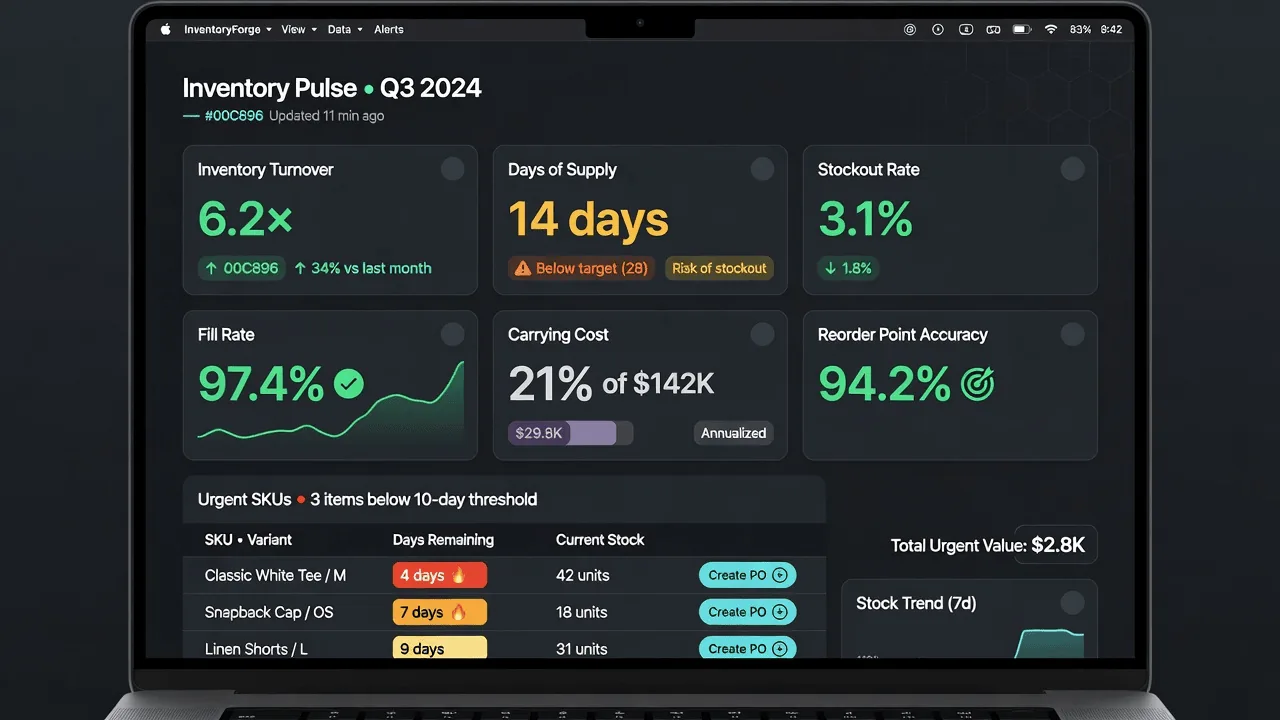
Why Inventory KPIs Are Different From Revenue Metrics
Revenue and profit are lagging indicators — they tell you what happened. Inventory metrics are leading indicators — they tell you what's about to happen. A store with deteriorating inventory turnover will see declining cash flow before it shows up in P&L. A store with a rising stockout rate will lose ranking in Shopify's search and Google Shopping before the lost revenue is visible in monthly reports.
The six metrics below form a diagnostic system. Each one measures a different dimension of inventory health:
You don't need to track all six from day one. Start with days of supply and stockout rate — they have the most immediate impact on revenue. Add the others as your operations mature.
| KPI | Healthy Range | Warning Zone | Critical |
|---|---|---|---|
| Inventory turnover rate | 4–8× per year | 2–4× per year | < 2× per year |
| Stockout rate | < 2% of SKUs | 2–5% of SKUs | > 5% of SKUs |
| Days of supply | 30–60 days | 60–90 days | > 90 days |
| Carrying cost (% of inventory value) | 20–30% annually | 30–40% annually | > 40% annually |
| Dead stock ratio | < 5% of SKUs | 5–15% of SKUs | > 15% of SKUs |
| Reorder point accuracy | > 90% on-time restocks | 75–90% | < 75% |
| Gross margin return on investment (GMROI) | > 2.0 | 1.0–2.0 | < 1.0 |
| Fill rate (orders fully fulfilled) | > 95% | 90–95% | < 90% |
KPI 1: Inventory Turnover Rate
Inventory turnover measures how efficiently you convert stock into sales. A high turnover means your capital is working hard — you're buying, selling, and replenishing quickly. A low turnover means capital is sitting in slow-moving stock, generating carrying costs without generating revenue.
Formula
Example: A store with $180,000 COGS over the past 12 months and an average inventory value of $45,000 has a turnover rate of 4.0 — meaning the entire inventory sold through four times.
| Turnover Rate | What it typically signals | Status |
|---|---|---|
| Below 2 | Serious overstock, slow-moving products, or weak demand | Investigate |
| 2–4 | Acceptable for low-velocity or high-ticket products | Monitor |
| 4–8 | Good for most consumer product categories | Healthy |
| 8–12+ | Excellent; common in fast-moving consumables or apparel | Strong |
Benchmarks vary significantly by category — a furniture store at 2.5 is fine; a supplement brand at 2.5 has a problem. Compare against your own historical trend first, then against category peers.
To improve turnover, the levers are: faster reorder cycles (smaller, more frequent orders), tighter purchasing (buy only what demand velocity justifies), and aggressive clearance of truly slow-moving SKUs. Increasing order sizes to hit supplier MOQs without the demand to support them is the most common cause of low turnover.
KPI 2: Days of Supply
Days of supply (also called days of stock remaining) is your real-time stockout early warning system. It tells you exactly how long your current inventory will last given recent sales velocity — and whether you need to order now.
Formula
Example: A product sold 120 units in the last 30 days and has 48 units in stock. Daily velocity is 4 units/day. Days of supply = 48 ÷ 4 = 12 days. If the supplier lead time is 10 days, you have a 2-day ordering window before a guaranteed stockout.
The critical threshold is days of supply minus lead time. When that number hits zero or goes negative, you're already too late — stock will run out before the next shipment arrives. Building a safety buffer (typically 3–7 days depending on demand variance) gives you a realistic reorder trigger.
Manually calculating days of supply for even 50 SKUs takes 30–45 minutes in a spreadsheet. For 200+ SKUs it's practically impossible to keep current. This is exactly where inventory apps earn their cost — EZStock calculates days of supply per variant from live Shopify sales data and sorts your dashboard by urgency (lowest days remaining first).
KPI 3: Stockout Rate
Stockout rate measures how often your demand planning fails completely. A single stockout event has cascading consequences: lost immediate revenue, Shopify's algorithm treating the out-of-stock product as lower quality, Google Shopping pausing the listing, and customers discovering a competitor — and potentially not coming back.
Formula
Example: 8 out of 120 active SKUs went to zero inventory at some point in May. Stockout rate = (8 ÷ 120) × 100 = 6.7%.
| Stockout Rate | Interpretation | Status |
|---|---|---|
| Below 2% | Excellent demand planning; minor gaps in edge-case SKUs | Target |
| 2–5% | Acceptable; review which SKUs are consistently stocking out | Monitor |
| 5–10% | Demand planning has systematic gaps; audit reorder points | Investigate |
| Above 10% | Significant revenue and customer experience impact | Urgent |
When investigating stockouts, segment them. Are they concentrated in a specific supplier (lead time issue)? In seasonal products (forecasting issue)? In your fastest-moving SKUs (reorder point set too low)? The pattern tells you where to fix the process, not just that something is broken.
One nuance: distinguish between planned stockouts (you intentionally discontinued a product or are letting it sell through) and unplanned stockouts (you expected to be in stock but weren't). Only unplanned stockouts count against your rate. Tracking both separately prevents the metric from masking intentional clearance decisions.
KPI 4: Fill Rate
While stockout rate measures inventory failure from the supply side, fill rate measures it from the customer side. Fill rate answers: when a customer places an order, what percentage of the time can you ship everything they ordered, immediately, in full?
Formula
Example: 847 orders in a month. 23 orders had at least one item out of stock and were partially shipped or delayed. Order fill rate = ((847 − 23) ÷ 847) × 100 = 97.3%.
Fill rate below 95% typically indicates systemic inventory problems. Fill rate below 90% is operationally serious — customers are regularly receiving partial shipments or waiting for backorder fulfillment, and every interaction like that erodes repeat purchase rates.
Fill rate and stockout rate are related but not identical. You can have a low stockout rate but low fill rate if your multi-item orders are disproportionately affected by the few SKUs that do stock out. Conversely, if your stockouts are mostly slow-moving SKUs that rarely appear in orders, the fill rate impact is small. Track both.
KPI 5: Carrying Cost of Inventory
Inventory carrying cost is the most underestimated cost in product businesses. It's not just warehouse rent — it's the sum of every cost generated by holding stock that hasn't sold yet. For most businesses, carrying cost runs 20–30% of the total inventory value per year.
Components of Carrying Cost
| Component | Typical Range | Notes |
|---|---|---|
| Capital / opportunity cost | 5–10% | Money locked in stock vs. invested at market rates |
| Storage (warehouse/3PL) | 2–8% | Higher for 3PL per-unit billing; lower for owned space |
| Insurance | 1–2% | Usually bundled into business insurance policy |
| Shrinkage and damage | 1–3% | Varies by product category and storage conditions |
| Obsolescence risk | 2–5% | Higher for fashion, electronics, seasonal items |
| Total carrying cost | 11–28% | 20–25% is the standard planning assumption |
Example: A store holding $200,000 in average inventory at 22% carrying cost incurs $44,000/year just to hold that stock. If they could optimize to $150,000 average inventory (through tighter purchasing and faster turnover), carrying cost drops to $33,000 — saving $11,000 annually with no revenue impact.
The lever for reducing carrying cost is turnover rate. Higher turnover means lower average inventory value for the same revenue — fewer dollars sitting in stock, lower carrying cost. This is why turnover and carrying cost should always be analyzed together: a business chasing high fill rates by overstocking is trading fill rate improvement for carrying cost increases.
KPI 6: Reorder Point Accuracy
Reorder point accuracy is a meta-metric — it measures the quality of your demand planning system itself. A reorder point that triggers too late causes stockouts. A reorder point that triggers too early causes overstock and elevated carrying costs. Accurate reorder points minimize both.
The Reorder Point Formula
Example: Average daily velocity: 4 units. Max daily velocity (during last promotion): 7 units. Lead time: 12 days. Safety stock = (7 − 4) × 12 = 36 units. Reorder point = (4 × 12) + 36 = 84 units.
To measure reorder point accuracy retrospectively, review stockouts and overstock events and ask: did the reorder point trigger in time? A reorder point is accurate if the new stock arrived before the existing stock hit zero, and the amount ordered kept average inventory within a reasonable range of the reorder quantity.
| Reorder Point Error Type | Symptom | Fix |
|---|---|---|
| Set too low | Stockout before new stock arrives | Increase by adding safety stock buffer or increasing lead time estimate |
| Set too high | New stock arrives with weeks of old stock still on hand (overstock) | Decrease by auditing whether lead time and velocity inputs are current |
| Not updated after velocity change | Works in some periods, fails in others | Recalculate from actual sales velocity rather than last year's estimates |
| Same for all suppliers | Accurate for one supplier, wrong for others | Set reorder points per supplier, using that supplier's actual lead time |
Most manually-managed reorder points are set once and forgotten. Velocity changes — a product gets featured in a promotion, a competitor goes out of stock and you absorb their demand, a seasonal period begins. Reorder points that aren't updated to reflect current velocity gradually lose accuracy, and the error compounds over time.
How to Start Tracking These Metrics Without a Dedicated BI Tool
You don't need a data warehouse to track these six KPIs. A practical starting approach:
Setting Targets for Each KPI
Generic benchmarks are a starting point, not a target. Your targets should be set based on your cost structure, customer expectations, and product category. Here's a practical framework:
| KPI | Conservative Target | Strong Target | Primary Driver |
|---|---|---|---|
| Inventory Turnover | 4×/year | 8×/year | Purchasing discipline, reorder frequency |
| Days of Supply | 30–45 days on hand | 14–21 days on hand | Shorter order cycles, more frequent POs |
| Stockout Rate | < 5% | < 2% | Reorder point accuracy, lead time reliability |
| Fill Rate | > 95% | > 98% | Stockout rate, safety stock levels |
| Carrying Cost | < 25% of inventory value | < 18% of inventory value | Turnover rate, storage cost negotiation |
| Reorder Point Accuracy | < 8% error rate | < 3% error rate | Velocity data freshness, safety stock buffer |
Set targets one KPI at a time. Start with whichever metric is furthest from a reasonable baseline — that's usually where the biggest revenue or cost impact sits. Once you've stabilized one metric, move to the next. Trying to improve all six simultaneously fragments attention and makes it hard to attribute what's working.
The Interdependence Problem
These six KPIs are not independent — they trade off against each other in ways that matter for decision-making:
- Higher fill rate requires higher safety stock, which increases carrying cost and reduces turnover. The optimal fill rate isn't 100% — it's the point where the cost of stockout equals the cost of carrying the extra safety stock.
- Higher turnover requires more frequent smaller orders, which can increase supplier transaction costs and may push you below MOQ thresholds. The optimal turnover rate is constrained by supplier minimums.
- Lower carrying cost favors lean inventory, which increases stockout risk. The right inventory level minimizes the total of carrying cost + stockout cost, not either in isolation.
The practical implication: when you're trying to improve one metric, model what happens to the others. If you're cutting inventory to reduce carrying cost, project the impact on days of supply and fill rate. If you're raising safety stock to improve fill rate, calculate the carrying cost increase. The best inventory decisions optimize across the system, not one metric in isolation.
Making KPIs Actionable, Not Just Informational
The mistake many merchants make is tracking KPIs for reporting rather than for decisions. A KPI is only valuable when it triggers a specific action. Build a decision rule for each metric:
- Days of supply falls below (lead time + safety days) → create a purchase order today
- Stockout rate exceeds 5% for two consecutive months → audit reorder points for all affected SKUs
- Fill rate drops below 95% → investigate which SKUs generated partial shipments and tighten their reorder points
- Turnover below 3× for a product category → identify slow-moving SKUs and plan clearance or discontinuation
- Carrying cost exceeds 25% of inventory value → reduce next PO quantities and increase order frequency
Without decision rules attached, KPIs become dashboard decoration. With decision rules, they become a systematic process for catching inventory problems early — before they become revenue problems.
