Why supplier terms matter more than product price
When merchants think about supplier negotiations, they almost always focus on unit price. Can we get 5% cheaper per unit? Can we get a volume discount at 500 units? Price negotiation is worthwhile, but it's not where the biggest operational leverage lives.
Lead time, minimum order quantity, and payment terms have a larger impact on your cash flow and inventory risk than unit price in most cases. A supplier who charges 8% more per unit but delivers in 7 days instead of 35 may be dramatically more valuable — because you can carry less safety stock, order more frequently in smaller quantities, and respond to demand changes faster. The unit price saving from the slower supplier gets erased by the carrying cost of the extra inventory you need to buffer the longer lead time.
The frame for any supplier negotiation: you're not just buying products, you're buying operational characteristics. Lead time, MOQ, and payment terms are as important as price — sometimes more so.
| Product Category | Domestic US | China/SE Asia | Europe |
|---|---|---|---|
| Apparel / clothing | 2–4 weeks | 6–14 weeks | 4–8 weeks |
| Electronics / gadgets | 3–6 weeks | 8–16 weeks | 6–10 weeks |
| Beauty / skincare | 2–3 weeks | 5–10 weeks | 4–7 weeks |
| Food / supplements | 1–3 weeks | 8–12 weeks (regulatory) | 4–8 weeks |
| Home goods / furniture | 4–8 weeks | 8–16 weeks | 6–12 weeks |
| Jewelry / accessories | 2–4 weeks | 4–10 weeks | 4–8 weeks |
| Books / printed goods | 1–3 weeks | 3–6 weeks | 3–5 weeks |
| Custom/OEM products | +2–4 weeks sample time | +4–8 weeks sample time | +2–4 weeks sample time |
Lead time negotiation
Lead time is the number of days between placing an order and receiving stock. It directly determines how much safety stock you need to carry and how far in advance you must forecast demand.
Why shorter lead times compound in your favor
Consider two suppliers for the same product. Supplier A: 35-day lead time, $10/unit. Supplier B: 10-day lead time, $10.50/unit.
With Supplier A's 35-day lead time, you need to forecast demand 35 days into the future plus maintain a safety buffer of 7–14 days. You're carrying 42–49 days of inventory at any given time. With Supplier B's 10-day lead time, you only need to maintain 17–24 days of stock — less than half. At $10.50 instead of $10, you pay 5% more per unit. But you're carrying 50% less inventory, which reduces carrying costs (typically 20–30% of inventory value annually), reduces your cash tied up in stock, and reduces your risk of holding obsolete or slow-moving inventory.
Shorter lead time is often worth paying for. The question is how to get it.
How to negotiate lead times
Suppliers quote standard lead times that include buffer for their own uncertainty. The actual production and shipping time is usually shorter. A few approaches that work:
- Ask directly what drives the lead time. "Is the 35 days production time, shipping time, or both?" If most of it is shipping, there may be a faster shipping option at modest cost that dramatically shortens your lead time.
- Offer predictability in exchange for speed. Suppliers can move faster for customers who give reliable, predictable order volumes. Commit to a regular order cadence (e.g., "we'll place a PO every 6 weeks") and ask whether that commitment enables a shorter quoted lead time.
- Order during their off-peak season. Many suppliers have capacity constraints during peak periods that inflate lead times. Orders placed during their slow season often ship faster than the standard quote.
- Ask about air freight vs. sea freight thresholds. For international suppliers, sea freight drives most of the lead time. Ask at what order value it makes sense to air freight — sometimes the speed is worth the cost for your fastest-moving SKUs.
Minimum order quantity (MOQ) negotiation
MOQs exist because suppliers have setup costs, production run minimums, and packaging requirements that make small orders unprofitable for them. Understanding why the MOQ exists gives you leverage to negotiate around it.
The real reason suppliers set MOQs
A factory with a minimum production run of 500 units sets an MOQ of 500 because running the line for fewer units doesn't cover setup costs. A distributor sets an MOQ of $500 because pick-and-pack costs for small orders erode their margin. A brand sets an MOQ of 100 units to maintain scarcity and brand positioning.
Each of these motivations suggests a different negotiation approach:
- Factory with production run minimums → Ask whether you can share a production run with another customer, accept a longer lead time (waiting until they're running the line anyway), or order a mix of SKUs that together hit the minimum.
- Distributor with order value minimums → Meet the value threshold by bundling multiple products from the same distributor in one order, even if some are products you wouldn't otherwise order yet.
- Brand with positioning MOQs → These are the hardest to negotiate down. Try starting with a trial order framing: "We'd like to test this product with our audience before committing to full quantities. Is there a first-order exception?" Many brands will make this accommodation for new stockists.
When to accept the MOQ and when to push back
Not every MOQ is worth fighting. For a product with high velocity and long shelf life, ordering at the MOQ and holding the inventory is often the right call. For a product you're testing for the first time, or one with seasonal risk, pushing for a lower MOQ is worth the effort even if you pay slightly more per unit.
A useful framework: if the MOQ quantity represents more than 90 days of current sales velocity, push back on the MOQ or find an alternative supplier. Ordering 90+ days of inventory in a single shot means you're taking significant demand risk — if the product doesn't sell as expected, you're sitting on excess stock that ties up cash and may never move.
Payment terms negotiation
Payment terms determine when you pay relative to when you receive goods — and therefore how much of your cash is working for you versus sitting with your supplier.
Payment due 30 days after invoice date
The most common B2B term. You receive goods, sell them, and have 30 days before payment is due. For fast-moving products, you may have already sold much of the inventory before the invoice is due — a significant cash flow advantage.
Payment due 60 or 90 days after invoice
Better terms that larger buyers negotiate. If you have strong payment history with a supplier, asking for Net 60 after 12 months of reliable Net 30 payments is reasonable. Frame it as an expansion of business: "We're planning to increase order frequency, and Net 60 would help us manage cash flow at higher volumes."
2% discount if paid within 10 days, otherwise Net 30
A supplier offer of early payment discount. If you have cash available, a 2% discount for paying 20 days early annualizes to roughly 36% — almost always worth taking. Ask suppliers if they offer early payment discounts even if they don't advertise them.
Payment before goods are shipped
Common with new suppliers or international suppliers who don't know you yet. Push back toward Net 30 once you've established a payment track record. After 3–4 on-time prepayments, ask: "We've been consistent with prepayment — would you consider Net 15 as a next step?" Progress incrementally rather than jumping straight to Net 30.
How to negotiate better payment terms
Payment terms negotiation works best after you've established reliability. The sequence that works:
- Pay every invoice on time or early for 6 months. Build a track record.
- Ask for a terms review: "We've been working together for 6 months with consistent on-time payments. We're planning to scale our orders — would you consider Net 30?"
- Frame improvements as enabling growth: suppliers extend better terms to customers they expect to grow with, not to customers asking for a favor.
- If the supplier won't move on payment terms, ask about early payment discounts instead — a different mechanism for the same cash flow benefit.
Volume discounts and pricing tiers
Most suppliers have unpublished pricing tiers that kick in at higher volumes. The question is not whether the tiers exist — they almost always do — but at what quantity thresholds.
Ask directly: "What does your pricing look like at 500 units? At 1,000?" You're not committing to anything by asking. You're mapping the landscape so you can plan purchasing decisions around it.
Common patterns you'll find:
- Flat pricing below a certain quantity, then a meaningful step down at a specific threshold (e.g., 10% cheaper above 500 units). If you're regularly ordering 400 units, it's worth knowing that 500 units saves 10% — sometimes you should slightly over-order to hit the tier.
- Annual volume discounts based on total purchase value across the year. Even if individual orders don't hit a price break, total annual spend might qualify you for a retroactive rebate. Ask about this explicitly.
- Exclusive or preferred pricing in exchange for exclusivity commitments (agreeing not to carry competing products). Weigh the pricing benefit against the strategic constraint before agreeing.
Documenting supplier terms so they scale
Negotiated terms are only valuable if they're documented and accessible. A supplier agreement that lives in someone's email thread or memory is fragile — when that person is unavailable or leaves, the terms are effectively lost.
What to document for every supplier
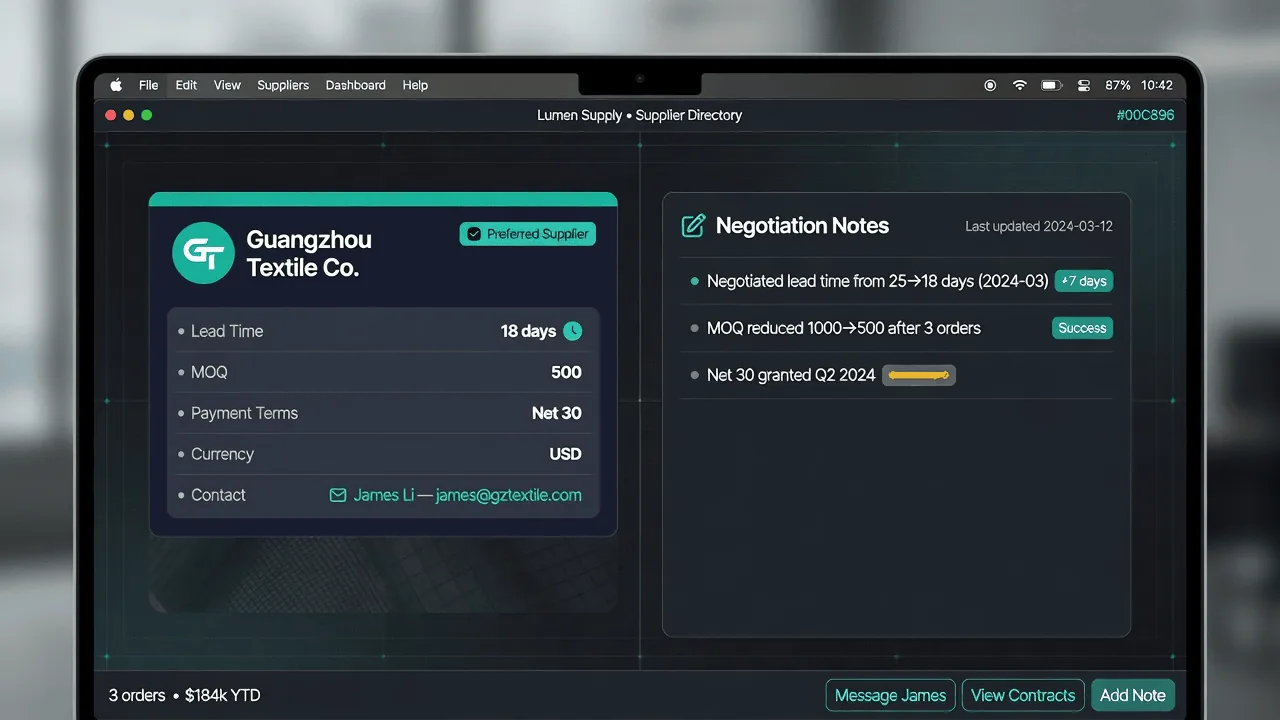
- Lead time — both quoted and actual average from your order history
- MOQ — per product line, not just globally
- Payment terms — what was agreed, not what was originally offered
- Pricing tiers — the quantity thresholds and corresponding unit prices
- Contact details — the specific person who handles your account, not just the general inbox
- Preferred order format — some suppliers want POs by email, some have a portal, some want a specific format
- Currency — particularly important for international suppliers where exchange rate movement affects real cost
- Notes — anything specific to this relationship that a new team member would need to know to work with this supplier effectively
EZstock stores all of these fields per supplier record. Lead time and currency feed directly into demand forecasting calculations. Payment terms and MOQ live in a notes field. The contact name and email are attached to every PO you create with that supplier — so whoever is placing the order has all the context they need without hunting through email.
Building leverage with suppliers over time
The best position to negotiate from is not being a new customer — it's being a reliable, growing customer who represents predictable future revenue for the supplier. Everything in this guide compounds over time: better payment history → better terms → lower cash requirements → ability to order larger volumes → better pricing. The merchants who run the most efficient supply operations have been building this position systematically for years.
The practical starting point, regardless of where you are today: document what you currently have, identify the one term that has the biggest operational impact on your business (usually lead time), and make a plan to renegotiate it at your next order cycle. One improvement at a time, applied consistently, produces compounding results.
Track every supplier term in one place
EZstock stores lead times, MOQs, payment terms, currencies, and contact details per supplier — and uses lead time directly in demand forecasting so your reorder points are always accurate.
Install EZstock free →14-day free trial on paid plans · no credit card required · works with any Shopify plan
