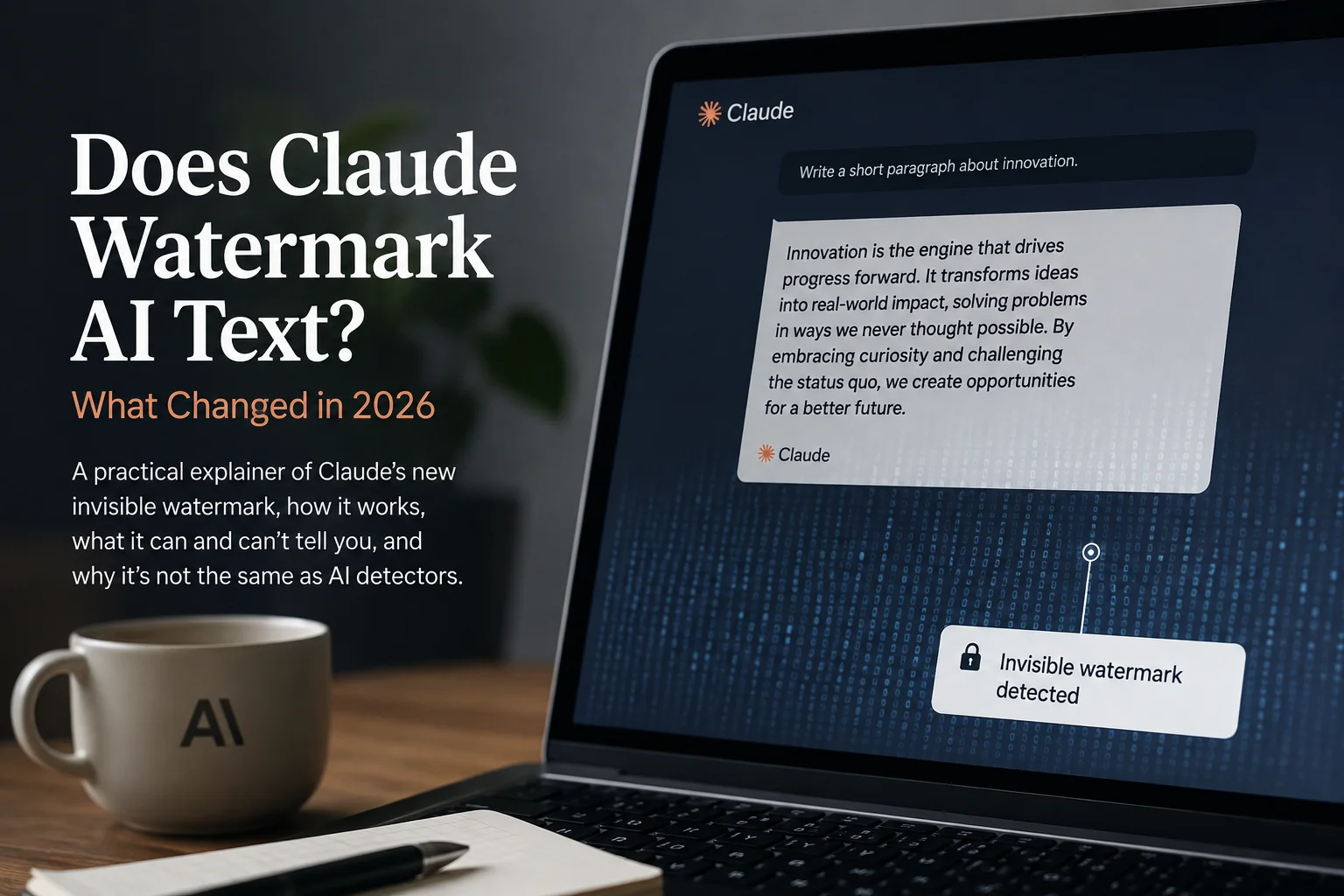
The short version: Yes, as of August 2026 Claude embeds an invisible statistical watermark in text it generates. It uses Google DeepMind's SynthID-Text method and travels with the text when you copy and paste it. But it only shows Claude was involved, not that Claude wrote the whole thing, and it weakens or disappears when the text is heavily edited, paraphrased, or translated. Only Anthropic can read it. It is not the same as an AI detector, and a normal detector cannot see or remove it.
Anthropic signed the EU's transparency code and turned on text watermarking for new Claude models. The rule behind it, Article 50 of the EU AI Act, became enforceable on August 2, 2026 and requires companies that build generative AI to label their machine-made output. Rather than limit the change to Europe, Anthropic applied it to everyone worldwide, across the API, claude.ai, Claude Code, and Claude accessed through the big cloud providers.
How the watermark works
When Claude writes, it picks each word from a set of options. Often several fit equally well. After "the weather was cold and," it could pick "grey" or "overcast" with no real difference in meaning. Claude's watermark uses a secret key plus the words that came before to nudge which of those interchangeable options gets chosen. Do that across a whole passage and you get a faint statistical pattern that a reader can't see, but Anthropic can measure with the key. Quality doesn't change; the choices just aren't fully random anymore.
That design has a direct consequence: the mark needs room to accumulate. A long passage offers many word choices to carry the pattern. A short reply or a dry factual sentence offers few, so the confidence drops.
What the watermark can and can't tell you
Headlines oversold this part. Anthropic stays clear about the limits, and they matter.
Involvement, not authorship
A positive result means Claude was likely part of making the text. What it cannot do is separate "Claude wrote this from scratch" from "a person wrote it and Claude cleaned it up." So you get evidence that AI touched the text, never proof of who the author is.
Editing fades it
A light edit usually leaves the mark readable. Rewrite it fully, paraphrase heavily, or translate it into another language, and the signal dilutes until it's gone. Passing the text through a second model tends to wipe it too, because that model repaints every word choice with its own pattern.
Only Anthropic can read it, for now
Because the signal is keyed, you can't check a passage yourself today. Anthropic has said a detection service is coming but hasn't shipped it or set the access terms, so right now this stays a capability the company holds, not a public tool.
Why this is not the same as an AI detector
People mix these up, so it's worth being precise. A watermark is a hidden fingerprint added while the text is being written, and it lives in the token choices. An AI detector does the opposite job: reading the finished prose for style habits, like a flat, even sentence rhythm, stock opener phrases, stacked hedging, and a tidy formula ending. One is a cryptographic mark that only the key holder can verify. Its counterpart is a judgment about how the writing sounds.
They also fail differently. Rewriting defeats a watermark. A style detector, by contrast, gets fooled by good editing, and it misfires on formulaic human prose and on non-native English, which is why its score should never be treated as proof. For the mechanics of that second kind of check, we cover it in how to tell if text is AI-written.
What it means for you
If you write with AI help, nothing about your rights changes; Anthropic says the mark doesn't affect ownership. If you're a teacher or editor, the practical takeaway is the same as before: don't accuse anyone based on a single signal. A watermark, once the detector exists, would tell you AI was probably involved somewhere, not that a student cheated. Pair any signal with judgment and a conversation.
And if your goal is writing that reads like a person rather than a machine, the watermark is beside the point. It doesn't touch the style tells that make text feel AI-made. Fixing those is still a matter of editing the phrasing, the rhythm, and the structure, which is exactly what humanizing AI text is about.
Free tools from Extensions Market
Check how human your writing reads. The watermark isn't something you can read, but the style tells are. The free AI Detector scores any passage in your browser and shows the exact phrases and patterns that read as AI, and Anti-Slop does the same on any page as a Chrome extension, for both text and design.
Running a Shopify store? We also make free, no-signup tools: Store Audit, AI Shopping Checker, Checkout Deadline Checker, Product CSV Checker, and the Stocky Converter.
Open the free AI detector →Frequently asked questions
Does Claude watermark the text it writes? Yes. Since August 2026 Claude adds an invisible statistical watermark, built on DeepMind's SynthID-Text approach, to text it generates. It's invisible to readers and readable only with Anthropic's key.
Why did this start? The EU AI Act's Article 50 transparency rules became enforceable on August 2, 2026 and require generative AI output to be marked. Anthropic applied the watermark to all users worldwide, not only in Europe.
Does editing remove it? Light edits usually don't; a full rewrite, heavy paraphrase, or translation does. It's also weak on short and factual text, where there are fewer word choices to carry the signal.
Can it prove who wrote something? No. It shows Claude was probably involved, and can't tell writing from editing. It says nothing about ownership.
Is it the same as an AI detector? No. The watermark is a hidden signal only Anthropic can read. An AI detector reads the writing's style for tells and gives you a score you can see. A detector can't read or remove the watermark.