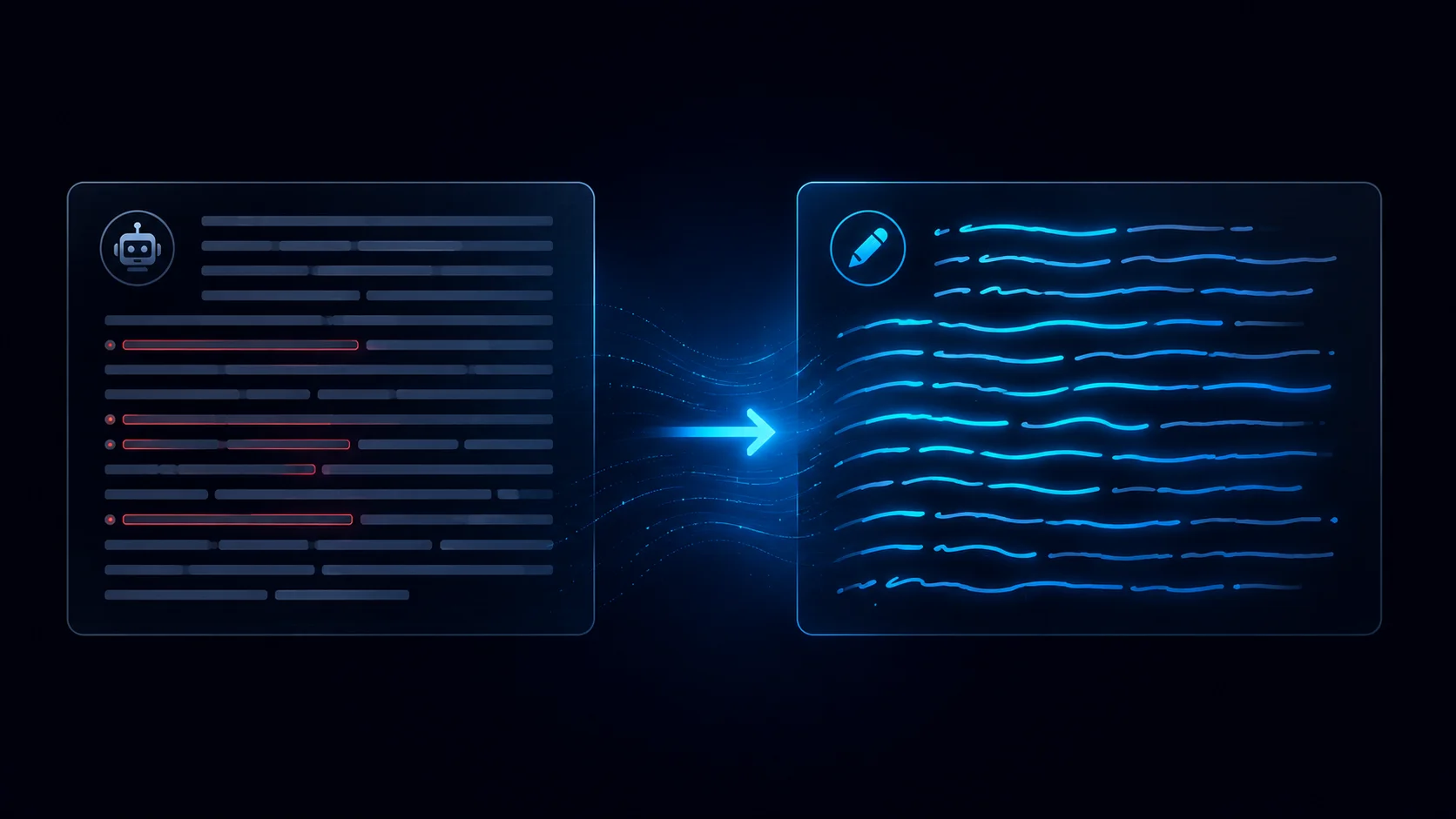
The short version: to make AI text sound human, work in three passes. First, cut the stock phrases and buzzwords. Second, fix the rhythm — vary your sentence lengths so it isn't a flat drone. Third, fix the structure — kill the canned intro and conclusion, break up run-on sentences, and add real specifics. Synonym-swapping alone won't do it; the rhythm and structure are what actually give AI away.
Here's why the popular "humanizer" tools disappoint: they operate on single words. They see "utilize" and write "use," see "leverage" and write "harness." That helps a little, but it leaves the two things that most make text feel machine-made — the metronome sentence rhythm and the formulaic shape. You have to fix those by hand. The good news is it's fast once you know what to change.
Pass 1: Fix the phrasing (fastest wins)
Start by deleting the tells that don't require any rewriting: just removal or a plain swap.
Cut the stock phrases
Delete opener filler outright. "In today's digital landscape," "It's important to note that," and "When it comes to" can almost always be removed with no loss of meaning. The sentence is stronger without the runway.
Swap the buzzwords for plain words
Replace the small set of words AI overuses with the word a person would actually say: delve → look at, leverage → use, utilize → use, robust → strong, comprehensive → full, facilitate → help, numerous → many.
Remove decorative em-dashes and hedges
Turn em-dash splices back into commas or periods. Then find the stacked qualifiers ("may sometimes potentially") and commit: say what you mean once.
Pass 2: Fix the rhythm (the pass everyone skips)
This is the one that actually moves the needle, and no synonym tool does it. Human writing is bursty: a short sentence, then a long one, then a medium one. AI writing settles into one length and drones. To break it:
- Split your longest sentences. Any sentence stacking two or three clauses with "and… but… so…" is usually two or three sentences hiding as one. Cut them apart.
- Then merge a couple of short ones, or drop in a very short sentence for punch. Three words. Like that.
- Vary how sentences start. If three sentences in a row begin with "This" or "The," rewrite two of them.
Read the paragraph out loud. If it sounds like a person talking and not a form being filled out, the rhythm is fixed.
Pass 3: Fix the structure
The shape of AI writing is predictable: a throat-clearing intro, evenly-weighted body paragraphs, and a bow-tied conclusion. Break the mold:
- Delete the canned intro and conclusion. Start with the actual point. End when you're done, not with "In conclusion" and a restatement.
- Take a position. Replace "while X, it's also true that Y" false-balance with a real opinion. Humans commit; models hedge.
- Add specifics. Swap "studies show" and "experts agree" for a real number, a named source, or a concrete example from your own experience. Specific detail is the single hardest thing for AI to fake, and the single most human thing you can add.
Humanize and check, free in your browser
Our free AI detector does Pass 1 for you with one click. It swaps the buzzwords, trims the hedges, and even splits the worst run-on sentences, then shows you the before/after score. Paste your text, hit Rewrite, and you'll see exactly what changed. Then use the per-sentence view to find the spots that still need the human passes above. All in your browser, nothing uploaded. Writing a job application? The same method applied to making a cover letter sound less AI-generated is worth a read.
Open the free AI detector →Frequently asked questions
Do AI humanizers actually work? The synonym-swapping ones only partly. They clean up obvious buzzwords but leave the flat rhythm and formulaic structure that most give AI away. The three-pass method above fixes all three levels, which is why it works where a one-click tool doesn't.
Is humanizing AI text cheating? Editing an AI-assisted draft into good writing is just writing. Using a tool specifically to sneak AI work past a detector where that's prohibited is the part that crosses a line. Aim for better prose, not a defeated checker.
How do I know it worked? Read it aloud, and check it in a detector for a second opinion, remembering the score is a signal, not proof. If it sounds like you and the tells are gone, you're done.