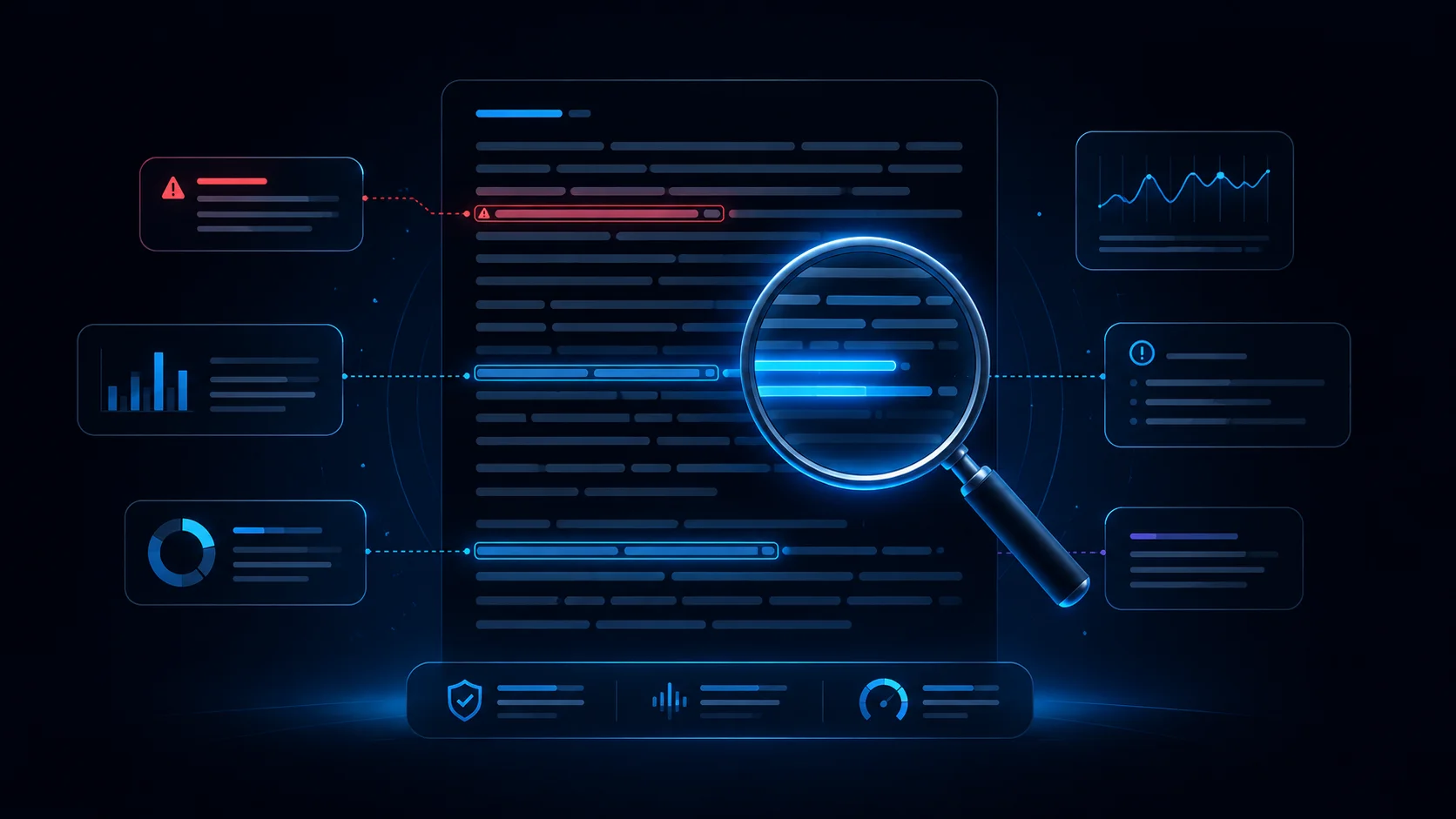
The short version: AI-written text tends to lean on stock phrases ("in today's digital landscape"), overuse a handful of buzzwords (delve, leverage, tapestry, robust), keep every sentence about the same length, stack hedges (may, might, often, typically), and wrap up with a formulaic conclusion. No single tell proves anything, but three or four together are a strong signal. You can check any passage free at the end of this article.
First, an honest caveat that shapes everything below: you cannot prove text is AI-written. OpenAI shut down its own AI-detection classifier because it was too inaccurate, and a widely cited Stanford study found that AI detectors wrongly flagged 61% of essays written by non-native English speakers as machine-generated. So read the tells below as evidence that raises or lowers your suspicion, never as a verdict you'd use to accuse a student, an employee, or a writer.
With that said, the tells are real, and once you've seen them you can't unsee them. Here they are, roughly in order of how reliable each one is.
Stock opener phrases
Models reach for the same warm-up phrases to start paragraphs and sentences. They add no information; they just fill the runway. If a paragraph opens with one of these, your suspicion should go up.
"In today's digital landscape…" · "It's important to note that…" · "In the ever-evolving world of…" · "When it comes to…" · "Navigating the complexities of…"
A small set of overused buzzwords
Certain words appear far more often in AI writing than in natural human prose. One or two is nothing; a cluster of them in a short passage is a strong signal. Watch for these especially.
delve, leverage, tapestry, robust, seamless, comprehensive, pivotal, paramount, multifaceted, nuanced, intricate, meticulous, foster, underscore, realm, showcase.
Uniform sentence length
Human writing is bursty. We mix a three-word sentence with a rambling twenty-five-word one. AI text tends to settle into a narrow band — most sentences land around the same length, giving the prose a flat, metronome rhythm. Read a paragraph out loud: if every sentence feels the same size, that's a tell. (Researchers call this low "burstiness," and it's one of the oldest signals in AI detection.)
Repetitive sentence openings
Look at the first word of each sentence in a paragraph. Humans vary them naturally. AI often starts several sentences the same way ("This…", "The…", "It's…", "By…"), or leans on the same connective ("Additionally," "Moreover," "Furthermore") to begin line after line.
Hedge stacking
Models are trained to avoid sounding too certain, so they pile up qualifiers. When you see two or three hedges crammed into one sentence, a person probably didn't write it. A person would just commit.
"This may sometimes potentially lead to results that could arguably be somewhat beneficial in certain cases."
Decorative em-dashes
AI writing uses the em-dash as an all-purpose connector, dropping it in where a comma or a period would do. A couple of em-dashes is normal style. A passage sprinkled with them, several per paragraph and often mid-sentence, is a habit of generated text.
False-balance framing
The "while X, it's also true that Y" and "on one hand… on the other hand…" construction shows up constantly, because models are trained to present things evenhandedly. Used once it's fine. Used repeatedly, it reads as a machine refusing to take a position.
The canned conclusion
AI loves to tie a bow on things. A section that ends with "In conclusion," "Ultimately," or "In summary," followed by a restatement of what was just said, is a formulaic tell. So is the rhetorical wrap-up question: "So what does this mean for you?"
Low word variety and "empty" specificity
Generated text often recycles the same vocabulary (a low type-token ratio) and offers detail that sounds specific but isn't: "studies show," "experts agree," "research consistently indicates," with no actual study, expert, or number attached. Real expertise names things; AI gestures at them.
How to use the tells
No single item on this list is proof. A careful human writer might use an em-dash or two, and a rushed one might stack a couple of hedges. What matters is how many tells cluster together. One tell means nothing. Three or four in a short passage (stock phrases plus flat rhythm plus a canned ending) is a strong signal you're reading AI or heavily AI-assisted text.
It also matters where they cluster. Mixed human-and-AI documents are the common case now: a person drafts, a model polishes, or vice versa. Scanning sentence by sentence for the tells tells you more than judging the whole piece at once.
Check any text free, in your browser
Our free AI detector runs this whole checklist automatically. Paste any text and it scores it 0–100 for human-ness, flags the exact phrases and structural tells it found, highlights the riskiest sentences, and — if you turn it on — runs a real AI-detector model, all privately in your browser. Nothing is uploaded, and there's no signup.
Open the free AI detector →Frequently asked questions
Can you actually tell if text is AI-written? You can spot the likely signs, but you can't prove it. The tells above raise or lower your suspicion; skilled editing removes them, and some human writing shares them. Treat any judgment as evidence, not proof.
How do I check if something was written by ChatGPT specifically? There's no way to identify the exact model from style alone. All detectors and all the tells above work on the style of generated text, not its origin. One exception is starting to appear: some models now add a hidden watermark to their own output, which is a different mechanism entirely — see does Claude watermark AI text for how that works and what it can't prove.
Do AI detectors work? Not reliably enough to accuse anyone. They're useful for surfacing the tells quickly and giving you a starting point, but a percentage from any tool — including ours — is a signal to investigate, not a verdict.