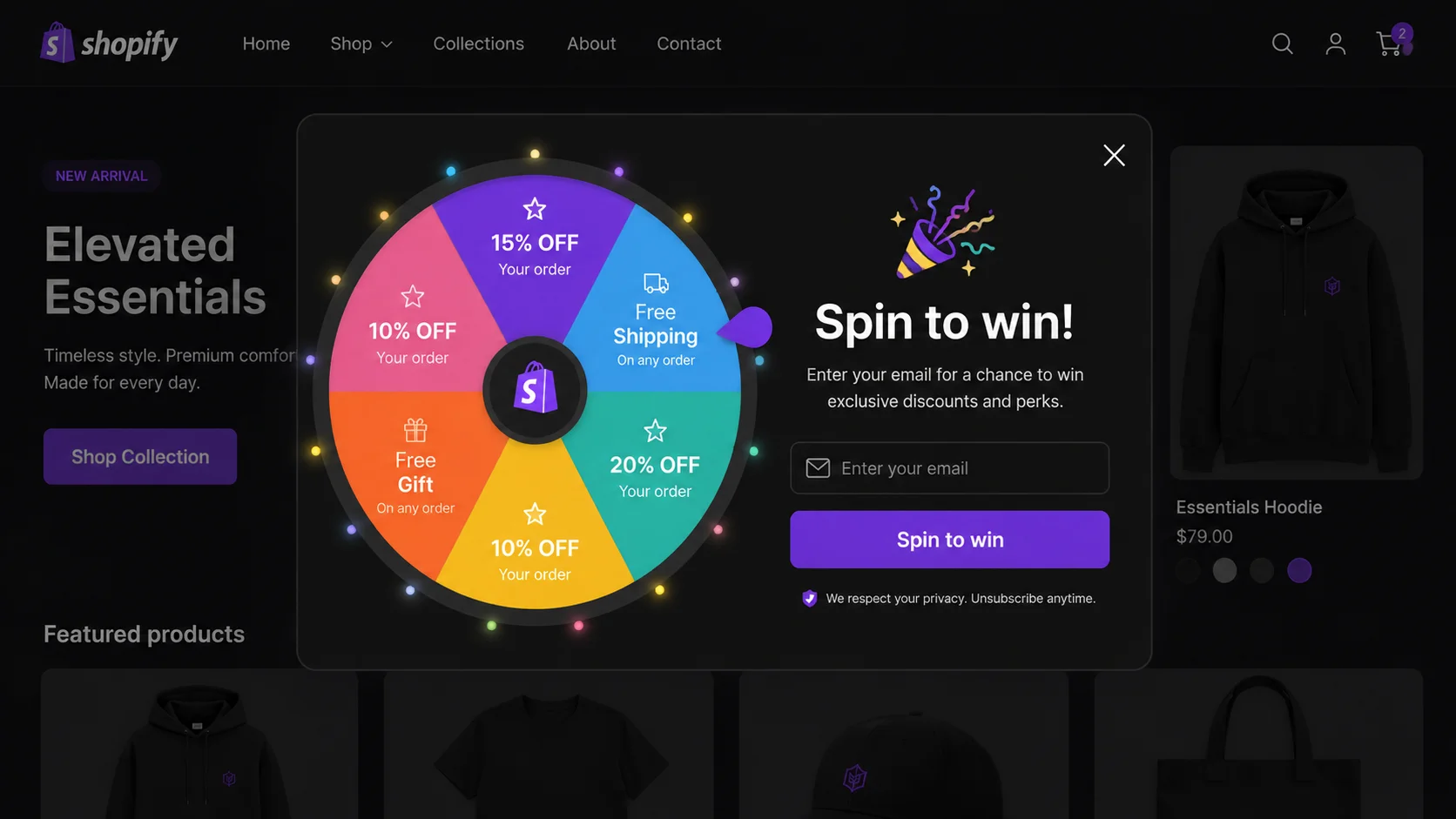
- Spin wheel popups convert at 8–12% opt-in rate vs. 2–4% for static email forms — roughly a 3× improvement (OptinMonster).
- Gamification increases engagement up to 48% vs. non-gamified alternatives (TalentLMS research).
- All wheel segments must be real prizes. Fake "Better luck next time" segments destroy trust and suppress conversion rates.
- Trigger on exit intent only — never on page load. Exit-triggered popups are exempt from Google's intrusive interstitial penalty.
- Spin wheels work for fashion, beauty, and accessories. They hurt conversions for B2B and high-ticket considered purchases.
What Is a Shopify Spin Wheel Popup, and Why Does It Convert Better?
A Shopify spin to win popup presents visitors with an interactive wheel divided into prize segments — varying discount percentages, free shipping, or a small gift — in exchange for their email address. The visitor enters their email, clicks spin, and watches the wheel animate to a random outcome. The discount code is then revealed in-popup and sent to their inbox.
The mechanic works because of dopamine anticipation. The brief moment between clicking spin and seeing the outcome activates the same neurological reward pathway that makes slot machines engaging: the brain releases dopamine not at the moment of reward, but during the period of uncertain anticipation just before it. That moment of suspense is what separates a spin wheel from a static form — and it's what drives the conversion lift.
Beyond the dopamine effect, spin wheels benefit from variable reward psychology. When every visitor gets the same static "10% off" on a flat form, the offer feels routine. When some visitors get 5%, some get 15%, and one in eight gets 20%, the perceived value of spinning is higher than the average discount would suggest. Visitors don't know what they'll get, which makes the offer feel more exciting than it mathematically is.
Why Spin Wheels Convert: The Data Behind the Mechanic
The conversion advantage of spin wheel popups over static email forms is consistent across published benchmarks. Spin-a-Sale, one of the oldest dedicated spin wheel apps for Shopify, reports average opt-in rates of 9–11% across its merchant base, compared to industry averages of 2–4% for popup email forms. OptinMonster case studies document individual merchants seeing 3–5× improvements after switching from a static discount popup to a spin-to-win format.
Three mechanisms explain the gap:
1. Dopamine anticipation. The brain's reward system activates during uncertainty, not at the moment of reward. The spin animation — typically 2–4 seconds — creates a focused moment of suspense that static forms entirely skip. That suspense increases engagement with the outcome, which increases the likelihood of completing the required action (email submission) to see the result.
2. Variable reward. Fixed-discount forms offer the same deal to every visitor. Spin wheels offer different deals to different visitors, which makes each spin feel like a personal outcome rather than a generic promotion. Behavioral economics research consistently shows that variability in reward increases engagement and perceived value of the reward itself.
3. Completion bias. Once a visitor has submitted their email and clicked spin, they are highly motivated to follow through with using the discount — the act of completing the game creates psychological commitment to the purchase. Spin wheel email-to-purchase conversion rates are measurably higher than general newsletter signup conversion rates for this reason.
Three Design Rules That Prevent Spin Wheel Popups From Annoying Visitors
A poorly configured spin wheel is worse than a static form. These three rules separate high-converting spin wheels from the ones that damage brand perception:
Rule 1: Trigger on exit intent, not page load
A spin wheel that fires 3 seconds after a visitor lands on your store is interrupting someone who hasn't had time to decide if they're interested. It's loud, it's presumptuous, and it makes the store feel desperate. By contrast, an exit-intent spin wheel fires only when the visitor has already decided to leave — their cursor is heading toward the browser navigation bar, or they're scrolling rapidly back toward the top on mobile. At that moment, a discount offer is genuinely relevant: they were interested enough to browse, they haven't bought, and a 15% discount might change that calculation. See our full exit intent popup guide for the full trigger mechanics.
Rule 2: Every segment must be a real prize
This is the most common spin wheel mistake: including "Better luck next time," "Try again," or "Free tip" non-prize segments. Visitors spin with the expectation of winning something. When they land on a fake-lose segment, they feel deceived — and that emotion transfers to your brand. Remove every non-prize segment. Use graduated real prizes: 5% off on four segments, 10% off on two segments, 15% off on one segment, free shipping on one segment. Every spin wins something real. The distribution can still favor lower discounts without including fake losses.
Rule 3: One spin per email address, once per 14 days per device
Spin wheels that can be triggered repeatedly on the same visit, or that fire again on the next visit two days later, train visitors to dismiss them immediately. A 14-day cookie gap per device, combined with one spin per email address (enforced at code redemption if not at submission), prevents the popup from becoming background noise. Return customers should almost never see the spin wheel — limit it to first-time visitors where possible.
How to Implement a Spin Wheel Popup on Shopify (4 Steps)
PopBoost's email popup widget handles exit-intent triggering and discount code delivery but does not include a spinning wheel UI. That's an honest distinction worth making: if the spinning animation is specifically what you want, dedicated apps handle it better. Here's how to implement either path:
Choose your app
For a full spinning wheel UI: install Wheelio ($14.92/month), Spin-a-Sale ($9.99/month), or Tada (free–$29/month) from the Shopify App Store. Wheelio is the most feature-complete, with full segment control, A/B testing, and mobile optimization. Spin-a-Sale is the lightest and easiest to configure. Tada adds scratch card and slot machine formats alongside the spin wheel.
For exit-intent popup + discount code without the spin animation: PopBoost handles this alongside six other conversion widgets (FOMO notifications, countdown timers, product badges, announcement bar, free shipping bar, and social proof). It's a cleaner experience for stores where the gamification aesthetic doesn't fit the brand.
Configure real wheel segments only
Set every segment to a genuine prize. A balanced 8-segment wheel might look like: 5% off (4 segments), 10% off (2 segments), 15% off (1 segment), free shipping (1 segment). All codes should be auto-generated as unique single-use Shopify discount codes and delivered to the visitor's email immediately after the spin. Never reuse the same code across multiple visitors — it trains visitors to share codes and undercuts your discount control.
Set exit-intent trigger and frequency caps
Configure the trigger to exit intent only — not page load, not time delay. Set a minimum time-on-page of 15 seconds before exit intent can fire (filters out immediate bounces). Set a session cap of once per session and a day cap of 14 days per device. In Wheelio and Spin-a-Sale, these settings are in the Display Rules panel. This is also where you restrict the popup to specific pages — product pages and the cart page are highest-value; the homepage is lower.
Enable via App Embeds and test
Enable the app via Online Store → Themes → Customize → App Embeds. Test in a private browsing session by navigating to a product page, waiting 15+ seconds, then moving your cursor toward the top of the browser window. Verify the wheel fires, animates correctly, assigns a discount code, and sends a confirmation email. Test on mobile by scrolling down the page, then scrolling back up rapidly. Check that the popup is mobile-responsive and that the wheel is legible at mobile viewport width.
Want exit-intent discount popups without the spin wheel?
PopBoost's exit-intent popup delivers a targeted discount offer to abandoning visitors with no spin animation — cleaner for premium brands, faster to configure, and bundled with 6 other conversion widgets at $19/month.
Install PopBoost free →Free plan available · 14-day Pro trial · no credit card required · works with all Shopify themes
When Spin Wheels Win — and When They Hurt
Spin wheel popups are not universally beneficial. The gamification mechanic amplifies engagement for audiences that respond to playful interactivity, and actively repels audiences that find it juvenile. Match the format to the store.
When spin wheels work
Fashion, beauty, and accessories. These categories attract audiences who enjoy brand personality and interactive experiences. The spin wheel's visual energy matches the tone of discovery and play that drives these categories. Conversion lifts in fashion and beauty are consistently among the highest for spin wheel apps.
First-time visitors. A visitor who has never bought from you before has no existing brand relationship to protect. The spin wheel's gamification creates a positive first interaction — they won something from you before they've even bought anything. That primes a favorable initial impression.
Mid-price impulse purchases ($20–$100). At this price point, a 10–15% discount is genuinely meaningful and can push a hesitant buyer over the line. The spin mechanic amplifies the excitement of receiving that discount.
When spin wheels hurt
B2B and professional tools. A spinning wheel popup on a B2B SaaS landing page or a professional services site signals a lack of seriousness. The audience is evaluating whether to trust you with a business decision; a game show mechanic undermines that evaluation.
High-ticket considered purchases ($500+). Furniture, jewelry, electronics, and luxury goods buyers are in a deliberative mindset. The spin wheel's casual energy creates cognitive dissonance with the seriousness of a $1,200 purchase. A value-reinforcement popup ("Free returns, 2-year warranty") or a curated email capture ("Join our waitlist for new arrivals") fits the category better.
Return customers. A loyal customer who visits your store regularly and encounters a spin wheel popup is not being rewarded — they're being treated like a first-time stranger. Segment your popup audience to exclude customers who have purchased before. Most dedicated spin wheel apps support customer tag-based exclusions via Shopify customer data.
Spin Wheel Copy Formulas That Close the Deal
The wheel itself does the heavy lifting, but the copy around it determines whether visitors engage or dismiss. Three moments require distinct copy: the prompt before the spin, the post-spin confirmation, and the follow-up email.
For more on FOMO marketing copy principles and how discount framing interacts with cart abandonment, our cart abandonment guide covers the post-capture email sequence that maximizes the value of every email your spin wheel collects. For the full technical and design framework for Shopify popups, see our popup guide.
Frequently Asked Questions About Shopify Spin Wheel Popups
Do spin wheel popups work on Shopify?
Yes. Spin wheel popups consistently outperform static email popups in opt-in rate benchmarks. OptinMonster data shows spin wheel opt-in rates of 8–12% versus 2–4% for static forms — roughly a 3× improvement. The gamification mechanic (anticipation during the spin, variable reward on outcome) activates dopamine-driven engagement that a flat form cannot replicate. They work best for fashion, beauty, accessories, and impulse-buy categories.
What is the best spin wheel app for Shopify?
The main dedicated options are Wheelio ($14.92/month), Spin-a-Sale ($9.99/month), and Tada (free–$29/month). Wheelio is the most feature-complete. Spin-a-Sale is the easiest to set up. Tada adds multiple gamification formats. If you want exit-intent popup and discount code functionality without the spinning UI, PopBoost bundles exit-intent popup with six other conversion widgets at $19/month — cleaner for brands where gamification doesn't fit the aesthetic.
Do spin wheel popups hurt SEO?
No, when configured correctly. Google's intrusive interstitial penalty targets popups that fire immediately on page load and obstruct content before the user engages. Spin wheel popups configured to fire on exit intent are exempt from this guideline — Google's policy explicitly carves out exit-triggered modals. The SEO risk is zero if the popup is exit-triggered. The brand perception risk — annoying return customers with a game show popup — is more significant than any SEO consideration. For more on popup SEO, see our exit intent popup guide.
How do I set up a spin wheel popup on Shopify?
Install a dedicated spin wheel app (Wheelio, Spin-a-Sale, or Tada) from the Shopify App Store. Configure every wheel segment with a real prize — no fake lose segments. Set the trigger to exit intent with a 15-second time-on-page minimum. Configure discount codes to be auto-generated as unique single-use Shopify codes. Enable via App Embeds in your theme and test in a private browsing session. Full step-by-step walkthrough is in the How to Implement section above.
What discount should I offer on a spin wheel?
Use graduated real discounts: 5% on the most common segments, 10% on mid-weight segments, 15–20% on the rarest segments, with a free shipping segment for variety. Every segment must be a genuine win. Keep the floor at 5% minimum — anything lower feels meaningless after the anticipation of the spin. Avoid going above 20% as a maximum; it conditions visitors to expect deep discounts and compresses margin across your customer base over time. See our email popup best practices for discount calibration by product category.
Spin wheels are one tactic in a broader FOMO marketing stack. For stores where the gamification aesthetic fits, they're a high-ROI list-building tool. For stores where it doesn't, a clean exit intent popup with a well-framed discount achieves the same objective with less visual noise. Match the format to your brand, configure it honestly, and measure opt-in rate and email-to-purchase rate over 30 days to confirm the lift.
