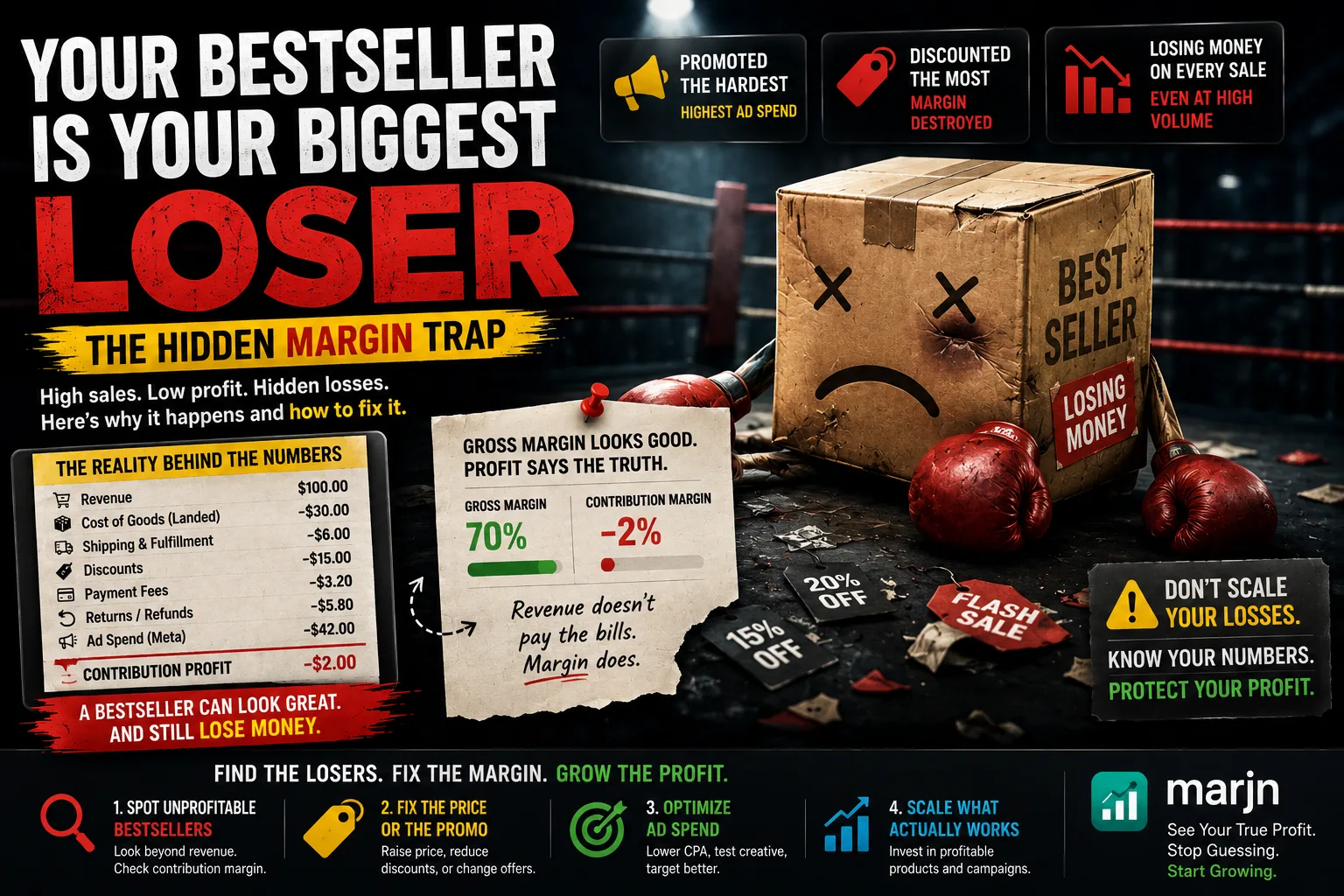
In one line: A bestseller can be your biggest loser because the products you sell most carry the heaviest discount and ad load. They are the ones you put in ads and on sale, so a large share of their orders use a code and a large share of your ad spend targets them. Even a product with a strong gross margin can finish each order below zero on contribution margin once those costs come out, and the loss stays hidden inside high revenue and volume.
How do I check if my bestseller is profitable? Look at its contribution margin, not its gross margin. Take the average price after discounts, subtract landed cost, shipping, the payment fee, and the ad spend aimed at that product. If what is left per order is negative, your bestseller is losing money on every sale.
The short version
- Bestsellers attract the most discounts and the most ad spend, the two costs that sink margin fastest.
- Gross margin can look healthy while contribution margin, which includes ads and discounts, is negative.
- Volume hides the loss: a small loss per order times a large number of orders is a large, invisible hole.
- The fix is usually to raise the price, cut the discounting, or reduce ad spend, not to drop the product.
- You cannot see this from a sales report. It takes a per-product profit view that includes ad spend.
Every store has a hero product. It sits at the top of the sales report month after month, it is the first thing you mention when someone asks what you sell, and it feels like the safe foundation everything else is built on. So it rarely occurs to anyone to check whether it makes money. The volume feels like proof.
Volume is not proof. A product can sell constantly and lose a little on each order, and because there are so many orders, the total loss is larger than anything else in the store. The reason this happens to bestsellers specifically, rather than at random, is that popularity attracts exactly the two costs that destroy margin.
Why popularity attracts the costs that kill margin
Two forces concentrate on your best-selling products, and both of them come straight out of profit.
1 Bestsellers get discounted the most
Think about which product ends up in your promotions. It is the popular one. It anchors the sitewide sale because it is the one people want. It is what the welcome code gets spent on, because new visitors buy the thing everyone else is buying. It is the item most likely to be in an abandoned cart, so it takes the recovery offer too. The result is that a much larger share of a bestseller's orders carry a discount than the average product, and every discount is margin handed back to the customer.
2 Bestsellers get the most ad spend
You advertise what converts, and what converts is your bestseller. So the product already giving up the most margin to discounts is also the one absorbing the largest share of your Meta and Google spend. Two of the biggest deductions in the entire profit-and-loss, discounts and advertising, both land hardest on the same product. That is how a healthy-looking hero item quietly goes underwater.
This is not a rare edge case. It is common enough that operators write about it directly, and the mechanism they describe is exactly this: heavy promotion plus concentrated ad spend on the products that already move fastest. A resistance-band set that reads as a top performer can turn out to have most of its orders discounted, so its real margin is a fraction of what the sticker suggests.
The gross margin lie: how a 70 percent product loses money
The trap works because the number most owners glance at, gross margin, is blind to the two costs above. Gross margin subtracts the cost of goods and nothing else. It does not know about the discount on the order, the shipping, the payment fee, or the ad spend. So a product can show a beautiful gross margin and still lose money on the sale.
Put real numbers on it. Take a product that sells for $50 and costs $15 to land. That is a 70 percent gross margin, the kind of number that makes you feel safe. Now watch a typical bestseller order for it.
| Line | Amount | Running total |
|---|---|---|
| List price | $50.00 | $50.00 |
| Discount code (22%) | −$11.00 | $39.00 |
| Landed cost of goods | −$15.00 | $24.00 |
| Shipping and fulfillment | −$6.00 | $18.00 |
| Payment processing fee | −$1.43 | $16.57 |
| Ad spend attributed to the sale | −$18.00 | −$1.43 |
The gross margin was 70 percent, and the order still finished at a loss. The discount and the ad spend, the two costs that pile onto bestsellers, did the damage. Multiply that small loss by hundreds or thousands of orders a month and you have a product that is both your top seller and your single largest drain, sitting in plain sight at the top of the report.
Find your unprofitable bestseller inside Shopify
Marjn calculates true margin per product from your Shopify order revenue, your landed cost, and your Meta ad spend, then answers it inside Shopify Sidekick. Ask which products are losing money after ads and see the real number, ranked. Free plan, no card.
Get Marjn on the Shopify App Store →Why volume makes the loss invisible
A losing bestseller is harder to catch than a losing slow-mover, and the reason is psychological as much as mathematical. When a rarely-sold product loses money, the total damage is small, and you might spot the ugly margin because you have time to look at a product that only sells a few units. When a bestseller loses money, the per-order loss is easy to dismiss as noise, and the volume is read as success. The store is busy, the revenue chart is up, orders are flowing. Nothing about the surface says "this is where the money is leaking."
Meanwhile the total is compounding. A dollar of loss on a product that sells fifty times a month is a small annoyance. The same dollar on a product that sells two thousand times a month is a serious hole, and it is being dug faster the better the product sells. Scaling ad spend on that product, the natural instinct for a top performer, makes the hole deeper, because more of the loss-making orders get created. This is the same dynamic that makes revenue grow while profit falls across a whole store, covered in why your Shopify store is not profitable.
The loss leader that never leads to anything
Some owners defend a thin or negative bestseller with a familiar argument: it is a loss leader that brings customers in, and the profit comes from what they buy alongside it or on their next order. That can be a real strategy. It can also be a comfortable story that hides a plain loss.
The difference is whether you have actually measured the follow-on. A true loss leader earns its loss back through a higher average order value on the same order, or through a strong second purchase from the customers it acquires. If you have checked and the customers who buy your hero product really do add profitable items to the cart, or come back and buy again at a healthy margin, then the loss on the first item is an acquisition cost you chose on purpose. That is defensible.
What is not defensible is assuming the follow-on exists without looking. If the bestseller loses money on the order and the customer never returns, and the rest of the cart is thin too, then it is not a loss leader. It is just a loss. The only way to tell the two apart is to look at the contribution margin of the whole order and the repeat behavior of the customers the product brings in, rather than trusting that the strategy is working because it sounds reasonable. Cold-acquired customers in particular are often unprofitable on the first order and do not always come back at the rate the loss-leader story assumes, so the second purchase you are counting on may not be arriving.
How to check your own bestsellers
You can do a rough version of this by hand for your top few products. The goal is to get to contribution margin per order, the number that includes discounts and ads.
1 Start with the real average selling price
Not the list price. Take total revenue for the product over a period and divide by units sold, so discounts are already baked in. This is usually lower than owners expect, because the discounts on a bestseller are heavier than they remember.
2 Subtract landed cost, shipping, and the fee
Use landed cost, not the supplier sticker. Add real shipping and the payment fee. If your Shopify cost-per-item field is empty or wrong for this product, fix it first, because a wrong cost makes the whole check meaningless.
3 Subtract the ad spend aimed at this product
This is the hard one to do precisely by hand, because ad spend is reported by campaign, not by product. A workable first pass is to take the spend on the campaigns that sell this product and divide by the units those campaigns drove. Blended is fine to start. The point is to stop pretending the ad cost is zero.
4 Read the per-order result
What is left is the contribution margin per order for that product. If it is negative, your bestseller is losing money on every sale, and the volume is making it worse, not better. If it is thin but positive, you have a product that is one discount increase or one CPM rise away from flipping negative, so it is worth watching.
Doing this once for your hero product is often a genuine shock, and it is the moment pricing and promotion decisions start to be grounded in profit instead of vibes. The catch, same as always, is that a hand calculation is a snapshot. The next sale, the next campaign, and the next promotion move the number, and the answer you need is "is this product profitable right now," per product, on demand. That is the gap a live margin view fills, and it is why Marjn answers "which products are losing money after ads" directly inside Shopify Sidekick, using your own revenue, landed cost, and ad spend.
What to do once you find one
Discovering that a bestseller loses money is not a reason to panic or to pull the product. It is usually one of the most fixable problems in a store, precisely because the product is popular. Three levers, roughly in order of least disruptive to most:
1 Raise the price
A bestseller has pricing power that a slow-mover does not, because demand is already proven. A modest increase often moves an order from a loss to a profit while barely denting conversion. Test it. The product that sells the most is the one where a small price change has the largest total effect on profit.
2 Cut the discounting
If most of a bestseller's orders carry a code, the discount policy, not the product, is the problem. Exclude the hero product from the sitewide sale, remove it from the automatic welcome code, or cap how many promotions can stack on one order. You are not selling less; you are keeping more of each sale.
3 Reduce or retarget the ad spend
If the product converts well organically, you may be paying to acquire customers who would have bought anyway. Pull back the cold spend aimed at it and watch whether sales actually fall. Often they do not fall as much as the spend, which means the ads were buying orders you already had.
Behind all three is the same idea that runs through this whole topic: the number to manage is contribution margin, not revenue and not gross margin. A bestseller is only a good product if it makes money on each sale, and the only way to know is to include the discounts and the ads in the math. If the break-even side of this interests you, the companion piece on why a good ROAS can still lose money shows how to set the ad-spend floor that keeps a product like this profitable.
The reason this trap is so common is not that store owners are careless. It is that the tools most people use point the other way. A sales report ranks products by revenue and volume, which is exactly the ranking that puts your most dangerous product at the top and dresses it up as your best one. Until you sort your catalog by contribution margin instead, the losing bestseller keeps its crown, keeps its ad budget, and keeps its discounts, and the store keeps wondering where the money went. Flip the sort, include the ads and the discounts, and the real ranking is often nothing like the one on the dashboard.
Frequently asked questions
How can a bestselling product lose money? Bestsellers carry the heaviest discount and advertising load. They are the products you promote and put on sale, so a large share of their orders use a code and a large share of your ad spend targets them. Even a healthy gross margin can turn into a negative contribution margin once those costs come out, and the loss hides inside strong revenue and volume.
Can a product with a 70 percent gross margin still lose money? Yes. Gross margin subtracts only the cost of goods. It ignores the discount, the shipping, the payment fee, and the ad spend. A 70 percent gross margin product discounted 22 percent with heavy ad spend can finish each order below zero on contribution margin.
How do I find out if my bestseller is profitable? Calculate contribution margin, not gross margin. Take the average price after discounts, subtract landed cost, shipping, the payment fee, and the ad spend attributed to the product. If what is left per order is negative, it is losing money on each sale.
Should I stop selling an unprofitable bestseller? Usually not. The fix is to change the price, cut the discounting, or reduce the ad spend, not to drop the product. A popular item has pricing power, so a modest increase or a tighter discount policy often flips it to a profit without hurting demand much.
Why do discounts hurt bestsellers more than other products? Promotions concentrate on popular products. A bestseller is the item most likely to be featured in a sale, paired with a welcome code, or targeted by an abandoned-cart offer, so far more of its orders are discounted than the average product. Each discount comes out of margin, so the most-discounted product loses the most.