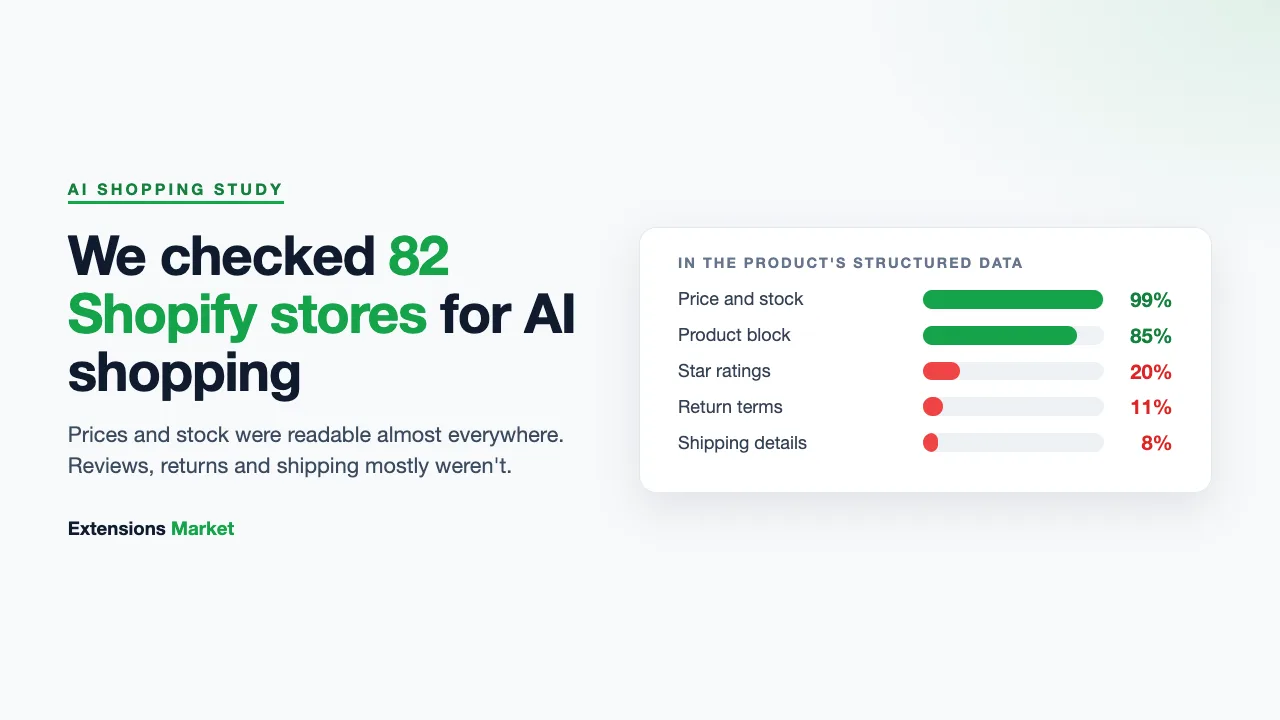
Short answer: across 82 Shopify product pages, 99% had price and stock in their structured data and every store let the AI search crawlers in. Only 20% had star ratings in their structured data, though 57% showed stars to shoppers. Return terms were in the markup on 11% of pages and shipping details on 8%. The median store scored 71.5 out of 100.
Key numbers
- 99% of pages (81 of 82) had price and availability in their structured data, and 85% (70 of 82) had a full Product block.
- 100% allowed Googlebot, Bingbot, OAI-SearchBot, PerplexityBot and Claude-SearchBot.
- 20% (16 of 82) had star ratings in structured data, while 57% (47 of 82) showed star ratings on the page.
- 11% (9 of 82) had return terms and 8% (6 of 80) had shipping details in their structured data.
- 27% of the stores that listed a GTIN (12 of 45) had one that failed the barcode check digit.
How we ran the check
The sample was 101 stores: 41 featured on Shopify's examples page and 60 well-known brands that sell on Shopify. For each store we took the first available product from its public product list and ran that product page through the same engine as the AI Shopping Readiness Checker. 82 stores could be checked. The other 19 had no public product list, blocked the request or asked us to slow down.
The checker uses no AI. It fetches the page and reads its structured data, visible text, robots.txt, and policy pages, then scores eight areas. One page per store is a snapshot, and a store's other products can differ. We're not publishing scores for individual stores.
What most stores get right
The product basics were close to universal. Nearly every page had a price, a currency, an availability value, a brand and a product image in its structured data, and 94% were open to indexing. Google says that with product structured data, "users can see price, availability, review ratings, shipping information, and more right in search results," so these are the facts that travel furthest.
No store blocked the crawlers that feed AI search and answers: Googlebot, Bingbot, OAI-SearchBot (ChatGPT search), PerplexityBot, Claude-SearchBot, Applebot, ChatGPT-User and Claude-User all got through on all 82. The training crawlers GPTBot and ClaudeBot were allowed on 81 of 82.
OpenAI's product feed specification lists the fields ChatGPT uses to show a product. Of the nine required fields our checker looks for from that spec, 67 of the 82 pages showed all nine, and the most common gap was a missing description (11 pages).
Where stores fall short
| Check | Stores passing |
|---|---|
| Star ratings shown on the page | 57% (47 of 82) |
| Star ratings in structured data | 20% (16 of 82) |
| Return terms on the product page | 34% (28 of 82) |
| Return terms in structured data | 11% (9 of 82) |
| Shipping time or cost on the product page | 50% (40 of 80) |
| Shipping details in structured data | 8% (6 of 80) |
| Care or usage instructions | 29% (23 of 80) |
| Fit or size guidance | 36% (29 of 80) |
| A product FAQ | 20% (16 of 82) |
| Warranty details | 18% (15 of 82) |
| Barcodes on every variant | 52% (43 of 82) |
Reviews: shown to shoppers, missing from the markup
More than half the stores showed star ratings on the product page, usually from a review app. Only one in five put those ratings into the product's structured data. A shopper sees the stars. A crawler that reads the markup finds a product with no rating at all.
Many review apps can add the rating to the page's Product markup: look for the setting, or ask the app's support. Make sure the result is one Product block with the rating inside it. Our guide on a theme and an app both emitting Product schema covers how to avoid ending up with two.
Returns and shipping: on a policy page, missing from the product
Most stores had a returns page (74%) and a shipping page (70%). Far fewer said anything about returns (34%) or shipping (50%) on the product page itself, and almost none put those terms in structured data. Google's product documentation has separate guides for merchant return policy and shipping policy markup, so these are facts it can read when they're there.
Say it in plain words near the price, such as "Free returns within 30 days" or "Ships in 2 to 3 business days," and add the markup if your theme or an app supports it.
Barcodes and GTINs
Only about half the stores had a barcode on every variant. Of the 45 stores whose page listed a GTIN, 12 had one that failed the check digit. OpenAI's feed specification asks for a GTIN of "exactly 8, 12, 13, or 14 digits, including a valid check digit," so a mistyped barcode isn't a harmless typo. The last digit is worked out from the others, using the method GS1 publishes, so a check digit that doesn't match usually means a wrong or made-up number.
The questions shoppers ask
Size or dimensions appeared on 69% of pages and materials on 68%. Care instructions (29%), fit guidance (36%) and a product FAQ (20%) were much rarer. Shoppers want these answers before they buy, and a page that doesn't give them leaves an assistant nothing to quote.
Scores by area
| Area | Median score |
|---|---|
| AI crawler access and indexing | 100 |
| Commercial data hygiene | 91 |
| Product identity and data | 90 |
| Price, stock and variants | 89 |
| Agent buying path | 75 |
| Buyer-question coverage | 61 |
| Merchant trust signals | 49 |
| Reviews and authority | 20 |
The median overall score was 71.5. 16 stores (20%) scored 80 or more and 8 (10%) scored under 50. Stores featured on Shopify's examples page (median 71) and the well-known brands (median 73) landed close together, so size didn't buy much here.
What to fix first on a Shopify store
- Put your star ratings in the structured data. Use your review app's markup option if it has one, and keep one Product block.
- Add return and shipping terms to the product page. One plain line each, near the price.
- Give every variant a valid barcode. Check the GTIN's last digit, or leave the field empty if the product has none.
- Answer the buyer questions. Size, materials, care and fit, in the description or a specs table.
- Check one product page. Run it through the AI Shopping Readiness Checker and fix what it flags first.
Check your own product page, free
The free AI Shopping Readiness Checker runs the same checks as this study on any product URL: structured data, reviews, return and shipping terms, barcodes, buyer questions and crawler access. No signup, nothing stored.
Check my product page →Frequently asked questions
How many stores did you check? 82 Shopify stores, one product page each, on October 24, 2026: 37 featured on Shopify's examples page and 45 well-known brands. 19 more stores couldn't be checked because their public product list was missing or blocked.
What does AI shopping readiness mean? How well a product page gives search engines and AI shopping tools the facts they use: price, stock, identifiers, reviews, return and shipping terms, and answers to buyer questions, in a form a machine can read.
Why do ratings need to be in structured data if they're on the page? The stars a review app shows aren't the same as a rating inside the product's markup. 57% of stores showed stars, but only 20% had ratings in the markup, and search engines read that markup as product data.
What is a GTIN check digit? The last digit of a barcode number, calculated from the other digits by a method GS1 publishes. A GTIN whose last digit doesn't match is usually mistyped or made up. 12 of the 45 stores that listed a GTIN had one that failed.
Did big brands score better? Only slightly. The well-known brands had a median of 73 and the stores featured on Shopify's examples page 71. Reviews and return terms were missing from the markup in both groups.
Sources
- Google Search Central, "Intro to Product Structured Data on Google," retrieved October 24, 2026, developers.google.com/search/docs/appearance/structured-data/product
- OpenAI, commerce product feed specification, retrieved October 24, 2026, developers.openai.com/commerce/specs/feed
- GS1, "How to calculate a check digit manually," retrieved October 24, 2026, gs1.org/services/how-calculate-check-digit-manually
- Shopify, "Examples" (the store sample), retrieved October 24, 2026, shopify.com/examples