Why hype matters before launch day
Most Shopify merchants treat their product launch like a press release: they build the product, set up the store, and announce it to an audience that has never heard of it. The result is a slow first week, a muted launch metric, and a product that never gains the momentum it deserved.
Hype is not about overpromising. It's about activating three psychological levers — urgency, scarcity, and social proof — before the product is available, so desire reaches a peak at exactly the moment people can act on it.
- Urgency — a countdown or limited window compresses the decision from "I'll think about it" to "I need to act now."
- Scarcity — limited quantity makes each unit feel more valuable and makes inaction feel like a real loss.
- Social proof — seeing hundreds or thousands of others waiting validates that this product is worth wanting, before the buyer has to decide for themselves.
When all three work together, launch day becomes a release valve rather than a cold start. That's the goal of running a product drop on Shopify the right way.
7 tactics to build product launch hype on Shopify
Here is a direct answer to "how do you build hype for a Shopify product launch" — these are the seven tactics, in the order you should deploy them:
- 1. Launch a referral waitlist (not just a signup form)
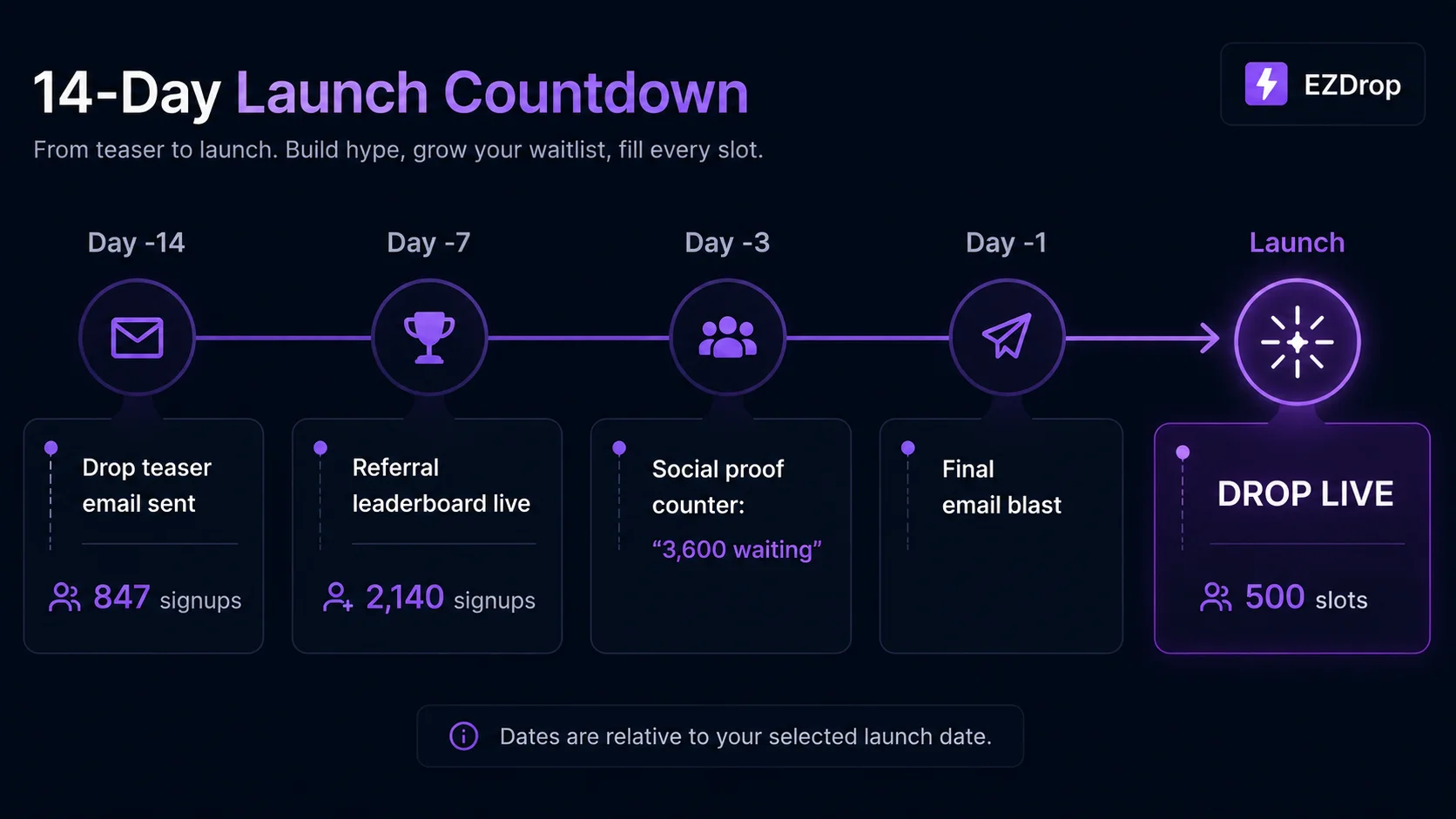
- 2. Drip teasers across 14 days
- 3. Show a live social proof counter
- 4. Seed 5–10 micro-influencers before launch
- 5. Build a coming soon page with countdown timer
- 6. Offer exclusive early access to your email list
- 7. Produce limited quantity on purpose
Launch a referral waitlist — not just a signup form
A referral waitlist turns every signup into a recruiter because their queue position depends on how many friends they bring in. A standard email signup form captures intent passively. A referral queue converts intent into active distribution — every person who joins has a self-interested reason to share the waitlist link with their network.
The mechanic is simple: each signee receives a unique referral link. Every friend who signs up through that link improves the referrer's queue position. Top-ranked positions get early access when the drop goes live.
This is the same model Robinhood used in 2013 to generate 1 million pre-launch signups with minimal ad spend. You can set up a viral waitlist for Shopify in under 30 minutes using EZDrop — no developer required.
Typical referral rates with this mechanic: 30–50% of waitlist entries come through peer referrals at zero marginal cost.
Drip teasers across 14 days
A 14-day drip sequence works because it trains your audience to expect reveals, creating a habit of engagement in the weeks before you need their attention most. Rather than one announcement followed by silence, you send one signal at each of the 14, 7, 3, and 1 day marks before launch — each revealing one new detail about the product.
The cadence:
- Day −14: Pre-announcement. "Something is coming. Get on the list." No product details yet — just the waitlist link.
- Day −7: First reveal. Share one specific detail: the colorway, the key ingredient, the material, the collaborator. Keep everything else hidden.
- Day −3: Second reveal. Show a close-up product image or a 10-second video clip. Mention the queue count ("over 400 people are already waiting").
- Day −1: Final push. Full product reveal, launch time, reminder to share the waitlist link to move up. This email should go to the waitlist, not the general list — exclusivity reinforces that joining early was worth it.
Each email should be short — 3–5 sentences max. The goal is to reveal enough to maintain desire, not enough to satisfy it.
Show a social proof counter
A visible waitlist count triggers two responses simultaneously — social proof ("this many people want it, so it must be worth wanting") and urgency ("there are more people ahead of me than behind me") — which is why it converts browsers into signups at significantly higher rates than static pages. Displaying "847 people on the waitlist" on your coming soon page costs nothing to implement and dramatically increases signup conversion.
Make the counter prominent — above the fold, in large type. Update it daily if you can't do it in real time. Even a number that's 24 hours stale is more persuasive than no number at all.
If your waitlist count is under 100, consider waiting until it crosses that threshold before displaying it publicly. Below 100, the social proof signal is weak enough that it can actually undermine credibility. Focus on seeding your initial list through your existing email subscribers and close network before making the counter visible.
Seed micro-influencers before launch
Coordinated influencer posts on launch day create the perception of widespread simultaneous buzz — which is far more powerful than scattered coverage across multiple weeks — because social media algorithms reward content that spikes in engagement within a short time window. Send the product to 5–10 micro-influencers (10k–100k followers) in your niche two weeks before launch. Ask them to post on launch day, ideally within the same 2–4 hour window.
Why micro-influencers over macro? Three reasons:
- Higher trust: their audiences perceive them as peers rather than celebrities, so recommendations carry more weight.
- Lower cost: many micro-influencers will post for a free product, especially if the product genuinely fits their content.
- Better engagement rates: 10k–100k accounts typically have 3–8% engagement rates vs. 1–2% for accounts above 1 million.
Don't script the posts. Give influencers the product and the launch date, and let them write in their own voice. Authentic reactions outperform polished scripts for this audience size.
Build a coming soon page with email capture and countdown timer
A dedicated coming soon page captures intent at its highest — the moment someone first discovers your product — instead of sending them away to return later, when their interest has cooled. The page should have one job: get the email address. Everything else is secondary.
Core elements:
- A countdown timer to launch date (creates urgency without any copy)
- Email capture form above the fold
- One headline that communicates what the product does and who it's for
- Waitlist count once you cross 100 entries
- Optional: one teaser image — blurred, cropped, or showing only a detail
Point all pre-launch traffic — social posts, bio links, ads, influencer posts — to this page. A fragmented pre-launch presence (some people landing on the homepage, some on the product page, some on the waitlist) diffuses your list-building. Centralise it.
Give your email list exclusive early access
Exclusive early access rewards subscriber loyalty and gives them a concrete, recurring reason to stay on your list — which turns list growth from a vanity metric into a competitive asset for every future launch. Email subscribers who joined before the product was announced get a 30–60 minute window to purchase before the waitlist opens and before the drop goes public.
This works on two levels. First, it rewards the people who have been with you longest — creating genuine loyalty rather than just transactional retention. Second, it incentivizes future list growth: once potential customers see that your email subscribers got early access that sold out before it went public, joining the list becomes a rational decision, not just a passive one.
Communicate this benefit clearly in your pre-launch sequence: "Email subscribers get first access — 30 minutes before the waitlist opens." Make the benefit tangible.
Produce limited quantity on purpose
Intentional limited quantity is the most credible form of scarcity marketing because it can't be faked — when the product sells out, it's gone, and everyone who missed it knows it. Manufacture only 30–50% of your expected demand for the first drop.
This achieves three things:
- Guarantees a sell-out — which becomes real social proof for the next drop ("sold out in 4 hours").
- Validates your pricing — if demand far exceeds supply, you have evidence that you could charge more.
- Creates a list for the next drop — everyone who missed out is a warm lead for the restock or the next edition of limited edition products.
Pair the limited quantity with a waitlist counter so visitors can immediately understand the supply-demand gap: "200 units available. 847 people on the waitlist." That sentence does more conversion work than any copy you could write.
What to do 24 hours before launch
The 24-hour window before go-live is where execution either locks in the momentum you've built or lets it dissipate. Use our detailed launch day checklist to cover every step — from final queue position freeze to email send timing to inventory confirmation. The checklist covers the exact sequence of actions that prevent the most common launch-day mistakes.
The three most time-critical tasks in the final 24 hours:
- Send your final teaser email to the waitlist with the exact launch time and a reminder to share their referral link before positions lock.
- Brief your micro-influencers with the confirmed launch time and ask for post confirmation — radio silence from an influencer the night before launch is a problem you want to catch now, not when you wake up on launch day.
- Confirm inventory numbers with your fulfillment partner and set your EZDrop slot count to match. If inventory runs low before launch, reduce slots now rather than overselling and disappointing winners.
Common hype-building mistakes to avoid
Most failed Shopify launches aren't undone by bad products — they're undone by avoidable execution errors in the pre-launch phase.
Starting too late
Starting hype-building one week out is rarely enough unless you already have a large, engaged audience. Most merchants need 2–3 weeks to build a waitlist large enough to create visible social proof. If you announce a drop and your waitlist count sits at 47, that number undermines rather than supports your launch. Start earlier, or delay the launch date until the list is large enough to display.
Using fake scarcity
Countdown timers that reset when they expire, "only 3 left" badges on products with unlimited stock, and waitlist queues with no actual limited supply — customers recognise these tactics now, and they erode trust rather than drive urgency. Use real limits. If you're not comfortable manufacturing limited supply, don't use scarcity mechanics. The foundation of effective hype is a product people genuinely want access to, not a fear of losing something that was never actually scarce.
Spreading pre-launch traffic across too many channels
Running an Instagram campaign, a TikTok campaign, a Twitter campaign, and a Reddit campaign simultaneously before a launch sounds like more reach — but if each channel is getting 20% of your budget and none is getting enough to build momentum, you end up with four weak campaigns instead of one strong one. Pick your highest-converting channel and concentrate pre-launch spend there. Diversify channels for the launch itself, not for the list-building phase.
Announcing too many details too early
Revealing the full product, pricing, and specifications two weeks before launch eliminates the need for follow-up engagement. If your audience already knows everything about the product, there's no reason to keep coming back. Keep something in reserve for each reveal. The most common thing to hold back until launch day: price. Revealing price at launch concentrates buying decisions at the right moment.
Frequently asked questions
How early should you start building hype for a Shopify product launch?
Start building hype 2–3 weeks before your Shopify product launch date. The first week is for a pre-announcement teaser and email capture via a coming soon page. Week two is for drip content, influencer seeding, and growing the waitlist. The final 3–7 days are for countdown urgency, social proof amplification, and confirming your early access list. Starting less than one week out rarely generates enough momentum for a meaningful sell-out.
What is the most effective hype tactic for a Shopify product launch?
A referral waitlist consistently outperforms other single tactics because it combines scarcity (queue positions), social proof (visible waitlist count), and viral distribution (every signup becomes a recruiter). Merchants using a referral queue on EZDrop regularly see 30–50% of waitlist entries come through peer referrals at zero paid acquisition cost.
How do you create scarcity for a Shopify product launch?
The most credible scarcity strategy is to produce 30–50% of expected demand on purpose. This guarantees a sell-out, which then becomes social proof for future drops. Pair intentional limited quantity with a visible queue counter ("847 people waiting for 200 units") so every visitor immediately grasps the supply-demand gap. Artificial countdown timers without genuine scarcity erode trust — real inventory limits are far more persuasive.
Do influencers help with Shopify product launch hype?
Yes, but micro-influencers (10k–100k followers) in your niche outperform macro-influencers for launch hype because their audiences trust their recommendations more. Seed 5–10 micro-influencers with the product 2 weeks before launch and ask them to post on launch day. Coordinate timing so all posts land within the same 2–4 hour window — this creates the impression of widespread buzz simultaneously.
Run your next drop with a built-in referral waitlist
EZDrop gives you a referral queue, coming soon page, social proof counter, and email capture — all in one Shopify app. Free plan includes 1 active drop, 500 entries, and the full referral queue. Read more at extensionsmarket.com/ezdrop.
Install EZDrop free →Free plan · full referral queue · no credit card required
Or learn more at ezdrop.app — the Shopify waitlist app