The 2-Line Version
Shopify Bundles (native): free, first-party, does fixed and multipack bundles. A set combination of products at one price, inventory tracked per component. Simple and reliable, but no mix-and-match, no volume tiers, and no automatic percentage discount.
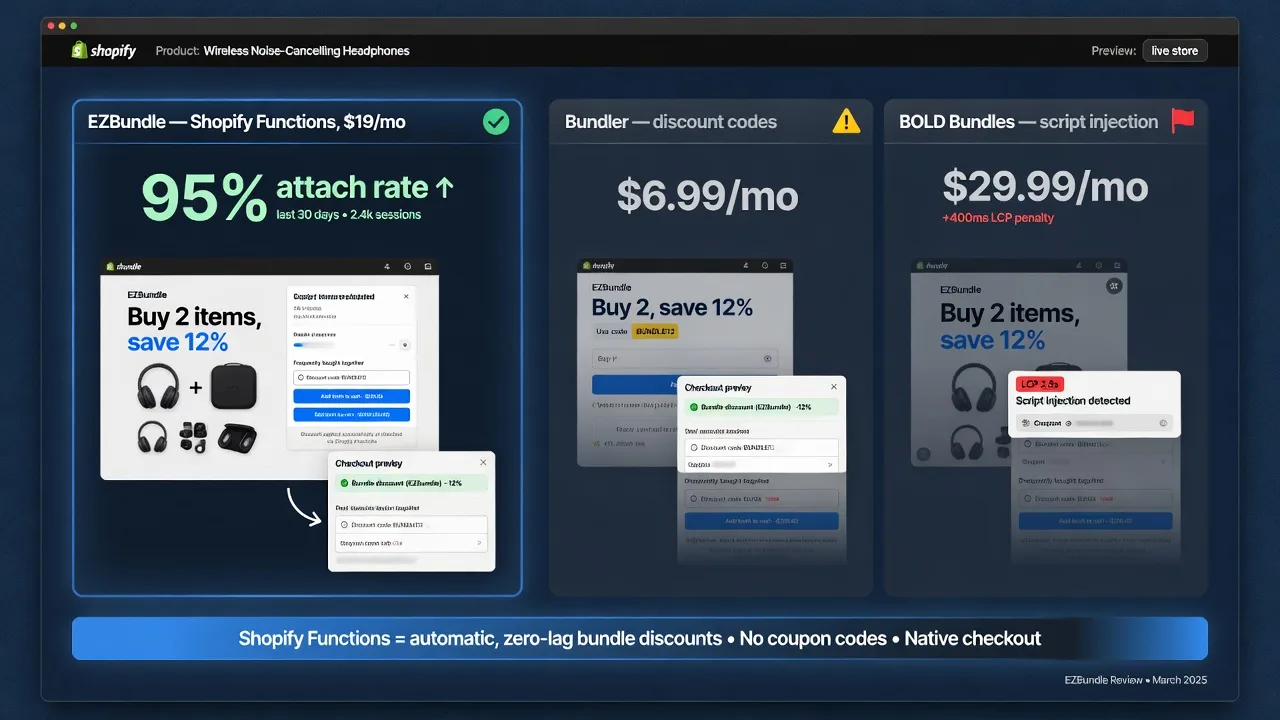
EZBundle: adds mix-and-match and volume or tiered discounts on top of fixed bundles, applies the discount automatically through Shopify Functions, and installs its storefront widget via a Theme App Extension. Free plan plus paid tiers from $19/month. Built for the bundle types the native app can't do.
What Shopify's Native Bundles App Does
Shopify offers a free first-party app called Shopify Bundles. It creates fixed bundles (a preset group of specific products sold as one item) and multipacks (several units of the same product). Inventory is tracked per component, so selling a bundle deducts stock from each item exactly as a normal sale would. There's no separate bundle inventory to manage.
For a store whose bundling need is "sell these three products together at one price," this is the right tool. It's free, it's made by Shopify, it works with native checkout, and there's no extra app overhead. If that describes you, install it and stop reading. Genuinely.
Where the Native App Stops
The native app is built for one shape of bundle: fixed contents, fixed price. Three common needs fall outside it.
Mix-and-match. Letting a customer build their own bundle from a collection, like "pick any 3 candles and save 20 percent," is not something the native app does. The contents of a native bundle are set by you, not the shopper.
Volume or tiered discounts. "Buy 2 save 10 percent, buy 4 save 20 percent" is a quantity-break structure, not a fixed bundle. The native app has no tiered pricing.
Automatic percentage discounts. The native app sells a bundle at a price you set. If you want the discount expressed as a percentage that applies on its own at checkout across flexible contents, that's a discount-function job, not a fixed-price product.
These three are exactly where average order value gets its biggest lift, because they give the shopper a reason to add one more item. That's the gap a dedicated bundle app fills.
Feature Comparison Table
| Capability | Shopify Bundles (native) | EZBundle |
|---|---|---|
| Fixed bundles | Yes | Yes |
| Multipack (same product) | Yes | Yes |
| Mix-and-match (pick from a collection) | No | Yes |
| Volume / tiered discounts | No | Yes |
| Automatic percentage discount | No (fixed price) | Yes, via Shopify Functions |
| Storefront widget | Basic | Theme App Extension, no code |
| Inventory per component | Yes | Yes |
| Works with native checkout | Yes | Yes |
| PageSpeed impact | Minimal | Minimal (async, no script injection) |
| Price | Free | Free plan + $19 / higher tiers |
The honest read of this table: the native app wins on "free" and does the two simplest bundle types well. EZBundle wins the three rows in the middle, which are the ones that change how much a customer spends.
The Automatic-Discount Difference
The mechanical difference worth understanding is how the discount is applied. A native fixed bundle is a product with its own price. EZBundle applies its discount through Shopify Functions, which is native Shopify infrastructure, not a workaround. That means the discount can apply automatically at checkout with no coupon code for the customer to enter, and it works with accelerated checkouts like Shop Pay, Apple Pay, and Google Pay.
Because it runs on Functions and a Theme App Extension rather than injected storefront scripts, it loads asynchronously and doesn't drag your product-page speed. If you've ever added an app that quietly cost you a second of load time, that architecture is the thing to check for. A quick way to confirm any app's real impact is a before-and-after free store speed audit.
Pricing
Shopify's native Bundles app is free. EZBundle has its own free plan, then paid tiers starting at $19/month for unlimited bundles and the mix-and-match and volume features. So the comparison isn't free-versus-paid across the board. It's free-for-the-simple-case versus a free-plus-paid app that also handles the cases the native one can't. If your bundles are all fixed sets, you never need to pay anyone. If you want choice-based or quantity-based discounts, that's where a paid tier earns its keep by lifting AOV.
Which One Fits You
Use Shopify's native Bundles app if: your bundles are fixed sets or multipacks at a set price, you want zero extra cost, and you don't need customers to build their own combinations. This is a lot of stores, and there's no shame in the free tool being the right one.
Use a dedicated app like EZBundle if: you want mix-and-match from a collection, volume or tiered "buy more save more" discounts, or an automatic percentage discount across flexible contents. These are the structures that move average order value, and they're outside the native app's scope.
For the full picture on how bundles lift AOV and how to structure them, the complete guide to Shopify product bundles covers the strategy behind whichever app you pick. And if you're weighing paid apps specifically, the EZBundle vs Bundler vs BOLD comparison lines up the main dedicated options.
Start with the free plan
Fixed, mix-and-match, and volume bundles with automatic discounts. Install free, no card, and only pay if you outgrow the free plan.
Get EZBundle →