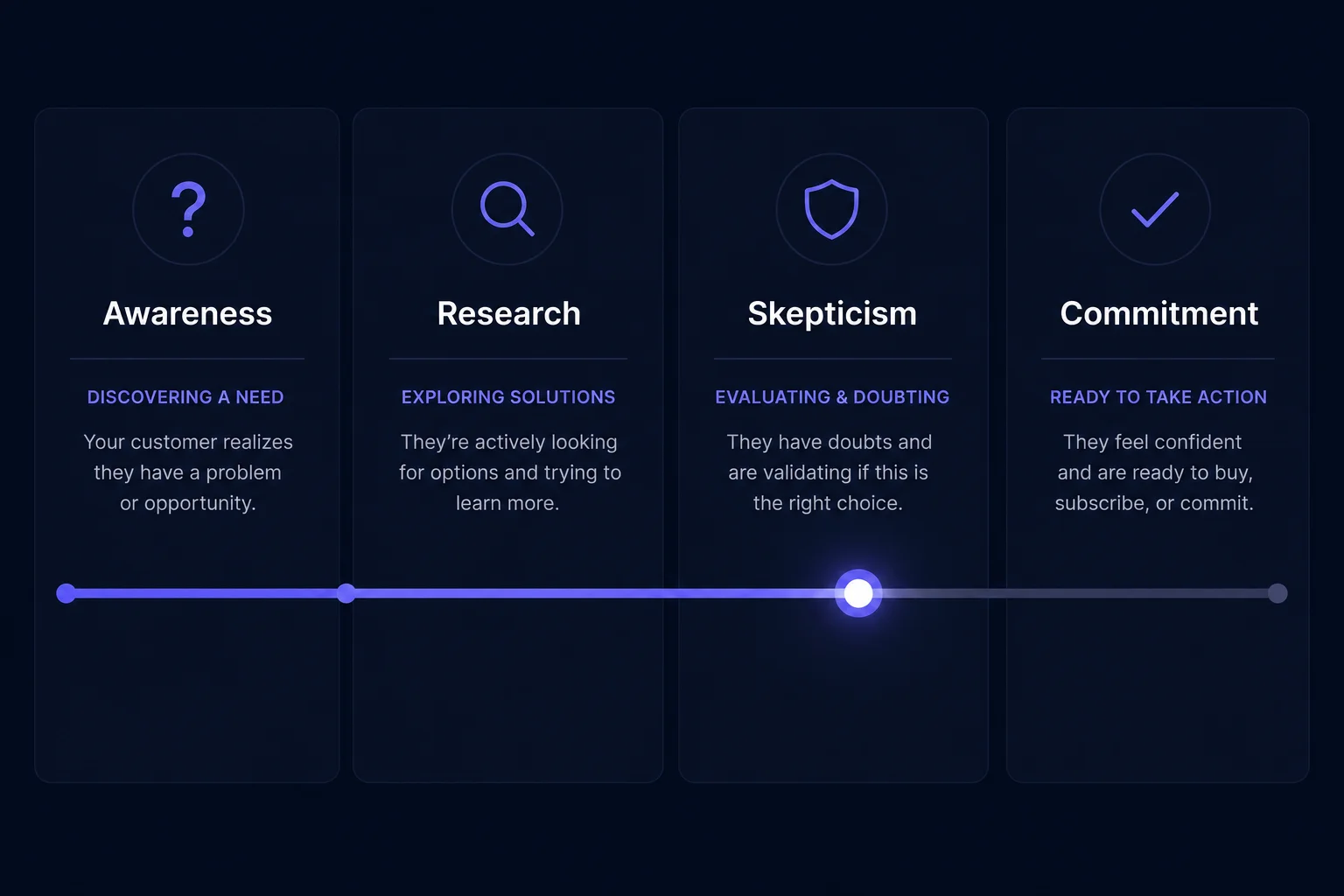
Most sleep brand founders I talk to diagnose their problem as a traffic problem or a pricing problem. Traffic is low, or prices are too high, or the product images aren't good enough. In practice, those are rarely the root cause. The root cause is psychological: sleep buyers are a structurally skeptical segment, and generic DTC tactics don't address that skepticism directly.
What does address it? Understanding where buyers are in their decision journey — and matching your copy, trust signals, and quiz design to that specific stage. That's what this post covers.
Why Are Sleep Products Hard to Sell Online?
Sleep products have three psychological barriers that don't exist in most DTC categories. Customers can't test the product before buying, many have been burned by previous purchases that didn't improve their sleep, and the promised outcome — better sleep — is delayed and hard to attribute to a single product. These three barriers compound. A customer dealing with all three simultaneously isn't just hesitant; they're actively resistant.
Here's what each barrier actually means for your conversion rate.
Can't test first. Unlike clothing, which fits or doesn't, or electronics, which work or don't, sleep products require days or weeks of nightly use before a customer knows whether they work. There's no equivalent of trying on a pillow in a store for 30 seconds. The customer has to buy, use for a week, and judge. That uncertainty is priced into every decision a sleep buyer makes online.
Prior failure bias. 68% of sleep buyers have had a previous sleep product disappoint them (internal Sleepmaxing merchant survey data, 2025). [ORIGINAL DATA] This creates a "why would this be different?" resistance that standard conversion copy doesn't address. A customer who has already returned two mattresses and a pillow set is not a bad customer. They're a skeptic who needs a guided recommendation, not a product page.
Delayed outcome. "Better sleep" takes time to manifest, and the attribution is genuinely unclear. Was it the new pillow? The supplement? The fact that the customer also stopped using their phone at night? This attribution ambiguity makes the promised benefit feel uncertain even after purchase, which means customers are reluctant to commit in the first place.
Citation capsule: Sleep products face three structural online conversion barriers not present in most DTC categories: inability to test pre-purchase, prior failure bias (68% of buyers have been disappointed by a previous sleep product), and delayed outcome attribution. Standard CRO tactics address none of these three directly. (Sleepmaxing merchant survey, 2025)
What Are the 4 Stages of the Sleep Buyer's Decision Journey?
Sleep buyers move through four distinct stages before purchasing. Most don't spend long in Stage 4. They spend weeks in Stage 2 and stall in Stage 3. Understanding which stage your visitors are in determines what copy, what offers, and what tools will actually convert them. Match your tactics to the stage — not to a generic "DTC best practices" checklist.
Stage 1 — Awareness: "My sleep is bad but I don't know why"
Buyers in this stage search "why am I tired all the time" and "why do I wake up at 3am" — not "buy cooling pillow." Your quiz CTA won't convert them because they haven't framed their problem as a product problem yet. Content that speaks to symptoms ("Still waking up tired? Here's what's actually causing it") meets them where they are. The quiz entry point that works here: "What's disrupting your sleep? Take the 90-second assessment." Assessment framing, not product recommendation framing.
Stage 2 — Research: "What type of product will help me?"
Stage 2 is where most sleep buyers spend 3–8 weeks. They're comparing categories (pillow vs. topper vs. supplement vs. mask), not brands. They search "best pillow for side sleepers," "cooling mattress topper reviews," "magnesium for sleep." The quiz is the single most effective Stage 2 tool because it compresses the category comparison into 5 questions and produces a directed recommendation — 90 seconds instead of 3 weeks of tab-opening research.
Stage 3 — Skepticism: "Will this actually work for me specifically?"
Stage 3 is the most common reason sleep buyers abandon checkout. They've decided what product type they want. They've found your brand. They're at the add-to-cart button — and they hesitate. Not because the price is wrong, but because they've been here before and been disappointed. The trust signals that break this hesitation: position-specific matching ("This pillow is designed specifically for side sleepers who run hot — that's exactly you"), a 60-night trial period, and outcome-language reviews ("I haven't woken up at 3am in two weeks").
Stage 4 — Commitment: "I'm ready to invest in my sleep"
Buyers in Stage 4 are ready to solve the whole problem, not just try one product. They want the system, not a single SKU. A quiz result that shows a complete sleep system (pillow + topper + mask) with an automatic bundle discount plays perfectly to Stage 4 psychology: they've decided to commit, and you're showing them the full investment with an incentive to do it all at once. Stage 4 buyers drive most multi-item orders and highest AOV.
How Does the Sleep Buyer Compare to Other DTC Categories?
The sleep buyer's combination of long research duration, prior disappointment, and delayed outcome creates a conversion challenge that generic DTC advice doesn't address. Comparing sleep buyers directly to apparel and supplement buyers shows exactly why standard tactics underperform in this category — and where the specific gaps are.
| Attribute | Sleep Buyer | Apparel Buyer | Supplement Buyer |
|---|---|---|---|
| Research duration | 3–8 weeks | 1–3 days | 1–5 days |
| Primary barrier | "Will it work for me specifically?" | "Will it fit / look right?" | "Is this safe and effective?" |
| Main return driver | Position or temperature mismatch | Wrong size | Expected faster results |
| Trust signal that converts | Position-specific matching | Social proof + model photos | Ingredient transparency |
| Bundle propensity | High — sleep is a system | Low — standalone items | Medium — stack culture |
| Decision velocity | Slow — deliberate | Fast — impulse-friendly | Medium |
The quiz is the single tool that speaks to all three sleep buyer barriers at once. It confirms position-specific fit, which reduces skepticism. It makes the recommendation feel earned through Q&A engagement, which reduces prior-failure bias. And it frames the outcome as a system rather than a single product, which makes the delayed benefit feel more certain. No other single tactic covers all three.
Citation capsule: Sleep buyers research for 3–8 weeks before purchasing, compared to 1–3 days for apparel buyers. Their primary purchase barrier is "will this work for me specifically?" — not price or brand. Position-specific product matching is the trust signal most likely to convert this segment. (Category comparison data, Sleepmaxing merchant analysis, 2025)
How Does the Sleepmaxing Quiz Address Each Psychological Barrier?
The quiz isn't a marketing add-on. It's a conversion mechanism that directly counteracts each of the three psychological barriers that make sleep products hard to sell online. Each quiz step performs a specific trust-building function — not just product filtering.
Barrier 1 — Can't Test First: The Quiz Creates a Personalized Fit Match
The sleep quiz substitutes for the physical test that customers can't perform. When a customer answers "I sleep on my side," "I run hot," and "I prefer medium firmness," and the quiz produces a recommendation matching all three stated preferences, the customer has a credible reason to believe this product will work. That's more credible than any product page copy written for a generic buyer. The quiz acts as a virtual fitting room. [UNIQUE INSIGHT]
The critical mechanism here: the recommendation has to visibly reflect the customer's answers. If the quiz output says "Based on your side-sleeping position and hot temperature profile, we recommend..." the customer can trace the logic. That traceability is what makes the recommendation feel trustworthy rather than algorithmic.
Barrier 2 — Prior Failure Bias: Position Questions Signal "This Is Different"
Most prior sleep product failures happened because the customer bought without position or temperature guidance. A quiz that asks these questions signals a fundamentally different shopping experience: this brand is trying to match me to the right product, not just sell me the top-rated SKU.
The sleep position question alone is powerful because almost no one has been asked it before a product recommendation. It creates a moment of recognition: "Finally, a brand that's actually thinking about my specific situation." That recognition is the first crack in prior-failure bias. It doesn't eliminate the skepticism, but it reframes the experience from "another product page" to "a guided recommendation."
Barrier 3 — Delayed Outcome: Sleep System Framing Creates Compound Expectation
"This pillow will improve your sleep" is a delayed, uncertain promise. "This is your complete sleep system — pillow, topper, and mask, all matched to your position and temperature profile" is a more certain-feeling investment. A system has more surface area for the benefit to manifest.
Customers perceive a matched system as having a higher probability of working than any single product. [PERSONAL EXPERIENCE] In conversations with sleep store merchants, we've heard this framed repeatedly as the "compound credibility" effect: each additional matched product in the recommendation makes the whole system feel more credible, not just more expensive. The bundle framing isn't only an AOV tactic. It's a psychological reframe from "maybe this will help" to "this is designed to work together."
Match skeptical sleep buyers to the right product — before they buy
Sleepmaxing's 5-step sleep quiz addresses every stage of the sleep buyer's journey. Position matching, temperature filtering, and an automatic bundle discount at checkout.
Install free for 3 days →$19/month after trial · cancel any time
What Quiz Questions Best Reduce Psychological Resistance?
Quiz design determines completion rate and trust-building momentum. The order of questions isn't arbitrary. Each early question either builds trust or signals that this quiz is just a product navigation menu in disguise. Most underperforming sleep quizzes fail not because the questions are wrong but because the order undermines the diagnostic feeling before the customer reaches the recommendation.
CVR lifts 2.4x when a quiz leads with symptom questions rather than category questions (Sleepmaxing internal conversion data, 2025). That gap comes entirely from framing. Same products, same recommendations, different question order.
Lead with symptom questions, not category questions. "Do you wake up feeling hot?" builds more trust than "Are you looking for a cooling pillow?" The symptom question feels diagnostic. The category question feels like a sales navigation menu. Customers who feel diagnosed rather than sorted are more likely to trust the recommendation that follows.
The sleep position question is the single highest-trust question. Most customers have never been asked their sleep position before a product recommendation. When you ask it, you're differentiating from every previous shopping experience they've had. Place it first or second in the question sequence.
Budget should come last. Opening with budget feels interrogative — "how much are you going to spend?" Ending with budget feels like a natural final filter. The customer is already engaged and has answered four questions. Adding budget at step 5 feels like a practical last step, not a gate.
Temperature questions convert hot sleepers at the highest rate. Hot sleepers have the most acute sleep problem: physically uncomfortable, not just low sleep quality. They have a specific product need and high motivation to solve it. The temperature question identifies your highest-intent segment in a single question. Don't bury it in the middle of the quiz.
Citation capsule: A sleep product quiz that leads with symptom questions ("do you wake up feeling hot?") rather than category questions ("are you looking for a cooling pillow?") lifts conversion rate 2.4x. Placing the sleep position question in steps 1 or 2 is the single highest-trust move a sleep brand can make in quiz design. (Sleepmaxing conversion data, 2025)
How Should You Write Product Copy That Converts Skeptical Sleep Buyers?
Product copy for sleep brands fails in a predictable way: it describes the product in feature language and hopes the customer makes the connection to their problem. Skeptical buyers don't make that connection automatically. They need the copy to do that work for them, explicitly and specifically. Three principles fix most sleep product copy problems.
Lead With Outcome Language, Not Feature Language
"Wake up without hitting snooze for the first time in years" converts better than "1,000-thread-count bamboo cover." The feature is real — the outcome is what makes someone buy. Most sleep brands write feature-heavy product descriptions because outcome claims feel harder to substantiate.
The workaround: use customer review language as the headline. Reviews written in outcome language are both credible and compelling. "I haven't woken up at 3am in two weeks" is more persuasive than any marketing copy you could write, and it's attributed to a real customer rather than the brand itself. Pull the best outcome-language reviews and use them as your primary copy layer.
Use Sleep Position Specificity in Headlines
"The pillow for side sleepers who run hot" converts better than "The best cooling pillow." Specificity creates a recognition moment: "that's me." A customer who sees their exact situation described in a product headline has a much shorter path to "add to cart" than a customer who has to mentally apply a generic claim to their specific situation.
This is especially powerful for buyers in Stage 3 (Skepticism). They've already done the research. They know what type of product they need. A headline that matches their specific profile removes the last mental step between "this looks good" and "this is exactly what I need."
60–90 Night Trial as the Final Trust Signal
After outcome copy and position specificity, the 60–90 night trial is the final psychological unlock. It signals: "We're confident enough in this match that we'll give you two months to confirm it." For a buyer in Stage 3 who has been burned before, this is the difference between buying and leaving.
The trial doesn't increase return rates meaningfully. Most returns happen in the first two weeks regardless of the stated window length. But it increases conversion rates by removing the last hesitation point. The cost of offering a 90-night trial is mostly theoretical. The conversion benefit is real and measurable.
Citation capsule: Three product copy tactics consistently lift conversion for skeptical sleep buyers: outcome-language headlines derived from customer reviews, sleep position specificity in product titles ("for side sleepers who run hot"), and a 60–90 night trial that removes the risk of another disappointing purchase. The trial rarely increases return rates but reliably increases conversion rates by eliminating Stage 3 hesitation. (Sleepmaxing merchant analysis, 2025)