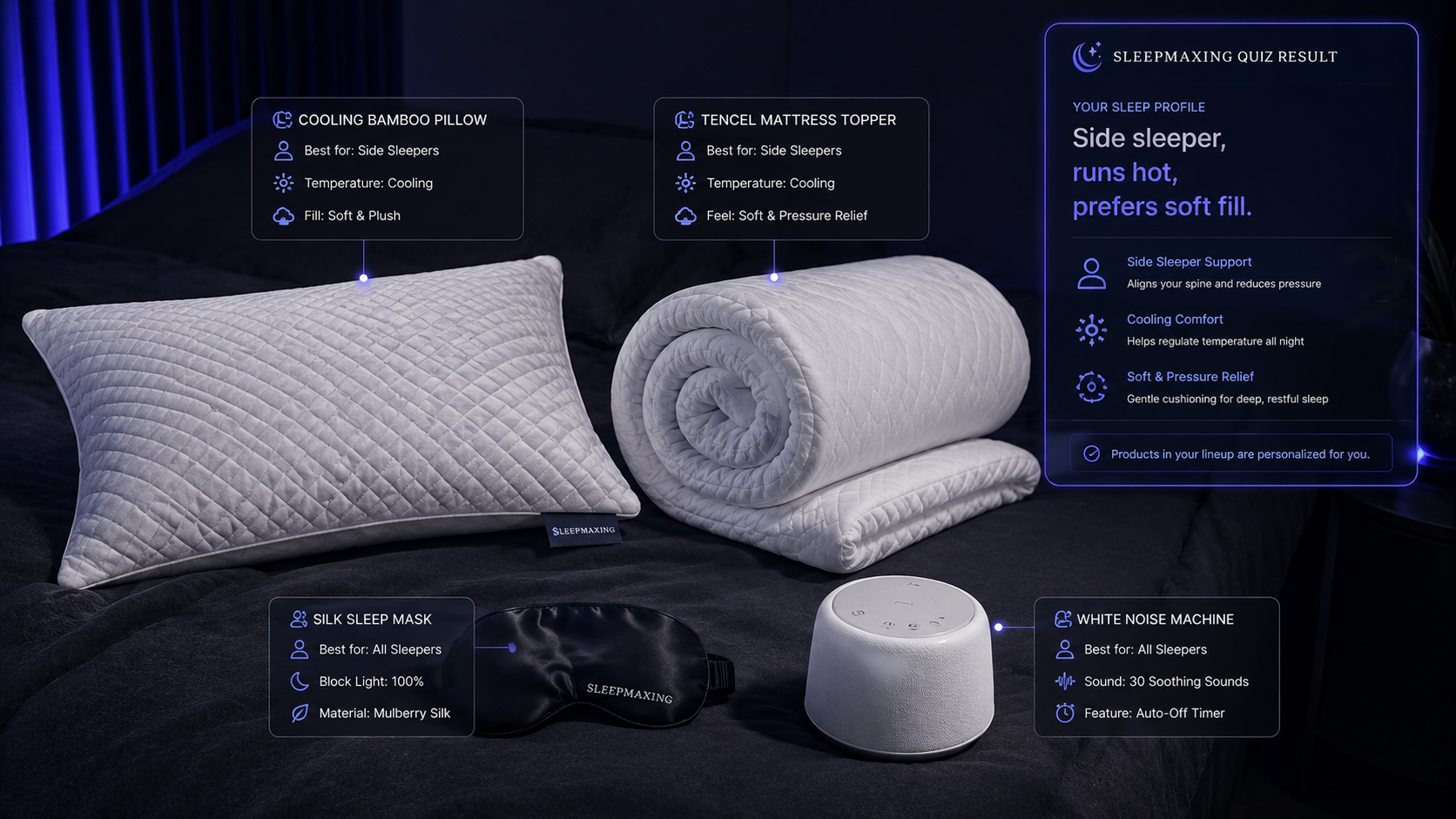
The Core Conversion Problem in Sleep E-Commerce
Every successful sleep brand solves the same underlying problem: purchase uncertainty at the point of decision.
A shopper browsing your pillow catalog faces a question you haven't answered: "Which one is right for me?" They see options — firm, medium, soft, cooling, memory foam, down alternative, adjustable loft — and without guidance, they don't know how to choose. The majority default to one of two behaviors: they either pick randomly (leading to higher returns when the product doesn't fit their sleep style) or they leave the page entirely to do more research and never come back.
This is not a traffic problem. Stores with this conversion issue often have perfectly healthy traffic. It's a guidance problem — and the solution is a structured recommendation system that asks the right questions and maps answers to specific products.
The underlying psychology: Sleep is high-stakes for consumers. A bad pillow means pain, poor sleep, and wasted money. The higher the consequence of getting it wrong, the more research-intensive the purchase becomes. Stores that guide buyers through the decision with a quiz remove the research burden and replace uncertainty with confidence — which is what actually converts.
| Category | Shopify Tag | Primary Customer Pain Point |
|---|---|---|
| Pillows | sleepmaxing-pillow | Neck pain, wrong support level |
| Mattress toppers | sleepmaxing-topper | Mattress too firm or too soft |
| Cooling products | sleepmaxing-cooling | Sleeping hot, night sweats |
| Sleep masks | sleepmaxing-mask | Light sensitivity, shift workers |
| Supplements | sleepmaxing-supplement | Trouble falling asleep |
| White noise | sleepmaxing-noise | Noise sensitivity, light sleeper |
How to Structure Your Sleep Product Catalog
Most sleep product catalogs fail conversion not because of the products themselves, but because they're organized by product type (pillows, mattress toppers, accessories) without helping shoppers understand which variant within each type is right for them.
Organize by sleep profile, not just product type
The highest-converting sleep catalogs are organized around sleep profiles — common combinations of sleep position, firmness preference, and temperature sensitivity. The product listing page for "Pillows" should surface the right pillow variant based on the visitor's context, not just list all 8 variants at equal prominence.
Practically, this means tagging your products with sleep profile attributes that a quiz can use to make recommendations:
- Sleep position: side, back, stomach, combination
- Firmness: soft (1–3), medium (4–6), firm (7–10)
- Temperature: cooling, standard, warming
- Fill: memory foam, latex, down, down alternative, adjustable
Sleepmaxing uses a sleepmaxing-* tag convention to attach these attributes to products — the quiz reads the tags and recommends the matching variant automatically. See the full product tagging guide.
Don't overwhelm — guide instead
More than 4–5 variants of the same product type (e.g., 8 different pillow firmnesses) increases purchase paralysis without increasing conversion. If you have a wide catalog, filter the default product listing to show the 3–4 most popular variants and let the quiz surface the right one for each shopper.
Sleepmaxing tags your products and maps them to quiz answers automatically
The quiz reads your product tags and recommends the right variant for each shopper's sleep profile — no manual mapping required.
Install Sleepmaxing Free →Why a Quiz Is Not Optional for Sleep Brands
A product recommendation quiz converts sleep product shoppers at 3–5x the rate of catalog browsing. This is not a small improvement — it's the single highest-leverage change a sleep brand can make to their Shopify store.
The mechanism is straightforward: the quiz asks the questions the shopper is already asking themselves ("am I a side sleeper?" "do I sleep hot?") and maps the answers to a specific product recommendation. The shopper arrives on the product page having already made their decision — they're confirming a recommendation, not choosing from a catalog. That's a fundamentally different psychological position at the purchase moment.
What your sleep quiz should ask
- Sleep position — Side, back, stomach, or combination. This determines pillow loft and mattress pressure relief needs.
- Temperature sensitivity — Do you run hot, cold, or neutral at night? This determines fill material and cooling properties.
- Firmness preference — Soft, medium, or firm. Critical for mattress toppers and pillows.
- Partner preferences — Shared sleep situation? This affects motion isolation importance.
- Budget range — Optional but useful for filtering recommendations to specific price tiers.
5 questions is the optimal length for sleep product quizzes. Under 3 feels too thin to be credible; over 7 increases abandonment before completion. Sleepmaxing's sleep quiz has these 5 questions pre-built — you don't configure the question logic, you configure which products match each answer combination.
Where to place the quiz
The highest-converting quiz placements for sleep brands:
- Homepage hero — "Find your perfect sleep setup →" as the primary CTA. Captures intent immediately.
- Product collection pages — "Not sure which to choose? Take the 60-second quiz." Intercepts browsers at the decision moment.
- High-traffic product pages — Embedded below the product description on your top-selling products. Catches shoppers comparing variants.
Sleep System Bundle Strategy
Single-product purchases in the sleep category convert lower than sleep system bundles — because shoppers who just bought a new pillow are already thinking about the other products in their sleep setup. Presenting a bundle at the recommendation stage (not the cart) captures this intent before they navigate away.
The three bundle types that work for sleep brands
1. The Sleep System Bundle — pillow + mattress topper + sleep accessory (eye mask, ear plugs, or pillow spray). AOV lift: 45–65% over single-product purchases. Presentation: the quiz recommends all three together as a "your sleep system" package.
2. The Starter Kit — one anchor product + two lower-priced accessories. Lower barrier to entry than the full system. Good for first-time customers or price-sensitive shoppers. AOV lift: 25–35%.
3. The Replenishment Bundle — for consumable sleep products (supplements, pillow sprays, essential oils). 3-month supply at a discount. AOV lift: 80–120% over single-unit purchase; drives repeat purchase behavior.
Bundle discount mechanics matter here: Sleep product bundles should apply discounts automatically at checkout — no coupon code required. Sleepmaxing uses Shopify Functions for this: when the quiz-recommended bundle products are in the cart, the discount appears without any action from the customer. Stores that require coupon codes for bundle discounts see 15–25% lower bundle attach rates.
Seasonal Peaks and How to Capitalize on Them
January — New Year Health Reset
The biggest sleep product month. "Better sleep" is a top January resolution. Run quiz-led campaigns from Jan 1–31. This month often accounts for 25–30% of annual DTC sleep revenue.
August/September — Back to School
College students buying bedding, dormitory-sized toppers, and sleep supplements. Gift-giver demand from parents. Run "dorm sleep setup" bundles with curated starter kits.
October–December — Holiday Gifting
Sleep products are high-value gifts. Run gift bundles with "sleep system" messaging. Add gift wrapping or premium packaging options. Quiz CTA: "Find the perfect sleep gift."
Black Friday / Cyber Monday
Highest purchase volume of the year. Offer bundle discounts (not single-product discounts) to maintain margins. Pre-build BFCM bundle configurations in Sleepmaxing before the sale.
Off-peak strategy
February–July and March–October are lower-demand periods. In these windows, focus on: building your email list via quiz completions (even non-purchasers are warm leads), retargeting quiz completers who didn't buy, and running replenishment campaigns to past customers. Sleep product customers re-buy every 12–24 months.
How to Reduce Returns with Better Pre-Purchase Guidance
Sleep product returns are expensive — typically 8–15% of revenue across pillow and mattress categories. The primary cause isn't product quality; it's wrong fit. A shopper who bought a firm pillow when they needed soft, or a cooling topper when they sleep cold, will return it.
Quiz-driven recommendation reduces returns by 20–35% because customers arrive at their purchase decision having already answered the questions that determine fit. They didn't guess — they were guided. That guided confidence translates directly to lower post-purchase regret and fewer return requests.
To reinforce this post-purchase:
- Include a "Your Sleep Profile" card in the shipping box — a reminder of why this product was recommended for them
- Send a Day 7 email: "How's your new [product] working for you?" — captures issues early before they become return requests
- Include a 30-night adjustment period in your return policy — many sleep products need time to work, and customers who understand this stick with the product longer
The High-Converting Sleep Store Playbook
Tag your products with sleep profile attributes
Use Sleepmaxing's tagging convention (sleepmaxing-position-side, sleepmaxing-temp-cooling, etc.) so the quiz can map answers to specific variants. The auto-tagger applies tags in bulk — one-time setup. See the tagging guide.
Place the quiz in 3 locations
Homepage hero ("Find your sleep system →"), top collection page ("Not sure which? Take 60-second quiz"), and top product pages below the description. Each placement catches a different shopping intent stage.
Build 2–3 sleep system bundles per quiz outcome
For each major quiz result (e.g., "side sleeper, hot, medium firmness"), create a sleep system bundle in Sleepmaxing with the recommended products and a 12–15% automatic bundle discount via Shopify Functions. The results page shows the bundle as the primary recommendation.
Capture quiz completers as email subscribers
Gate the quiz results with an email capture — "Enter your email to see your personalized sleep recommendations." Offer a 10% welcome discount. These leads convert at 3–4x the rate of cold email subscribers because they've already engaged with your brand through the quiz.
Run retargeting to quiz non-purchasers
Set up a Klaviyo flow for quiz completers who didn't purchase: Day 3 reminder ("Your sleep recommendations are waiting"), Day 7 social proof ("[X] people with your sleep profile chose this pillow"), Day 14 offer ("10% off your recommended sleep system — expires soon"). This sequence converts 15–25% of non-purchasers.
Sleepmaxing is free to install — set up your sleep quiz today
5-question sleep quiz with pre-built logic, automatic bundle discounts via Shopify Functions, product tagging, and a results page optimized for the purchase moment.
Install Sleepmaxing Free on Shopify →