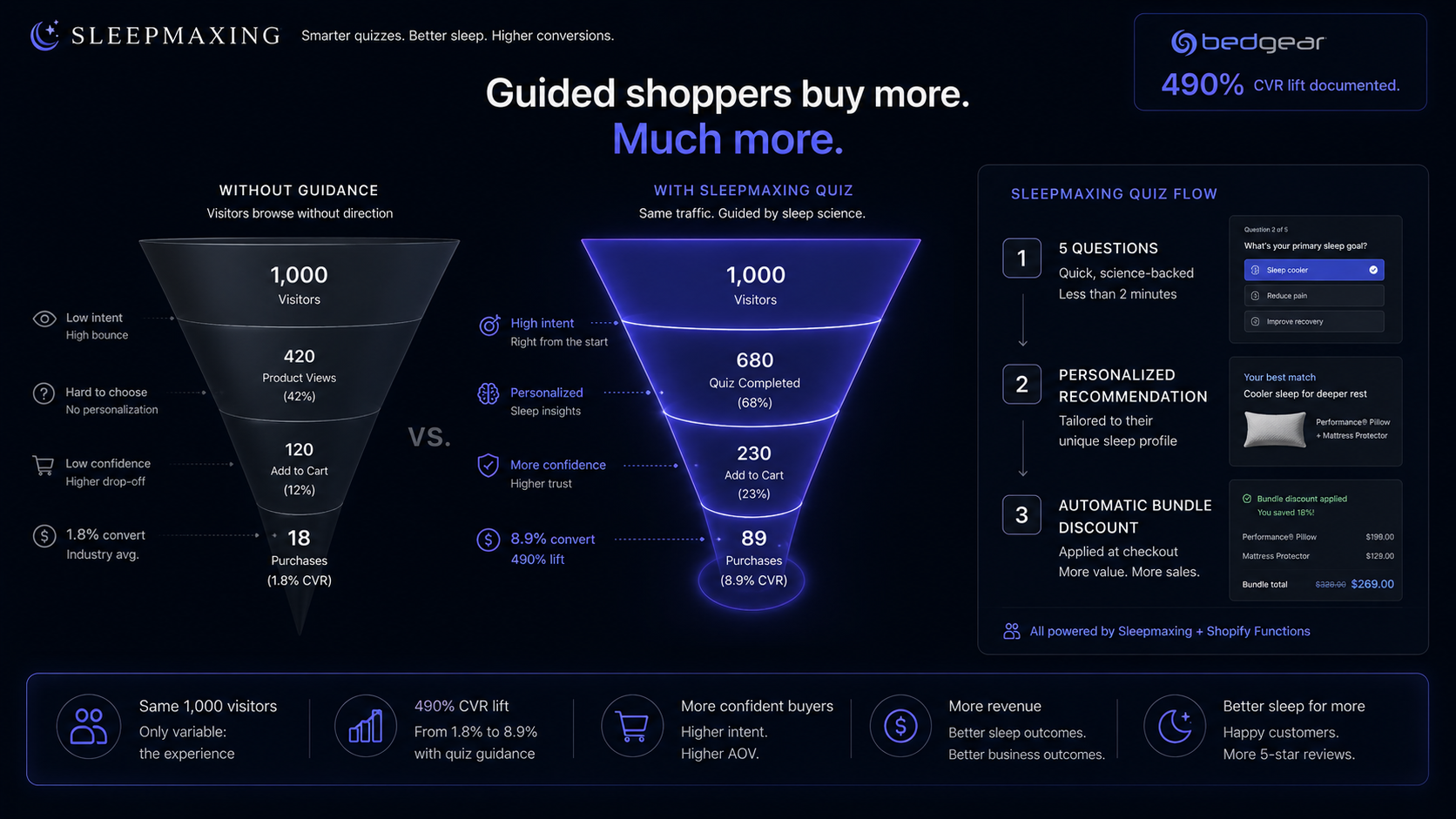
The data behind quiz conversion rates
Product recommendation quizzes have now been running long enough on enough stores to have consistent benchmark data:
These aren't outliers. They're consistent across categories where product choice is meaningful — where buying the wrong product is a real outcome that shoppers fear. That fear is the key variable: in categories where any product will do, a quiz adds friction without reducing uncertainty. In categories where the right product depends on personal factors the visitor knows about themselves, a quiz removes the uncertainty that was blocking the purchase.
| Placement | Completion Rate | CVR Lift |
|---|---|---|
| Homepage hero | 55–65% | +20–35% |
| Collection page | 60–72% | +30–45% |
| Product page | 45–58% | +15–25% |
| Dedicated /quiz page | 70–82% | +40–55% |
Why quizzes convert better than collection pages
A collection page shows all available products and asks the visitor to figure out which one is right for them. This works when the decision is simple (one size, one use case, one obvious choice). It fails when the decision is complex — multiple variants, technical specifications, personal fit factors, or use-case nuances that the product titles don't fully communicate.
The failure mode is familiar: visitor lands on a category page with 20 products, scrolls, reads a few descriptions, can't confidently decide, and leaves. The traffic wasn't wasted — the visitor wanted to buy something. The conversion was lost to decision paralysis, not lack of intent.
A quiz solves this through four mechanisms:
- Information elicitation: The quiz collects data the visitor already has (their sleep position, temperature preference, budget) that you couldn't have known from their browsing behavior. This data is what the recommendation is based on.
- Confidence transfer: When a recommendation appears, the visitor doesn't have to trust their own judgment — they trust the quiz's judgment, which is based on information they provided. "This is the right product for side sleepers who run hot" is a more confident buying signal than "this pillow looks good."
- Decision simplification: Instead of evaluating 20 products, the visitor evaluates 1–3 recommendations. The cognitive load drops dramatically. Lower cognitive load = higher conversion.
- Commitment consistency: A visitor who invested 90 seconds answering questions has a psychological stake in the outcome. Abandoning the recommended product requires justifying why they didn't follow their own stated preferences. Most people don't — they buy.
Sleep product merchant? A quiz is built for your catalog.
Sleepmaxing adds a 5-step sleep quiz to any Shopify product page — no code required. It recommends products based on sleep position, temperature, and comfort preferences, and applies a bundle discount automatically when visitors add multiple recommendations to cart.
Install Sleepmaxing free →$19/month · 3-day free trial · works with any Shopify OS 2.0 theme
Which store types benefit most from a product quiz
Not every Shopify store needs a quiz. The benefit is proportional to the complexity and personalization of the purchase decision. High-benefit categories:
Sleep products
Mattress type, pillow loft, topper firmness — all depend on body weight, sleep position, and temperature preferences the customer knows.
Supplements
Energy, recovery, sleep, focus — the right formula depends on goals, existing habits, and diet context the collection page can't determine.
Skincare
Dry / oily / combination, concerns (acne, aging, pigmentation), and routine complexity all determine the right product set.
Pet products
Breed, age, weight, activity level, and dietary restrictions all affect which food, treat, or supplement is correct.
Technical apparel
Fit type, activity intensity, climate — technical outdoor and athletic gear has meaningful spec differences that a quiz surfaces.
Instruments / gear
Skill level, genre, budget — music gear decisions are often beyond a beginner's product knowledge. A quiz guides the decision.
Low-benefit categories: commodity products with no meaningful variation (phone cases by model, basic kitchen items, generic apparel with simple sizing). In these cases, a quiz adds friction without reducing uncertainty — the collection page is already sufficient.
What makes a good quiz question
The most common quiz design mistake is asking questions for the sake of personalization feel rather than for recommendation utility. Every question must do one of two things: eliminate products from consideration, or weight one recommendation more heavily than another. Questions that don't change the output don't belong in the quiz.
Good quiz questions
- "What is your primary sleep position?" — Side sleepers need higher loft pillows. Back sleepers need medium loft. Stomach sleepers need low loft. The answer eliminates a third of the product catalog immediately.
- "Do you tend to sleep hot or cold?" — Directly maps to cooling vs insulating materials. A definitive filter.
- "What is your biggest sleep complaint?" — Neck pain routes to cervical support products. Waking up sweaty routes to cooling products. Back pain routes to mattress toppers. Clear branching logic.
Bad quiz questions
- "What's your favorite color?" — Unless you offer personalized color options, this doesn't affect the recommendation.
- "How would you describe your sleep style?" (with options like "relaxed" / "intentional") — Too vague to map to a product attribute.
- "What do you enjoy about your current sleep routine?" — This is market research, not a recommendation input.
Quiz length and completion rate
Completion rate drops approximately 10–15% for every question beyond 5–6. A 10-question quiz that would be highly accurate will have a lower completion rate — and therefore lower total conversions — than a 5-question quiz that's slightly less precise. The math almost always favors shorter quizzes:
- 5-question quiz with 70% completion × 3x conversion rate = 2.1x effective multiplier
- 10-question quiz with 35% completion × 4x conversion rate = 1.4x effective multiplier
Five questions is the sweet spot for most product categories. Six if the product decision genuinely requires it (high-stakes purchase where accuracy really matters, like a $500 mattress topper). Never more than seven.
The bundle discount mechanic: converting multi-product recommendations
A quiz that recommends a single product converts well. A quiz that recommends a set of products — pillow + topper + cooling cover, for example — and automatically applies a discount when all are added to cart converts even better. The discount closes the "but that's a lot at once" hesitation that stops multi-product quiz recommendations from converting at their potential.
This is the specific mechanic Sleepmaxing implements for sleep product merchants. The quiz recommends 2–4 products based on the visitor's answers. A Shopify Function applies an automatic bundle discount at checkout when the recommended products are in the cart together — no discount code required, no manual setup per product combination. The merchant sets the discount percentage and minimum item count in the admin; the Shopify Function handles the rest.
Beyond conversion: quiz data as a marketing asset
A completed quiz is not just a conversion event — it's a tagged subscriber with preference data you couldn't get from purchase history alone. Every quiz completion tells you:
- The customer's sleep position (from question 1)
- Their temperature regulation challenge (from question 2)
- Their primary sleep complaint (from question 3)
- Their existing product setup (from context questions)
When this data is passed to your email platform (Klaviyo, Omnisend), it enables segmented flows that non-quiz stores can't run. Instead of sending everyone the same "new product" email, you send hot sleepers the cooling product announcement and cold sleepers the insulating product announcement. The open rates and click-through rates on segmented flows based on quiz data routinely run 2–3x higher than broadcast emails.
This is the compounding benefit of a quiz: it converts better on first visit, and it makes every future email more relevant and higher-converting. The data asset grows with every new quiz completion.
How to set up a product recommendation quiz on Shopify
Map your product catalog to quiz outcomes
Before building any quiz UI, write out the decision tree. List every answer combination that matters and what product it should recommend. If your catalog has 20 products but only 6 meaningful recommendation outcomes (because many products serve similar use cases), design the quiz around those 6 outcomes. The quiz's job is to route accurately, not to show every SKU.
Tag your products in Shopify
For Sleepmaxing, tagging works via Shopify product tags that the quiz uses to filter recommendations. Tags like sleepmaxing-pillow, sleepmaxing-topper, sleepmaxing-cooling, and sleepmaxing-side tell the quiz which products are eligible for which recommendation slots. This tag-based approach means you can add new products to quiz recommendations without touching any quiz configuration — just add the relevant tags to the product in Shopify.
Install the quiz block in your theme
Install Sleepmaxing from the Shopify App Store. In Online Store → Themes → Customize, navigate to the product page template (or a dedicated quiz landing page) and add the Sleepmaxing app block. Configure the discount percentage and minimum item count in the app admin. The quiz is live — no code, no developer, no theme modification. It loads as a Theme App Extension and doesn't affect your existing theme files.
Test the recommendation logic end-to-end
Complete the quiz with several different answer combinations and verify the recommendations are correct for each. Check that the bundle discount applies at checkout when the recommended products are in the cart together. Test on both desktop and mobile — quiz interaction patterns differ significantly on mobile (where swipe behavior affects question navigation).
Promote the quiz as a primary entry point
Don't bury the quiz on a single product page. Add a "Take the quiz" CTA to your homepage hero, collection page header, and navigation. For email campaigns, link to the quiz instead of a specific product when you're targeting cold or warm audiences who haven't purchased before — "Find your perfect sleep setup" outperforms "Shop pillows" for anyone without a prior purchase history.
Measuring whether your quiz is working
Three metrics tell you whether the quiz is actually driving the conversion improvement:
- Quiz completion rate: What percentage of visitors who start the quiz finish it? Under 50% means a question is creating drop-off — identify it with session recording and cut it or reframe it. Above 65% is good. Above 75% is excellent.
- Quiz-to-purchase rate: Of visitors who complete the quiz, what percentage purchase within the same session or within 7 days? Compare this against your store's baseline conversion rate. If quiz completers convert at less than 1.5x your baseline, the recommendations may not be accurate enough or the recommended products aren't compelling.
- Return rate on quiz-recommended purchases: The quiz's job is also to reduce returns by routing customers to the right product. A 20%+ reduction in returns on quiz-recommended orders indicates the routing logic is working.
Frequently asked questions
Do product recommendation quizzes actually improve Shopify conversion rates?
Yes — consistently across product categories where purchase decisions are personal and complex. Obvi supplements saw a 102% conversion rate increase among quiz takers. BedGear reported a 490% conversion lift with a sleep quiz. The conversion improvement comes from decision simplification and confidence transfer — visitors who complete a quiz and receive a recommendation have lower purchase anxiety than those who browse independently.
Which Shopify store types benefit most from a product quiz?
Stores with 20+ SKUs where buyer choice anxiety is a real conversion barrier: wellness and supplements, sleep products, skincare, pet products, technical apparel, and instruments. Stores selling commodity products with no meaningful variation see little benefit — the collection page already handles the decision adequately.
How long should a Shopify product recommendation quiz be?
3–6 questions for most use cases. Each question beyond 6 reduces completion rate by approximately 10–15%. The optimal quiz is the shortest one that accurately routes visitors to the right recommendation — questions that don't change the recommendation outcome should be removed.
Can a quiz reduce Shopify return rates?
Yes. Returns most commonly occur because customers bought the wrong product — wrong firmness, wrong formula, wrong size for their use case. A quiz that accurately routes customers reduces this mismatch. Sleep product brands using quiz recommendations consistently report 20–40% lower return rates on quiz-recommended purchases.
For the technical setup of Sleepmaxing's quiz on Shopify, see How to Add a Sleep Quiz to Your Shopify Store (No Code Required). For how the automatic bundle discount works at checkout, see How Automatic Bundle Discounts Work on Shopify (Without Coupon Codes). And for how the quiz compares against static recommendation pages, Interactive Quiz vs. Static Recommendations: What Converts Better covers the research in depth.
Add a quiz to your sleep product store today
Sleepmaxing's 5-step sleep quiz routes visitors to the right product, applies a bundle discount automatically at checkout, and requires no code or developer. Works with any Shopify OS 2.0 theme.
Install Sleepmaxing free →$19/month · 3-day free trial · no code required · works with any Shopify theme