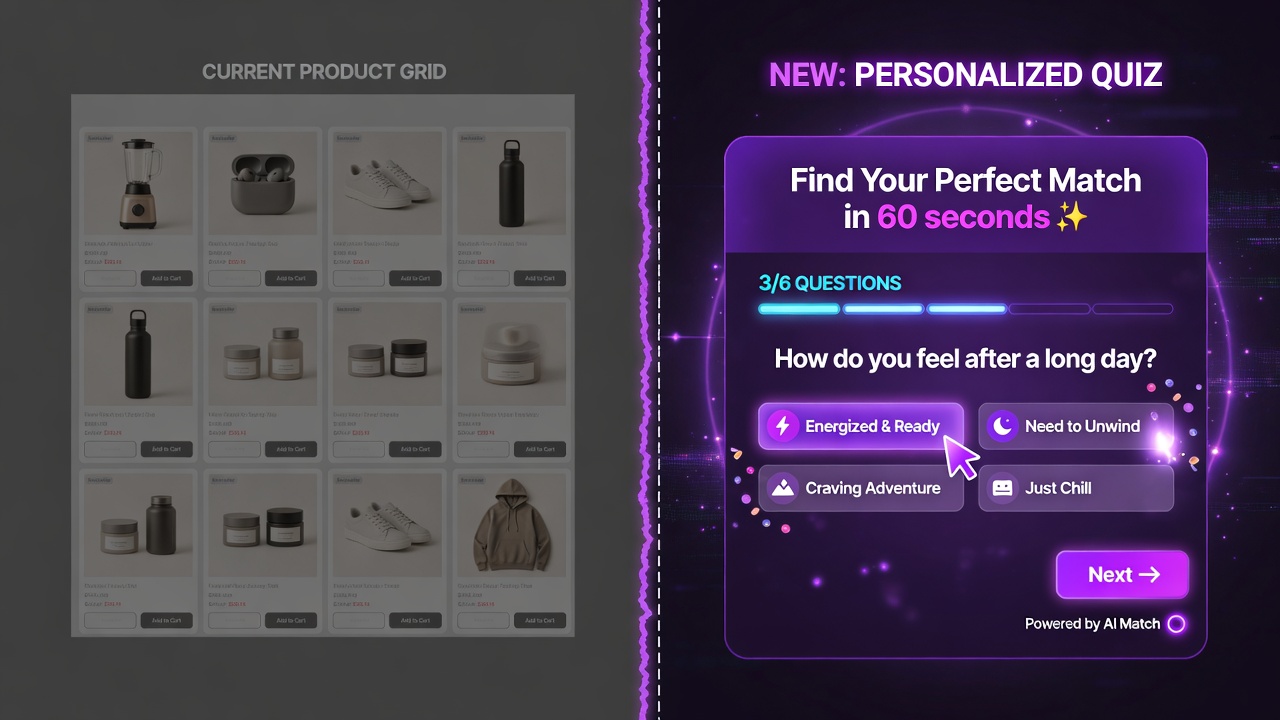
The static recommendation problem
Static product recommendations — the "Frequently bought together" or "Customers also viewed" sections that come with most Shopify themes — are based on purchase history. If your store is new, or if your top sellers are concentrated in one category, the recommendations are often circular: a customer looking at a pillow gets recommended more pillows.
Even when the recommendations are accurate, they're passive. They sit below the fold, easy to ignore. There's no narrative connecting product A to product B — no reason for the customer to understand why they should buy both.
For sleep brands specifically, the challenge is that sleep is a system. A side sleeper who runs hot has a specific set of needs: a contoured pillow, a cooling topper, possibly a mask if their room gets bright in the morning. That combination is worth 3–4x a single-product purchase. Static recommendations will occasionally surface that combination by accident. A quiz surfaces it on purpose, every time.
| Metric | Static Best Sellers | Quiz-Driven Recommendations |
|---|---|---|
| Conversion rate | 1.5–3% | 4–8% (quiz completers) |
| Average order value | Baseline | +20–40% |
| Return rate | 15–25% | 8–14% (better product-fit) |
| Time to first purchase | 2–5 sessions | 1 session |
| Customer satisfaction (NPS) | Baseline | +15–25 points |
| Email capture rate | 5–15% | 45–70% (quiz requires email) |
What a quiz does differently
An interactive quiz doesn't just show products — it earns the recommendation. When a customer tells you they're a hot-sleeping side sleeper with a noisy bedroom, and you respond with "here's exactly what you need for your sleep profile", the recommendation carries authority that a generic "customers also viewed" never can.
There are three structural advantages of quiz-driven recommendations:
1. Relevance
Every product shown is directly matched to something the customer just told you about themselves. There's no "why is this here?" — every result makes intuitive sense given the answers. This dramatically reduces the cognitive load of deciding whether to add a product to cart.
2. Commitment
Completing a quiz creates a small psychological investment. The customer has taken five deliberate steps to tell you about their sleep. The results feel earned. They're more likely to trust the recommendations and act on them than they would with a passive suggestion.
3. The bundle framing
A quiz naturally presents its results as a set — "your perfect sleep system" rather than "some products you might like". That framing makes adding multiple items feel like the right move, not an upsell. Combined with a bundle discount that fires automatically at checkout, the conversion path from quiz to multi-item purchase is frictionless.
The AOV multiplier
The most significant difference between quizzes and static recommendations is average order value. Static recommendations convert a small percentage of single-product customers into two-product customers. Quizzes convert single-product customers into three or four-product customers — and they do it at a higher rate.
The mechanism is the bundle discount. A customer who adds one product to cart has no financial incentive to add a second. A customer who sees "add one more product and save 15% on everything" has a direct financial incentive. The quiz creates the product set; the bundle discount closes the deal.
When static recommendations still make sense
Static recommendations aren't useless — they're just wrong for the main conversion path on a sleep brand's product pages. They work well in a few specific contexts:
- Post-purchase pages: After checkout, showing "people who bought this also bought" is a low-friction way to surface accessories without interrupting the purchase flow.
- Category/collection pages: Browsing-mode shoppers who aren't yet in purchase mode respond differently than product page visitors. Static social proof is appropriate here.
- Very simple catalogs: If you sell two products, you don't need a quiz. Complexity is the prerequisite for guided selling.
Implementation time: quiz vs. static
This is where quizzes traditionally lost the comparison — they were assumed to require developer time to build and maintain. Theme-native recommendation sections ship with Shopify and require no setup.
With a theme app extension like Sleepmaxing, the implementation gap has closed. Installing the quiz takes 10 minutes: install the app, tag your products, drag the block into Theme Editor, activate the bundle discount. There's no code to write, no quiz builder to configure, no custom storefront work.
The ongoing maintenance is also minimal: tag new products as you add them (or run the auto-tagger), and adjust the discount percentage from the admin when needed.
The right answer for most sleep brands
Use both — but give them different jobs. The quiz belongs on product pages as the primary conversion mechanism, driving multi-product bundles. Static recommendations belong on thank-you pages and collection pages as secondary discovery tools.
The quiz is the closer. Static recommendations are the follow-up.