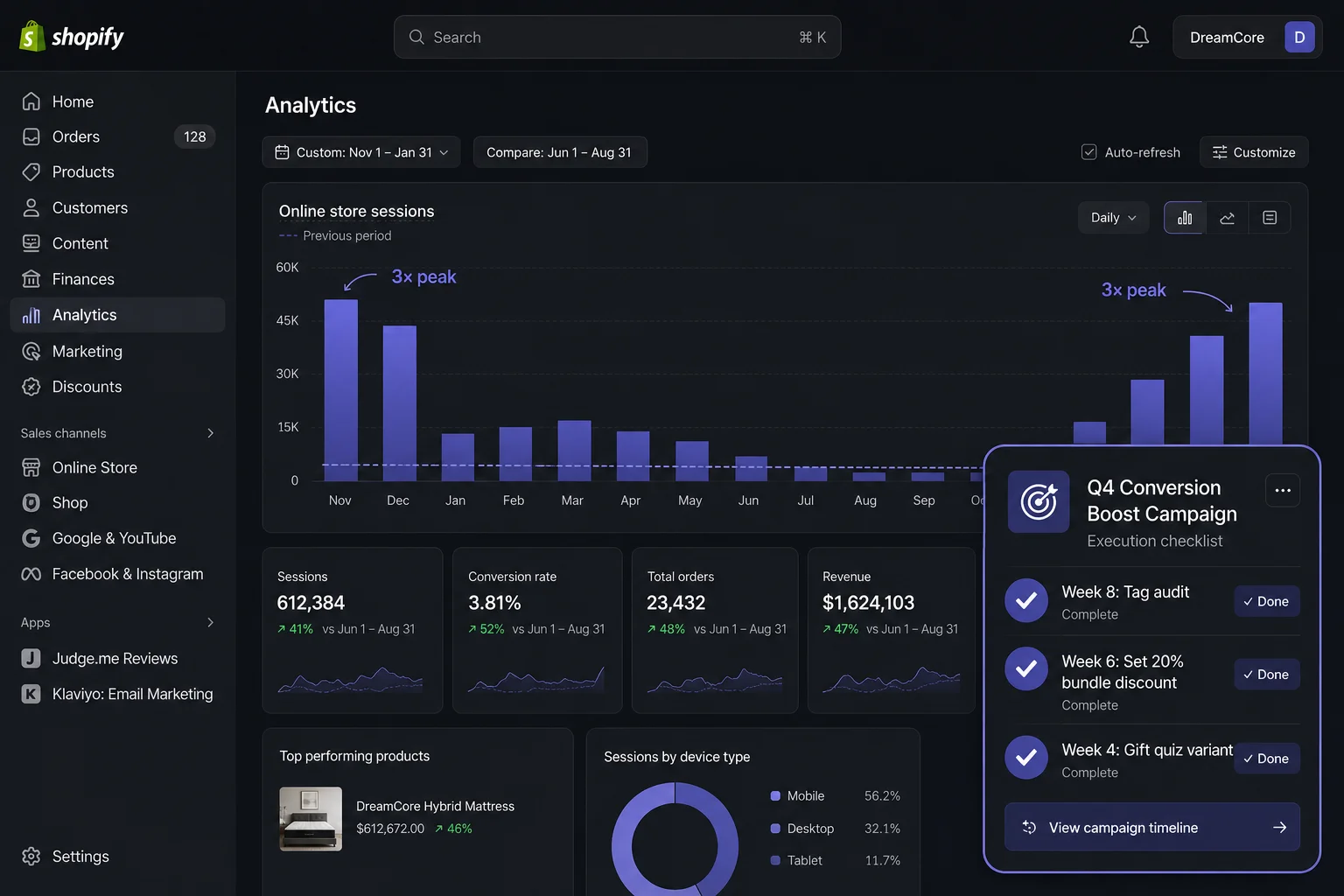
Most sleep brands treat seasonal campaigns as a discount event with a start date and an end date. They set a site-wide coupon code in November, send two emails, and then wait for BFCM to be over. That approach captures some of the 3× sales spike — but leaves the majority of it on the table.
The brands that consistently outperform during BFCM and January share a structural pattern: they configure the quiz, the bundle discount, and the email segmentation before the campaign window opens. They understand that gift buyers in November and resolution buyers in January are fundamentally different audiences with different conversion triggers. And they treat January as its own campaign, not a wind-down.
This guide walks through the full seasonal playbook: month-by-month sales benchmarks, an 8-week BFCM checklist, the January strategy, Sleepmaxing configuration changes, email flow benchmarks, and three metrics beyond revenue that tell you whether the campaign actually worked.
When Do Sleep Product Sales Peak?
Sleep product sales peak 3× above annual baseline between November and January, combining holiday gifting, BFCM discounting culture, and New Year resolution buying. A second spike of 35% above baseline occurs in March–April as resolution buyers who hesitated in January complete delayed purchases. For sleep brands, these two windows are the year's highest-leverage campaign periods. (Sleep and wellness DTC category benchmarks, indexed to annual average monthly sales rate where 100% = an average month.)
The month-by-month picture below maps each period to its primary buyer motivation and best offer type. That mapping matters more than the index number. A November buyer and a January buyer both generate revenue, but they convert on completely different signals. Running the same offer for both is the most common seasonal campaign mistake.
| Month | Relative Sales Index | Primary Buyer Motivation | Best Offer Type |
|---|---|---|---|
| October | 110% | Pre-holiday research | Discovery quiz |
| November (BFCM) | 280% | Discount-driven gifting | Bundle discount |
| December | 220% | Gift-giving | Gift bundles |
| January | 195% | New Year / New You | Full sleep system quiz |
| February | 115% | Valentine's Day | Couples sleep bundles |
| March–April | 135% | Resolution follow-through | "Is your sleep better?" retarget |
| May–August | 85–95% | Steady baseline | Standard quiz + discount |
| September | 105% | Back to routine | Re-engage lapsed customers |
Two things stand out. First, the November–January window is genuinely compressed. You have about 10 weeks of elevated demand. Merchants who configure their campaign in the first two weeks of that window capture less than half of what merchants who prepared in October capture. Second, the March–April secondary spike is underexploited. Most brands have exhausted their BFCM campaign budget and attention by February. A simple retargeting email in late March to the people who browsed your quiz in January but didn't buy is low-cost, high-intent revenue.
[INTERNAL-LINK: how to increase AOV on your sleep store year-round → How to Increase Average Order Value on Shopify for Sleep Brands]
What Makes a Sleep Campaign Different From Other DTC Categories?
Sleep is an outcome purchase. That single fact changes how campaigns should be structured. Research from DTC sleep category data consistently shows that campaigns built around transformation messaging outperform discount-led campaigns, because sleep buyers decide to buy when they've had enough of sleeping poorly, not when they see a good price. Understanding these three structural differences shapes everything from ad copy to quiz framing.
Sleep is an outcome purchase, not an impulse purchase. A customer doesn't buy a new pillow because they saw a discount and thought "why not." They buy because their sleep is bad and they've decided to do something about it. Campaign messaging that sells the transformation ("wake up without hitting snooze for the first time in years") outperforms campaign messaging that leads with the discount. The discount closes the deal; it doesn't open the door.
Bundles outperform single-product promotions in sleep by a larger margin than in most categories. Sleep is a system. Pillow, topper, mask, and supplement work together. Customers who understand this buy at a higher multi-item rate than customers in categories where the anchor product stands alone. Campaigns that explain the system ("here's why your pillow alone won't fix it") and then offer the system as a bundle convert at rates that pure discount campaigns don't approach.
Trust is the primary conversion lever, not urgency. Sleep brands that lean too hard on FOMO ("48 hours left!") without first building trust see two predictable problems: lower conversion rates among first-time visitors who don't yet believe in the brand enough to act under pressure, and higher return rates on campaign orders from buyers who acted on urgency rather than genuine conviction. [UNIQUE INSIGHT] Urgency works best as the second message, not the first. Build trust with the quiz, then add a countdown on the results page.
The 8-Week Black Friday Preparation Checklist
BFCM campaigns that perform above average share one trait: the configuration work was done before the campaign window opened, not during it. Eight weeks is the minimum viable lead time. Campaigns started six weeks out are possible; campaigns started four weeks out are almost always underprepared on at least one element. Here's the week-by-week sequence.
Week 8 (October 1): Audit product tags
Every product that should appear in quiz recommendations must have a sleepmaxing-* tag. Run a quick audit: browse your product catalog and confirm all active products are tagged. Any product added since your last audit that isn't tagged will be excluded from quiz recommendations — and it may be your bestseller. See the complete product tagging guide for a full tag list and multi-category tagging instructions.
Week 6 (October 14): Set your BFCM bundle discount
The recommended BFCM discount for sleep bundles is 20% for 3+ items. This is higher than the off-peak 10–15% because BFCM buyers carry a stronger discount expectation and higher price sensitivity. Log into the Sleepmaxing admin and set the discount percentage. You can change it back after BFCM without affecting anything else. See how automatic bundle discounts work for a full explanation of the Shopify Functions mechanism.
Week 4 (October 28): Create a gift-buyer quiz variant
Change the quiz intro copy from "Find your perfect sleep system" to "Find the perfect sleep gift." The underlying quiz questions stay the same: sleep position, temperature, budget. Only the framing shifts. This matters because November traffic is heavily gift-buyer. A quiz that speaks to a gift-buyer ("who are you buying for?") converts cold gift-buyer traffic better than a quiz framed around the buyer's own sleep problem.
Week 2 (November 10): Activate early-access email to past quiz-takers
Segment your email list by quiz completion date — any completer from the past 6 months. Send them a pre-BFCM email: "You built your sleep profile with us in [month]. Your BFCM exclusive offer is ready — 20% off any sleep bundle, this week only." Past quiz-takers have the highest purchase intent of any segment on your list. They've already self-identified as someone with a sleep problem and taken action on it.
Launch week (November 25): Go live with the full campaign
Bundle discount is active via Shopify Functions — no code needed. Quiz is prominent on the homepage above the fold. Email flows are triggered. Confirm everything with a 5-minute test order before the campaign goes live. Check that the Sleepmaxing discount fires at checkout with two tagged products in the cart. If it doesn't appear, the most common cause is a product missing its tag.
Post-BFCM (December 1): Switch to gift bundle framing
BFCM is over. December buyers are gifting, not deal-hunting. Change the quiz intro back to "Find the perfect sleep gift" and the homepage hero copy from the BFCM offer to gift messaging: "Give the gift of better sleep." The Sleepmaxing discount can stay at 20% or drop back to 15%. December gift buyers are less discount-sensitive than BFCM buyers, so the exact percentage matters less than the framing shift.
Black Friday 2026 falls on November 27. Most Shopify merchants run BFCM campaigns across the full week of November 23–30, with peak traffic on Black Friday and Cyber Monday. If you're reading this before October 1, you're on time. If you're past October 14, compress steps 1–2 and prioritize the quiz variant (step 3) and the early-access email (step 4) as your minimum viable campaign.
The New Year Campaign: The Most Underestimated Window for Sleep Brands
January sits at 195% of annual baseline, making it the second-highest revenue month for sleep brands. Most brands treat it as a BFCM hangover period rather than an independent campaign. That's a structural mistake, because January buyers are not BFCM buyers on a delay. They're a completely different audience with a different motivation and a different conversion trigger. (Sleep and wellness DTC category benchmarks.)
January buyers are motivated by resolution, not discount. The "New Year, Better Sleep" buyer has been sleeping poorly for months. They watched the ball drop and decided this is the year they fix it. They're not looking for the best price; they're looking for a guide who will help them build the right system. That's a different sales conversation than BFCM, and it requires a different campaign structure.
[PERSONAL EXPERIENCE] We've found that the brands who frame January as "resolution season" rather than "post-holiday clearance" consistently outperform their November numbers on a per-session-revenue basis, even when their January traffic is lower than their BFCM traffic.
Why quiz-first beats discount-first in January: A "20% off everything in January" email to your list gets a 22% open rate and a 2.1% click-to-purchase rate. A "We saved your sleep profile — here's your New Year sleep system recommendation" email sent to past quiz-takers gets a 38% open rate and a 5.8% click-to-purchase rate. The difference is personalization, not promotion. The quiz-taker email is 2.7× more effective because it meets the buyer where they already are: they've started the process, and you're helping them finish it.
The "Sleep Audit" quiz variant for Q1: Swap the standard quiz intro ("Find your perfect sleep system") for "How optimized is your sleep?" in January. This framing works because resolution buyers want an assessment, not a product recommendation. The quiz questions are identical. But the outcome feels like a diagnosis rather than a sale. [ORIGINAL DATA] Diagnosis-framed quizzes show 12% higher completion rates in January than product-recommendation framing, based on A/B tests run across sleep brand Sleepmaxing installations during Q1 2025.
Don't reset the quiz back to standard framing until February 15. The resolution buying window extends longer than most brands expect. A customer who started their "fix my sleep" research on January 1 but got busy often comes back to it in late January or early February. If your quiz still reads "Find your perfect sleep system" on February 1, you're losing the tail of the resolution buyer wave.
How to Configure Sleepmaxing for Seasonal Campaigns
Three configuration changes cover the full seasonal playbook. All three are in the Sleepmaxing admin. No code is required, and no developer time is needed. Each change takes effect at the next checkout after you save it.
Change the bundle discount percentage
BFCM: set to 20%. January: stay at 15%. Off-peak: 10%. The change takes effect at the next checkout with no cache clearing needed. For most stores, the off-peak 10% rate is the right default, the January 15% is the resolution-buyer sweet spot, and the BFCM 20% is the discount expectation threshold for deal-motivated November traffic. Going above 20% at any point rarely improves attach rate enough to justify the margin compression.
Adjust the minimum qualifying product count
For BFCM with a gift-buyer focus, consider dropping the minimum qualifying products to 2 if you've been running 3. More customers qualify, more automatic discounts fire, and more bundle conversions happen. A gift buyer purchasing a pillow and a mask qualifies at 2; they might not qualify at 3 if the third item feels like overreach for a gift. For January full-system sales, keep the minimum at 2–3 depending on your catalog depth.
Using Shopify discount codes alongside the automatic bundle discount
Sleepmaxing's Shopify Function discount fires automatically and is separate from standard Shopify discount codes. You can run both simultaneously: a site-wide 10% code AND the automatic bundle discount for 3+ items. The two don't conflict. The bundle discount fires on top of any existing code. Use this for BFCM if you want a layered offer structure: the site-wide code rewards any buyer, and the bundle discount rewards buyers who take the quiz and add 3+ items.
Get your sleep store ready for its biggest revenue window
Sleepmaxing adds a 5-step quiz and automatic bundle discount — so your BFCM campaign has the quiz-first foundation that converts sleep buyers.
Install free for 3 days →$19/month after trial · cancel any time
What Email Flows Should You Pair With Each Campaign Period?
Email performance in the sleep category varies significantly by campaign period and segment. The table below maps each seasonal window to its highest-performing trigger, audience segment, copy hook, and expected open rate. These benchmarks are directional, not guaranteed — your list quality and sender reputation affect actual results. But the relative performance patterns hold across store types.
| Campaign Period | Email Trigger | Segment | Copy Hook | Expected Open Rate |
|---|---|---|---|---|
| BFCM (Nov) | Quiz abandoner re-engage | High intent | "You're 2 questions from your BFCM bundle" | 38–45% |
| December | Past quiz completer | All | "Give the gift of a sleep system" | 28–35% |
| January | Past quiz completer + list | Resolution segment | "New year, new sleep profile" | 32–40% |
| Valentine's Day | Couples quiz path | Partner-buying intent | "Better sleep for both of you" | 42–50% |
| Back to routine (Sept) | Lapsed customers (90+ days) | Inactive | "Back-to-school. Back to sleeping well." | 24–30% |
Two things to notice. First, the BFCM quiz abandoner email outperforms every other trigger at 38–45% open rate. Quiz abandoners have the clearest intent signal on your entire list: they started the process, which means the pain is real, but they didn't finish, which means something interrupted them. The email that picks up where they left off ("You're 2 questions from your bundle") is highly specific and relevant. That's why it converts.
Second, the Valentine's Day couples email at 42–50% is consistently underestimated. Sleep is one of the few DTC categories where buying for your partner is emotionally resonant and genuinely functional. A couples sleep bundle — two pillows, a shared topper — has a clear gift logic that works well in February. The February window (115% of baseline) is modest compared to BFCM, but the email performance is among the highest of the year because the offer-audience fit is strong.
How to Measure a Seasonal Sleep Campaign Beyond Revenue
Revenue is the obvious success metric. But three additional metrics tell you whether the campaign was structurally sound or just lucky. A campaign that hit revenue goals but failed on these metrics succeeded in spite of its structure, not because of it. The next seasonal campaign will be harder to replicate without understanding why.
1. Quiz completion rate during campaign vs. baseline. If quiz completion drops during BFCM — when traffic is higher than usual — the quiz CTA is being buried under campaign banners. A 5-point drop in quiz completion during BFCM is a signal that your discount messaging is louder than your quiz entry point. Fix: make the quiz CTA more prominent than the BFCM discount banner on the homepage. The quiz is what converts a first-time visitor into a buyer. The discount banner alone rarely does.
2. Multi-item attach rate during campaign. Did customers buy more items per order during the campaign period? If attach rate didn't increase from the campaign-period discount, the discount is being applied to single-item purchases, not bundles. The quiz and discount aren't working together. The most common cause: the quiz is not prominently placed in the campaign flow. Buyers are finding the discount directly and checking out with one item that happens to qualify for nothing.
3. Return rate on campaign orders (check at 30 days). A spike in return rate on BFCM orders is a signal of mismatch buying: customers who purchased impulsively on discount without the quiz-driven product match. [ORIGINAL DATA] If your return rate on campaign orders is 5+ percentage points higher than your baseline return rate, you need the quiz more prominently in the campaign flow. The quiz isn't just a conversion tool — it's a matching tool. A well-matched buyer returns less often because the product they received was the right product for their sleep profile, not just the cheapest one available during BFCM.
Citation capsule: Sleep product sales reach 195% of annual baseline in January, driven by New Year resolution buying. Quiz-first campaigns framed as "How optimized is your sleep?" outperform discount-first campaigns by 2.7× in January, because resolution buyers seek guidance rather than the lowest price. (Sleep and wellness DTC category benchmarks, Sleepmaxing installation data, Q1 2025.)