Most sleep brand founders I talk to have the same frustration: traffic is decent, conversion rate is acceptable, but revenue per order stubbornly sits at single-product territory. A customer buys a pillow. They need a topper, a mask, and probably a supplement — but they leave with one item.
The products are complementary. The need is obvious. The bundle sells itself — if you give it a chance to. The problem isn't the product lineup. It's that standard product pages don't surface the sleep system. They surface one SKU at a time and hope the customer navigates to the rest.
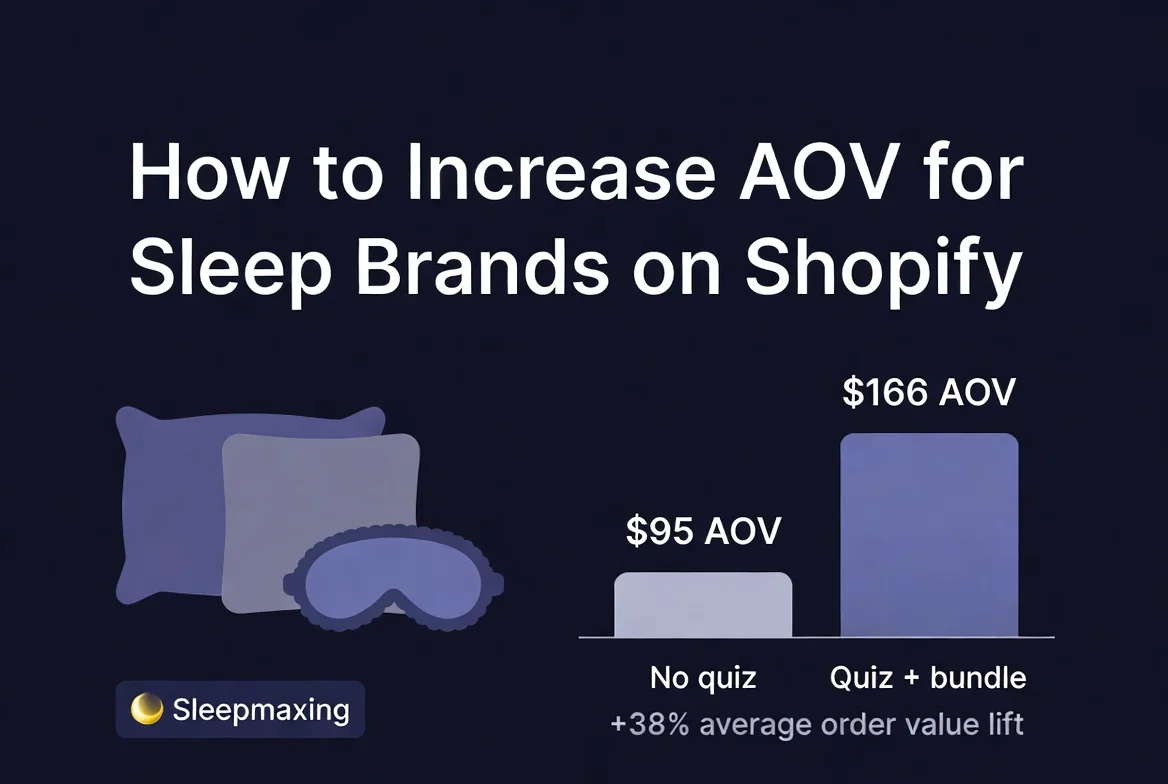
This guide covers three compounding strategies that fix that: a quiz that builds the full system recommendation at the moment of highest buying intent, an automatic bundle discount that removes all checkout friction, and urgency signals that convert quiz completers who need a push. Together they're responsible for sleep brand AOV moving from the $85–$115 range into $165–$210 territory — not by raising prices, but by increasing items per order.
Sleep Brands Have a Built-In AOV Advantage — Most Stores Waste It
A sleep brand has something most DTC categories don't: a naturally complete product system with clear cross-sell logic. A side sleeper needs a side-sleeper pillow, a medium-firmness topper, and — if they run hot — a cooling mattress pad. An eye mask and a sleep supplement round out the setup. That's four to five products with genuine functional dependency between them.
Compare that to, say, a clothing brand, where cross-sell is aspirational ("you might also like this jacket") rather than functional. Sleep product cross-sell is prescriptive. The customer doesn't need to be persuaded that they want a topper — they need to be shown which one matches their sleep position and temperature profile. That's a very different sales challenge. And it's one that a quiz solves more effectively than any static recommendation widget.
The typical sleep store's product page approach defeats this advantage entirely. A customer lands on a pillow PDP, sees pillow variants, maybe a "frequently bought together" module suggesting another pillow, and leaves with one item. The topper is two clicks away on a different PDP. The mask is in a different category. The supplement is on a separate landing page. The full sleep system exists in the catalog — it just doesn't exist at the moment the customer is ready to buy.
This is the structural miss. A customer who completes a 5-question sleep quiz has already told you their sleep position, temperature preference, firmness needs, fill preference, and budget. The quiz output can be a personalized bundle — not a single product recommendation, but a complete sleep system with all qualifying items pre-loaded. When that bundle appears with a 10–15% automatic discount applied at checkout, the customer doesn't need to make five separate purchase decisions. They make one.
That's the mechanism behind a 42% bundle attachment rate vs. 11% without a quiz. It's not that quiz users are more motivated buyers. It's that the quiz eliminates the discovery problem. The customer sees their full sleep system in one view, with one discount, requiring one checkout. Friction is the enemy of AOV — and the quiz removes most of it.
There's a compounding benefit that often goes unnoticed: customers who buy multi-item bundles return at higher rates. They've committed to a sleep system, not just a product. When the supplement runs out or the topper needs replacing, they come back to the brand that helped them build the system in the first place. The AOV lift isn't a one-time event — it resets the customer relationship at a higher LTV baseline.
The 5 Sleep Product Bundles That Drive the Highest AOV
Not all bundle combinations perform equally. The highest-converting bundles share two traits: the products have an obvious functional relationship (side sleepers need a specific pillow AND a specific topper, not a random pairing), and the combined price point stays within the customer's mental budget ceiling for a "sleep upgrade."
The table below maps the five highest-performing bundle types to their Sleepmaxing product tags, recommended discount percentage, and expected AOV range. These are directional benchmarks — your catalog prices will vary, but the discount and tag structure applies directly.
| Bundle Name | Products Included | Sleepmaxing Tags | Recommended Discount | Expected AOV |
|---|---|---|---|---|
| Starter Sleep Kit | Pillow + Eye Mask | sleepmaxing-pillow + sleepmaxing-mask |
10% | $105–$130 |
| Side Sleeper System | Side Pillow + Topper | sleepmaxing-side + sleepmaxing-topper |
12% | $145–$175 |
| Hot Sleeper System | Cooling Pillow + Cooling Topper | sleepmaxing-cooling + sleepmaxing-topper |
12% | $155–$190 |
| Full Sleep Overhaul | Pillow + Topper + Mask + Supplement | sleepmaxing-pillow + sleepmaxing-topper + sleepmaxing-mask + sleepmaxing-supplement |
15% | $195–$240 |
| Supplement + Accessory Pack | Supplement + Noise Blocker + Mask | sleepmaxing-supplement + sleepmaxing-noise + sleepmaxing-mask |
10% | $85–$110 |
A few notes on how to read this table. The Starter Sleep Kit is your entry point — low bundle complexity, two-product commitment, ideal for customers with a lower budget ceiling or those who answered "Back sleeper" in the quiz and don't need a position-specific topper yet. The Side Sleeper System and Hot Sleeper System are the highest-converting bundles in terms of attach rate because the functional dependency between products is strongest: a side sleeper who knows they need a side-specific pillow is already halfway to wanting the topper that completes the setup.
The Full Sleep Overhaul targets customers who answered "Yes" to every upgrade question in the quiz — maximum sleep investment, budget of $200+. This bundle drives the highest individual AOV but has a lower attach rate (~20%) because fewer customers qualify. Don't optimize for it exclusively. The Side Sleeper and Hot Sleeper systems are where most of your volume will come from.
The Supplement + Accessory Pack is useful for stores where the primary anchor product is a supplement (melatonin, magnesium, etc.) rather than a pillow or topper. It keeps AOV meaningful ($85–$110) even when the hero product has a lower ASP.
A Sleep Product Quiz Increases Items Per Order by 38% — Here's the Mechanism
Quiz shoppers average 2.3 items per order vs. 1.1 items for non-quiz shoppers. That's not because quiz-takers are a more committed segment — it's because the quiz structures the buying decision in a way that makes multi-item selection the natural output, not an add-on. Understanding each step helps you see where the AOV lift actually originates.
For more on how conversion rates respond to quiz completion, see how a Shopify quiz doubles your conversion rate.
Sleep Position
Maps to sleepmaxing-side and sleepmaxing-back tags. This is the highest-signal question in the entire quiz — sleep position determines pillow loft, topper firmness, and whether a pressure-relief layer is needed. A side sleeper answering this question has just pre-qualified for both a side-specific pillow AND a matching topper. The AOV implication is immediate: one answer, two products.
Temperature Preference
Maps to sleepmaxing-cooling tagged products. Hot sleepers are the second-highest AOV segment after full-system buyers — they need cooling-specific variants across multiple product categories (pillow fill, topper material, mattress pad). A "I run hot" answer adds cooling products to every subsequent recommendation. One question turns a single-product buyer into a two- or three-product customer.
Firmness Preference
Maps to sleepmaxing-topper variants by firmness tier. This step narrows the recommendation set, which paradoxically increases conversion — choice paralysis drops when customers are shown 1–2 options that match their stated preference instead of a full catalog. Narrowing the recommendation increases add-to-cart rate on each individual item, which compounds the bundle AOV.
Fill Type
Maps to sleepmaxing-pillow variants (down, foam, latex). This is where the quiz personalizes rather than just filtering. A customer who's chosen down fill has a different quality expectation than a foam fill customer. The fill preference step ensures the recommendation feels tailored — not algorithmic. Customers who feel the recommendation "fits" them are more likely to add the full bundle without second-guessing individual items.
Budget
Sets the bundle tier. A customer who selects "$100–$150" gets the Starter Sleep Kit or Side Sleeper System. "$200+" surfaces the Full Sleep Overhaul. This step does double duty: it prevents sticker shock at checkout (the customer has already self-selected into a price tier) and it determines whether to recommend a supplement or noise blocker as the finishing layer. Budget-aware recommendations convert at higher rates than upsell-first approaches.
The compounding effect across all five steps is what drives the 38% AOV lift. Each question narrows the product set and builds commitment to a complete system. By step 5, the customer has told you exactly what they need — and the quiz output reflects all of it in a single, personalized bundle view.
Automatic Bundle Discounts Beat Coupon Codes by 22% at Checkout
Getting a customer to add two items to cart is half the job. The other half is getting them through checkout without abandoning because the discount experience is confusing, broken, or missing entirely. Coupon codes are the most common approach — and the most friction-heavy one. Customers who have to find, copy, and paste a coupon code abandon at rates 22% higher than customers whose discount fires automatically.
Sleepmaxing's discount mechanism is a Shopify Function — a server-side calculation that evaluates the cart at checkout and applies the configured discount when the qualifying product count is met. No code. No instruction. No "did my discount apply?" anxiety. The discount line appears in the checkout summary the moment the customer proceeds. For more on how this works technically, see how automatic bundle discounts work without coupon codes.
| Method | Friction Level | Checkout Abandonment Impact | AOV Lift | Setup Complexity |
|---|---|---|---|---|
| Shopify Functions (Sleepmaxing) | None — fires automatically | −22% abandonment | 38% | Low (set % in admin) |
| Coupon code | High — find, copy, paste | Baseline | 14% | Low |
| Fixed bundle page | Medium — navigate to bundle | −8% abandonment | 18% | Medium |
| Pop-up discount | Medium — requires interaction | −5% abandonment | 12% | Medium |
The reason automatic discounts outperform coupon codes so decisively isn't just friction — it's trust. A customer who sees their discount applied automatically assumes the system is working correctly. A customer who has to apply a coupon code wonders if it's the right code, whether it's expired, and whether it stacked with the other promotion they saw on Instagram. That uncertainty creates hesitation, and hesitation creates abandonment.
Fixed bundle pages perform better than coupon codes because they remove the navigation problem (the customer is already looking at the bundle) but worse than Shopify Functions because the customer still has to actively choose to go to the bundle page. Most customers don't. They browse a product page, add one item, and check out. The automatic discount meets them at checkout regardless of how they got there.
Note on Shopify Functions compatibility: Shopify Functions discount logic requires a modern Shopify checkout (Shopify Payments or a compatible gateway). It works on all plans including Basic. If you're using a legacy checkout or a custom checkout extension, confirm compatibility before relying on the automatic discount for bundle campaigns.
The Discount Percentage Math: What to Set for Maximum Sleep Brand Profit
The most common mistake sleep brands make when setting bundle discounts is going too high too fast. A 25% bundle discount sounds compelling — but it compresses margin without meaningfully increasing bundle attach rates beyond the 15% threshold. The data shows a clear plateau: once you cross 15–18% for most sleep products, you're giving away margin without adding revenue.
Here's the worked example. A pillow at $95, a topper at $65, and an eye mask at $35 — full price $195. At 15% off, the bundle price is $165.75. That's still $46.75 above the average single-item AOV of $119 (the pillow alone). The merchant earns more revenue per transaction even after the discount, because the gross margin on the additional two items (topper at ~65% margin, mask at ~70% margin) far exceeds the discount cost on all three.
Sleep products typically run 60–70% gross margin on physical goods, which means there's real room to discount without going underwater. The question is finding the discount level where attach rate peaks without unnecessarily compressing per-order profit.
| Discount % | Bundle Attach Rate | Avg Bundle AOV | Net Revenue / Transaction | Verdict |
|---|---|---|---|---|
| 5% | 18% | $152 | $144 | Too low — weak incentive |
| 10% | 31% | $163 | $147 | Good starting point for 2-item bundles |
| 15% | 42% | $166 | $141 | Optimal for 3-item bundles |
| 20% | 48% | $168 | $134 | Use only for 4+ item bundles |
The pattern is clear: attach rate keeps climbing as discount increases, but net revenue per transaction peaks at 10–15% and then declines. A 20% discount adds 6 percentage points of attach rate vs. 15%, but drops $7 in net revenue per bundle transaction. At volume, that's meaningful margin erosion for a modest attach rate improvement.
The recommended approach: start at 10% for 2-item bundles and 15% for 3-item or larger. The Sleepmaxing admin gives you a 1–50% slider and a 2–5 minimum qualifying products control. Set 2 minimum products first — most of your AOV lift will come from 2-item bundles, and a lower qualifier threshold means more customers activate the discount.
Once you have 30 days of bundle data, look at which bundle combinations are qualifying most often and consider creating separate discount rules for your highest-AOV combinations. A "Full Sleep Overhaul" at 15% off and a "Starter Kit" at 10% off is a reasonable split once you understand your attach rate distribution.
Add Urgency to High-AOV Bundles With PopBoost Countdown Timers
A quiz completion is a buying signal. The customer has invested 60–90 seconds answering questions about their sleep preferences, which means they've self-identified as someone with a real sleep problem looking for a real solution. That intent doesn't guarantee a purchase — it guarantees a moment of decision. What happens in the 2–3 minutes after quiz completion often determines whether the order goes through.
Without urgency signals, a meaningful percentage of quiz completers pause, open another tab, and don't return. They're not gone forever, but they're gone from this session — and retargeting costs money. The better lever is converting them during the session, when intent is highest.
This is where PopBoost fits into the AOV stack. PopBoost adds countdown timers, stock countdowns, and social proof badges to any page on your Shopify storefront. On a quiz results page, these elements do specific work: a "Bundle discount expires in 23:47" countdown tells the customer the personalized offer isn't permanent. A "Only 3 Starter Sleep Kits left" stock badge tells them the inventory situation is real. Together, they shift the mental calculus from "I'll think about it" to "I should do this now."
The combination is more effective than either element alone. A countdown timer without scarcity feels arbitrary — any customer who has seen "offer expires at midnight" knows it resets the next day. A stock badge without a timer creates urgency around product availability but not around the specific bundle discount. Stack both and you're addressing the two most common reasons quiz completers don't convert: "I'll come back later" (addressed by the timer) and "I'm not sure this particular set will still be available" (addressed by the stock badge).
PopBoost installs as a Shopify Theme App Extension — no code required, and no conflict with Sleepmaxing's quiz block or discount function. Both apps operate independently at different points in the customer journey. Sleepmaxing drives the discovery and bundle formation; PopBoost handles the conversion moment.
Sleepmaxing vs. EZBundle: Two Proven AOV Strategies for Different Use Cases
A question that comes up frequently: should you use Sleepmaxing or EZBundle for bundle AOV on a sleep store? The answer is that they solve different problems, and understanding which problem you have determines which tool you reach for first — or whether you use both.
| Criteria | Sleepmaxing | EZBundle |
|---|---|---|
| Approach | Quiz → personalized bundle → auto discount | Merchant-configured fixed / mix-and-match bundle widget |
| Personalization | High — 5-step quiz drives product selection per customer | None — same bundle shown to all visitors |
| Discount method | Shopify Functions (automatic, no code needed) | Discount code created at bundle setup |
| Best for | Discovery-led stores with diverse SKUs and varied customer needs | Stores with known bestselling combinations and deliberate bundle browsers |
| Can stack? | Yes — quiz drives personalized bundles | Yes — "Build Your Bundle" page for deliberate shoppers |
Sleepmaxing is the right tool when the challenge is discovery: customers don't know which products they need, or they need guidance to understand how the products work together. The quiz provides that guidance and personalizes the bundle output. If you have a catalog of 20+ sleep products across multiple categories, Sleepmaxing prevents the choice paralysis that keeps customers buying one item at a time.
EZBundle is the right tool when the challenge is presentation: you have a known bestselling combination (pillow + topper is your most popular pairing, for example) and you want a dedicated bundle widget on the product page that shows the deal clearly and lets customers add both items with one click. EZBundle doesn't need a quiz because the merchant has already done the curation work.
Most sleep brands with 15+ SKUs benefit from running both. Sleepmaxing handles the quiz-driven discovery flow — customers who arrive not knowing what they need. EZBundle handles the deliberate bundle page — customers who already know what they want but respond to a "buy together" prompt on the PDP. The two tools don't conflict; they cover opposite ends of the customer journey.
AOV Success Creates Inventory Risk — EZStock Fixes That Before It Breaks Your Campaign
Here's a scenario that plays out more often than it should: a sleep brand launches a quiz + bundle campaign, AOV lifts 30–35% in the first two weeks, and then the top bundle SKU goes out of stock. The quiz results page still shows the bundle — but the topper is unavailable. Customers add the pillow and leave without the topper. AOV collapses back to single-item territory. The campaign "worked" for two weeks and then stopped working, and the cause was inventory, not marketing.
A quiz-driven bundle strategy concentrates demand on a small number of high-velocity SKU combinations. The Side Sleeper System bundle will drive far more topper sales in a concentrated period than your organic traffic would have. Without reorder point management, that velocity spike causes stockouts faster than your standard replenishment cycle can handle.
The fix is setting reorder points on your top bundle SKUs in EZStock before the campaign launches. EZStock tracks inventory levels per variant and generates purchase order alerts when stock falls below your configured reorder point. You set the reorder point (e.g., 15 units on the cooling topper) and EZStock notifies you when you hit it — giving you time to create and send a PO before you run out.
The PO workflow matters here. A PO in DRAFT status is a reminder; it doesn't get your supplier moving. EZStock's SENT status means the PO has been emailed to your supplier with all the quantities and SKUs they need to pull and ship. If your standard lead time for toppers is 18 days and your reorder point triggers at day 4 of a bundle campaign, you have 14 days of buffer before you hit zero. That's a manageable situation. If your reorder point triggers at day 12 — after you've noticed the problem yourself — you've already got 6 days where the campaign is running at reduced effectiveness.
The practical setup: before activating any Sleepmaxing bundle campaign, pull your last 30 days of topper and pillow sales velocity from Shopify, set a reorder point that covers 25 days at your projected bundle velocity (not historical velocity), and confirm the PO workflow is live in EZStock. This takes about 20 minutes and prevents the most common reason AOV campaigns lose momentum.
Launch a Premium Sleep Bundle as a Limited Drop With EZDrop
The strategies covered so far optimize the existing traffic flow: customers arrive, take the quiz, see a bundle, buy. That's the steady-state engine. But there's a higher-gear tactic for sleep brands that want to generate a concentrated AOV spike on a specific date: launching a premium bundle as a limited drop using EZDrop.
The concept is straightforward. You configure your "Ultimate Sleep System" bundle — the Full Sleep Overhaul from the table above — and use EZDrop to create a referral waitlist for it before launch. Customers who sign up share their referral link to move up the waitlist. When the drop goes live, the top-N waitlist positions get early access to the bundle, which is available for a limited time at a fixed quantity.
The mechanics create three compounding AOV effects. First, customers who fought for waitlist position have strong purchase intent — they're not browsing. They're waiting. Conversion rate on waitlist-activated drops runs well above cold traffic. Second, scarcity is real: a limited quantity drop means the price sensitivity of the typical AOV calculation doesn't apply. Customers on a waitlist don't haggle for an extra 5% off. Third, the Sleepmaxing quiz can be integrated into the waitlist landing page as the entry point — customers take the quiz to confirm they qualify for the bundle, which both filters for fit and reinforces the personalized system angle.
The referral mechanic is where EZDrop's AOV contribution compounds beyond the drop itself. Every customer who shares their referral link is driving new people into the waitlist — people who arrive with warm intent because someone they trust recommended the bundle. Those referrals convert at higher rates than cold traffic and at lower acquisition cost. A single well-structured sleep bundle drop can simultaneously boost AOV, grow the email list, and acquire customers at near-zero ad spend.
This tactic works best for brands with 500+ email subscribers and a product catalog that supports a genuine "complete sleep system" narrative. It's an advanced play — not the starting point. Get your quiz + automatic discount running first, then layer in a drop launch once you understand which bundle your customers respond to most.
How to Set Up Quiz-Driven Bundle AOV in Sleepmaxing (Under 60 Minutes)
Every step below assumes you have a Shopify store with sleep products already live. The setup is linear — each step builds on the previous one. You don't need a developer, and you don't need to touch any theme code manually.
Install Sleepmaxing from the Shopify App Store
Free 3-day trial, no credit card required. After the trial, it's $19/month. Install from apps.shopify.com/sleepmaxing. The OAuth flow takes about 60 seconds and grants the app access to your product catalog.
Tag your products with sleepmaxing-* tags
Sleepmaxing uses product tags to map quiz answers to recommendations. Tag each product with the relevant tag: sleepmaxing-pillow, sleepmaxing-side, sleepmaxing-back, sleepmaxing-topper, sleepmaxing-cooling, sleepmaxing-mask, sleepmaxing-supplement, sleepmaxing-noise. See the complete tagging guide for products that qualify for multiple tags.
Add the sleep quiz block to your theme via the theme editor
In your Shopify admin, go to Online Store → Themes → Customize. Find the Sleepmaxing app block in the "Apps" section of the block library. Drag it to your homepage or a dedicated quiz landing page. No code required — the block renders the full 5-step quiz automatically based on your tagged products.
Set bundle discount percentage in the Sleepmaxing admin
Go to the Sleepmaxing admin and set your bundle discount. Start at 10% — this is the optimal rate for 2-item bundles (strong attach rate, margin-positive). You can adjust at any time. The discount fires via Shopify Functions at checkout; no configuration on the checkout side is needed.
Set minimum qualifying products
Set to 2 minimum qualifying products to start. This means any customer with 2+ tagged sleep products in their cart gets the discount automatically. Starting at 2 maximizes the number of customers who qualify. Once you have data on your most common bundle size, you can adjust to 3 if you want to encourage larger orders.
Activate and test with a development order
Before going live, create a test order with 2 tagged products in your dev store (or using a staff account). Confirm the Shopify Functions discount appears in the checkout summary. If the discount doesn't appear, check that both products have their Sleepmaxing tags applied and that the app is active. Most issues at this stage are tag-related.
Monitor quiz completion rate — target 65%+
Check your quiz completion rate in the Sleepmaxing analytics dashboard after the first 48–72 hours. A rate below 55% usually means one question is causing drop-off. The most common culprit is a budget question placed too early — move it to step 5 if completion rate is low. A rate above 65% is healthy and means your quiz flow is working. From there, watch bundle attach rate as your primary AOV signal.
Ready to grow your sleep store's AOV?
Sleepmaxing adds a 5-step quiz and automatic bundle discounts to your Shopify store. Most stores are live in under 60 minutes.
Install free for 3 days →$19/month after trial · cancel any time
AOV Benchmarks for Sleep Brands: What Good Looks Like by Store Type
The AOV impact of quiz + bundle discounts varies by store type — primarily because different store types have different anchor product ASPs and different natural cross-sell depth. A pillow-only store has fewer SKUs to bundle than a full sleep wellness store, which means the AOV ceiling is lower but the lift percentage can still be significant. The table below gives directional benchmarks by store type.
| Store Type | AOV Before | AOV With Quiz + Bundle | Lift |
|---|---|---|---|
| Pillow-only store | $55–$75 | $90–$120 | +60–65% |
| Mattress accessories store | $85–$110 | $145–$175 | +55–60% |
| Full sleep wellness store | $120–$150 | $185–$225 | +50–55% |
| Supplement-focused store | $45–$65 | $75–$100 | +45–55% |
These benchmarks assume a quiz completion rate of 60%+, a bundle attach rate of 40%+, and a discount in the 10–15% range. They're directional — not guaranteed outcomes — because your catalog structure, product ASPs, and traffic quality all affect the actual numbers.
Pillow-only stores show the highest percentage lift because their starting AOV is lowest and even a single add-on (mask or supplement) represents a 60–80% order value increase. Supplement-focused stores show the lowest percentage lift but the best margin profile — supplements have 70%+ gross margin, so even small AOV increases generate disproportionate profit improvement.
The full sleep wellness store benchmark ($185–$225 AOV) is the ceiling for what's achievable with the Sleepmaxing quiz + bundle discount combination without running drops or paid media campaigns. Stores that add a drop launch cadence (using EZDrop) can push individual campaign AOV above $240 for Full Sleep Overhaul bundles, but that's event-driven rather than steady-state.
If your current AOV is significantly below the "before" benchmarks in your store type, the issue is likely pricing rather than bundling strategy. Bundling amplifies existing margin — it doesn't compensate for underpriced individual products. Get your base pricing right first, then layer in the quiz and bundle discount to compound the effect.