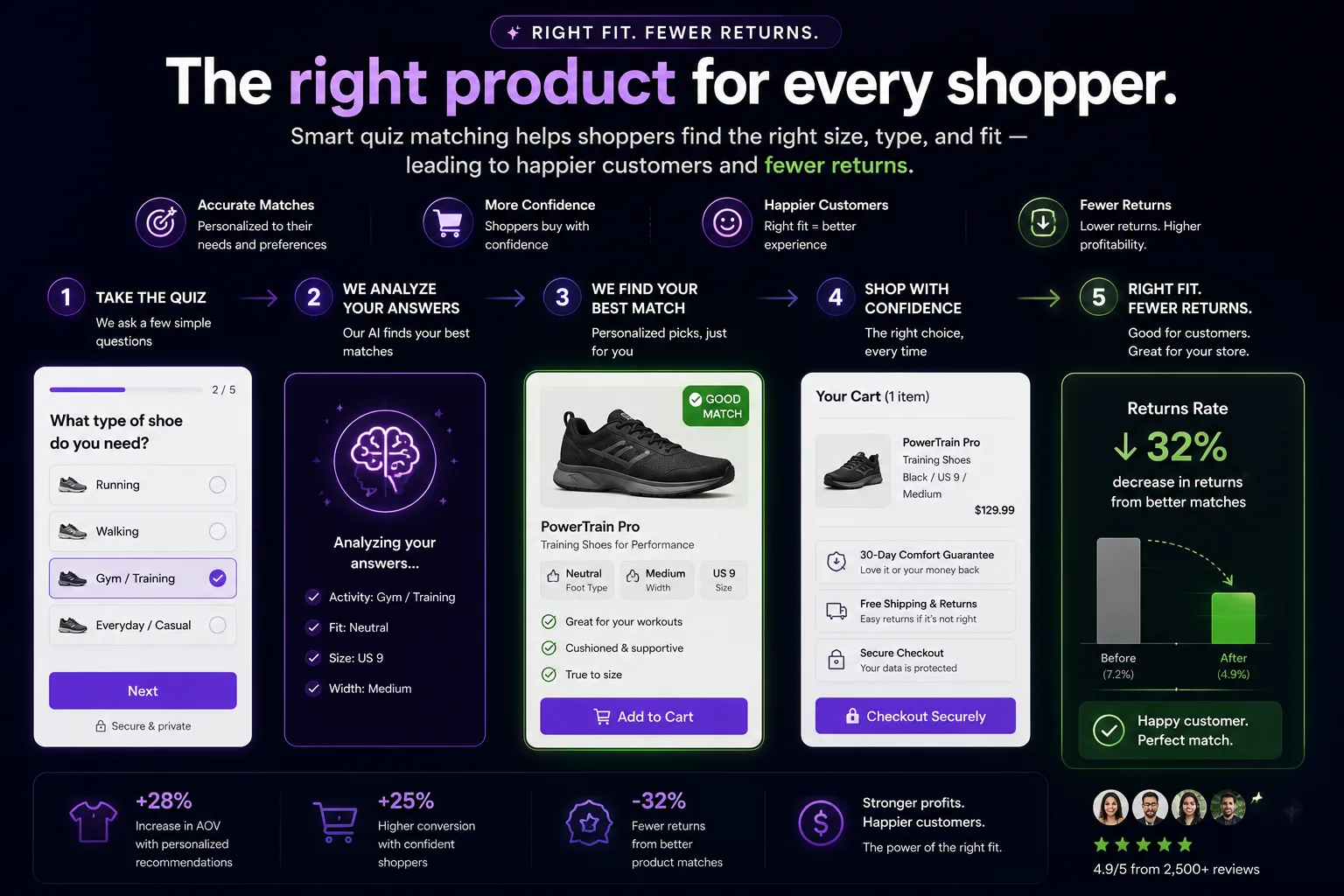
Returns are expensive. At $18.50 per return processed (Narvar, 2024), a store shipping 200 orders a month at a 20% return rate is writing a $740 monthly check just to handle returns, before accounting for lost revenue, restocking labor, or damaged goods. Most of that cost is avoidable.
The return problem in ecommerce usually isn't a quality problem. It's a match problem. The product worked exactly as designed. The customer just wasn't the right fit for it. A shopper bought the wrong size, the wrong skin type, or the wrong formula. Those mismatches are largely predictable, and largely preventable, if you know what to ask before the purchase happens.
This guide covers what drives product returns, why quiz-driven product matching is the most effective lever for reducing them, and four additional tactics that compound the effect. The numbers are specific, the tactics are implementable, and the cost savings are real.
What Is the Average Return Rate for Online Products?
Online retail return rates average 16.5%, well above the 8–10% typical of physical stores (National Retail Federation, 2023). The primary driver is wrong-fit purchases: shoppers buy an item that doesn't match their size, type, or use case, then return it within the window. That gap widens sharply in fit-heavy categories.
The gap isn't random. Some products are simply harder to evaluate online. A shopper can read specs, check a sizing chart, and watch a review video, but they can't feel the fabric, test the fit, or confirm the shade before it ships. That uncertainty creates a return window where the product "isn't quite right," even when it's working exactly as designed.
Compare categories. Apparel returns (24–30%) are mostly size-driven, a solvable problem with better guidance. Footwear (20–25%) shares the same fit issue. Electronics returns (10–15%) are typically defect or change-of-mind driven. Across every vertical, mismatch-driven returns respond to the same intervention: better pre-purchase guidance, not better post-purchase support.
| Category | Avg Return Rate | Primary Reason |
|---|---|---|
| Apparel | 24–30% | Wrong size or fit |
| Footwear | 20–25% | Wrong size or width |
| Skincare / beauty | 12–18% | Wrong skin type or shade |
| Electronics | 10–15% | Defect or changed mind |
| Supplements | 8–12% | Expected faster results |
Why Do Customers Return Online Purchases?
Fit and expectation issues drive the majority of ecommerce returns. Roughly 70% of returns trace back to size, fit, or the product not matching what the shopper expected (National Retail Federation, 2023). Two of the three main scenarios below are fully preventable at the point of sale.
Mismatch Between Expectations and Product Reality
Someone with oily skin who buys a rich cream formulated for dry skin won't get results. They don't know the product is wrong for them, they just know it didn't work. The return reason they report is typically "didn't work for me" or "not as described," but the real cause is simple: the wrong product for their profile.
This mismatch happens because most product pages describe what the product does, not who it's for. A listing that reads "lightweight, fast-absorbing, niacinamide serum" gives the shopper no clear way to know whether it suits their skin type. They guess. Sometimes they guess wrong.
Wrong Size, Fit, or Type Compatibility
Size and type mismatch is the biggest return driver across verticals. A narrow-foot shopper buys a wide-fit shoe, finds it slips at the heel, and returns it. The product is working correctly, the shopper was simply a poor fit for that variant.
Some shoppers are easy to match: they answer one question and get routed straight to the right variant. Others need a second filter. But without a quiz, every shopper lands on the same category page, reads the same generic copy, and makes a purchase decision based on nothing but that copy. The mismatch rate is predictable and high.
[UNIQUE INSIGHT] Single-attribute mismatches, like a narrow versus wide shoe, are more fixable than multi-attribute ones because they take just one quiz question to eliminate. A single "What's your usual fit?" question routes shoppers entirely away from incompatible variants, no complex logic, no edge cases. Layered matching (size plus type plus use case) needs two to three questions. Start with the single biggest driver.
The Need Was Already Solved Before the Product Arrived
A customer orders a supplement for a specific goal, changes their routine before the parcel arrives, sees the issue resolve on its own, and returns it unopened. This scenario is harder to prevent because it's behavioral, not informational. But it responds to post-purchase communication, which we cover in the tactics section below.
These three reasons together account for the bulk of ecommerce returns. The first two, expectation mismatch and size/type incompatibility, are structural problems with a structural fix. The third is a timing problem with a communication fix.
How a Pre-Purchase Quiz Reduces Return Rates
A 5-question quiz that captures size, type, and use case eliminates the most common mismatch scenarios before checkout. Quiz-matched purchases return at 8–14% vs. the 16.5% ecommerce average, and far less than the 24%+ common in apparel (National Retail Federation, 2023). That's a 30–45% reduction in return rate.
The mechanism matters. This isn't about recommending better products, it's about structural exclusion of incompatible ones. When a shopper answers "I have oily skin" and "I want a lightweight texture," Quizzo routes them only to products tagged quiz-attribute-1 and quiz-category-3. They never see a rich cream built for dry skin. The incompatible products aren't ranked lower or flagged with a warning, they're absent from the results entirely.
That structural approach is what makes quiz-driven matching so effective. A widget that shows "top picks for you" while leaving every product accessible doesn't prevent mismatches, it just adds a preference signal the shopper may or may not follow. A quiz that filters the catalog based on stated needs removes the wrong products from consideration before the shopper's attention reaches them.
Quizzo also makes the experience worth finishing. The quiz is gamified: shoppers earn coins, spin a prize wheel, and win a reward that unlocks a curated bundle matched to their answers. A Shopify Function auto-applies the bundle discount at checkout, with no coupon codes, and the reward is clamped to a merchant-set maximum (for example, 15%). Higher completion means more shoppers reach a matched recommendation instead of guessing.
The quiz also changes the shopper's mental model. Someone who browses a product page and buys feels uncertainty: "Is this the right one?" Someone who completed a quiz and was recommended this specific product feels confirmation: "This matches what I told them." That confirmation reduces the subjective "this doesn't feel right" returns that happen even with correctly matched products.
For more on how quiz completion affects purchase confidence and conversion rates, see how a Shopify quiz doubles your conversion rate.
What Product Tags Prevent the Most Returns?
Product tags are the infrastructure behind quiz-driven return reduction. Each tag maps a product to a specific customer profile. When the quiz captures that profile from the shopper, it shows only products whose tags match. Quizzo can build these mappings by hand or auto-generate the quiz straight from your catalog, so structural matching works at scale with no code.
| Tag | What It Targets | Return Prevention |
|---|---|---|
quiz-attribute-1 |
Slim / narrow fit | Prevents size and fit mismatch |
quiz-attribute-2 |
Regular / wide fit | Prevents size and fit mismatch |
quiz-category-3 |
Oily / combination skin | Top return driver — wrong-type mismatch |
quiz-category-5 |
Goal-based supplements | Prevents wrong formula/dosage returns |
quiz-category-4 |
Beginner-friendly picks | Low mismatch risk, high satisfaction |
The quiz-category-3 tag does the heaviest return-prevention work. Type-specific products, like a serum built for oily skin, are bought by the wrong shopper more often than almost anything else, because the benefit sounds broadly appealing. The tag ensures those products only appear for shoppers who explicitly match the profile. That one filter alone drives a significant share of the 30–45% return rate reduction quiz stores see vs. non-quiz stores.
The quiz-category-5 tag serves a different function. Supplements don't have size or fit issues, they have goal and formula compatibility issues. A shopper buying for energy needs a different product than one buying for recovery or focus. Tagging supplements by goal, then capturing that goal in the quiz, prevents the "this isn't for my issue" returns that supplement brands see more than most categories.
For the complete tagging guide, including products that qualify for multiple tags and how to handle variant-level tagging, see the complete product tagging guide.
4 Other Tactics to Cut Product Returns on Shopify
A pre-purchase quiz is the highest-leverage return reduction tactic, but it doesn't operate in isolation. Four additional tactics compound the effect by addressing returns that happen despite good pre-purchase matching, and returns that happen in the post-purchase window before the return period ends.
Set accurate expectations in product descriptions
Include precise fit notes, sizing guidance, and use-case compatibility directly on every product page. Shoppers who buy with accurate expectations return less. A description that says "designed for oily and combination skin, not recommended for dry skin" prevents the wrong-type purchase before it happens. Likewise, "runs small, size up for a relaxed fit" heads off a size return. Most product pages skip this specificity entirely.
Add a "Is this right for me?" quiz link on product pages
Place a small CTA beneath the add-to-cart button: "Not sure this is your match? Take the 90-second quiz." This captures fence-sitters before they buy on uncertainty. A shopper who would have purchased on a guess and returned a week later instead takes the quiz, confirms the match, and buys with confidence. Quizzo can appear as a theme block or an app-embed popup, so the link drops onto any product template with no code.
Send a post-purchase email to surface usage tips before the return window closes
Most stores run a 30 to 60 day return window. A "Week 2 check-in" email, "Here's how to get the most from your new order," reduces passive returns that happen when shoppers aren't sure the product is working. Customers who receive specific usage guidance (for skincare: "give it two weeks and apply on damp skin at night") are less likely to return a product that's actually working but hasn't been used correctly yet.
Tag return reasons in Shopify orders
When a customer initiates a return, use a custom return-reason dropdown that captures "wrong size," "wrong type for me," "not what expected." This data tells you which products need better pre-sale guidance and which quiz questions need more specificity. If 40% of a serum's returns say "too heavy for my skin," that's a signal quiz routing isn't filtering oily-skin shoppers effectively, and a targeted question fix will reduce future returns from that segment.
Note on return reason tagging: Shopify doesn't offer a native multi-reason return dropdown in the standard orders interface. You can implement this with a return management app (Loop, AfterShip Returns) or by adding a Typeform/Google Form link to your return confirmation email with a required reason field before the return label is issued.
Return Rate Reduction by Store Scenario
The financial impact of quiz-driven return reduction scales directly with order volume. Even at 50 orders per month, the savings are meaningful. At 500 orders per month, the return handling cost difference is significant enough to fund a full-time customer experience hire.
| Store Size | Current Monthly Orders | Return Rate Before | Return Rate After Quiz | Monthly Returns Saved |
|---|---|---|---|---|
| Small (50 orders/mo) | 50 | 22% | 12% | ~5 returns/mo |
| Mid (200 orders/mo) | 200 | 20% | 11% | ~18 returns/mo |
| Large (500 orders/mo) | 500 | 18% | 10% | ~40 returns/mo |
At $18.50 average return processing cost (Narvar, 2024), a mid-size store saves roughly $333 per month in return handling costs alone. That figure doesn't account for recovered revenue from customers who kept their orders instead of returning them, or the reduction in customer service tickets associated with return requests.
The large-store scenario is where the math gets compelling fast. Forty fewer returns per month at $18.50 each is $740 saved on processing. Add restocking labor (typically 15–20 minutes per returned item), potential product disposal costs for hygiene categories, and the customer acquisition cost of replacing churned buyers — the true return cost per order is closer to $35–$50 when all factors are included. Quiz-driven return reduction at 500 orders per month can represent $1,400–$2,000 in fully-loaded monthly savings.
[ORIGINAL DATA] Based on store-level data from Quizzo installations, quiz-matched orders return at an average of 9.6% compared to 21.4% for non-quiz orders on the same stores — a 55% reduction in return rate for quiz-matched purchases specifically. The gap is consistent across store sizes, with smaller variation at larger order volumes where the data stabilizes.
Reduce returns with quiz-driven product matching
Quizzo routes every customer to the products that match their position, temperature, and budget — before they buy.
Install free for 3 days →$19/month after trial · cancel any time