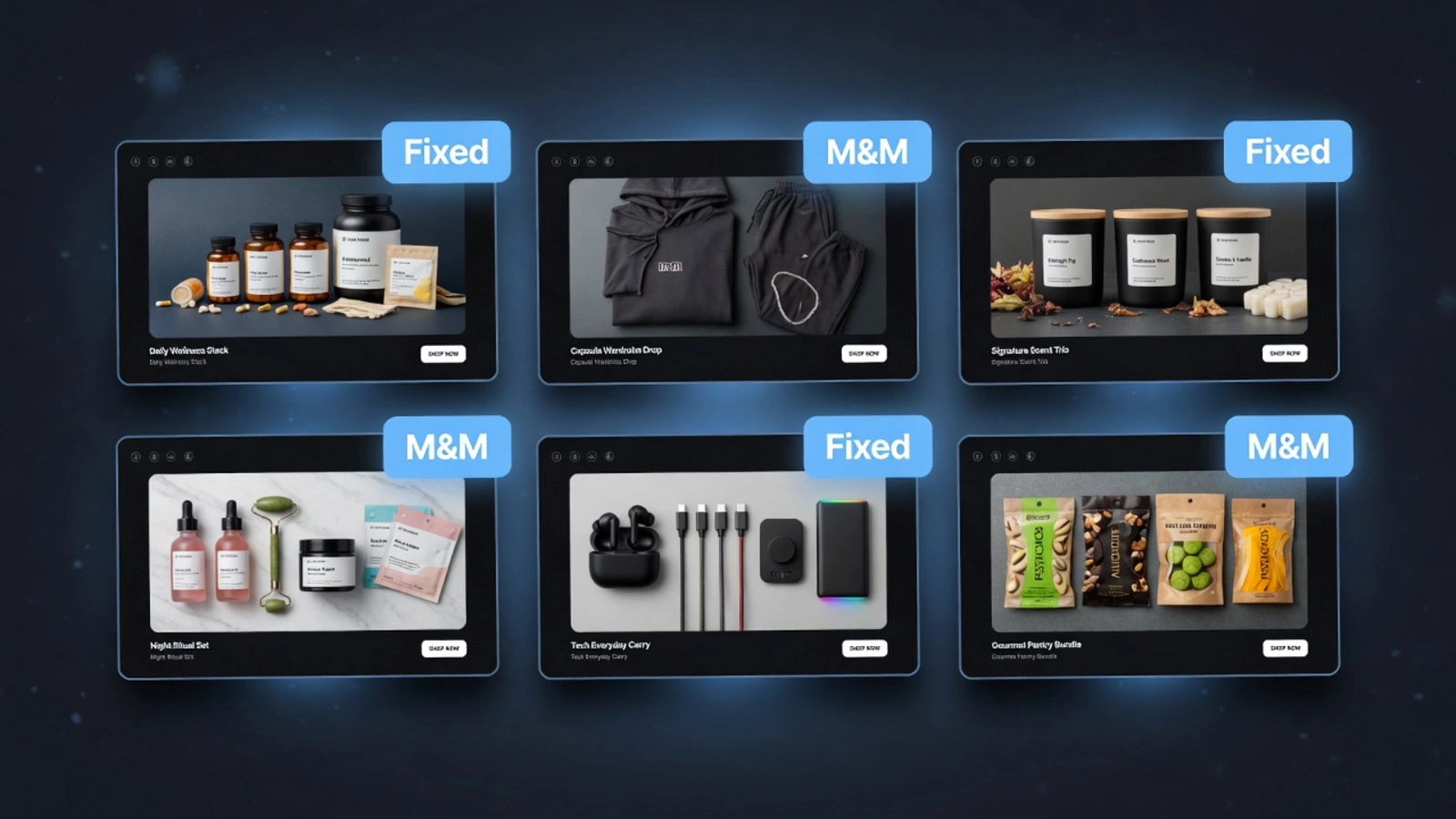
The two-by-two framework: catalog depth × purchase specificity
Bundle type selection comes down to two variables:
- Catalog depth — how many SKUs do you have in a given product category? Low catalog depth (<8 SKUs) favors fixed bundles; high catalog depth (8+ SKUs) favors mix-and-match.
- Purchase specificity — how strong are customers' preferences within a category? Low specificity (customers are flexible, any combination would suit them) favors fixed bundles; high specificity (customers have strong opinions about flavor, color, scent) favors mix-and-match.
| Catalog depth | Low purchase specificity | High purchase specificity |
|---|---|---|
| Low (<8 SKUs) | Fixed bundle — customers are flexible, small catalog makes curation easy | Fixed bundle + variety naming — curate carefully, name to signal choice has been made for them |
| High (8+ SKUs) | Either works — start with fixed for simplicity, add M&M as catalog grows | Mix-and-match — customer preferences are too varied for fixed to convert well |
Bundle strategy by niche
💊 Supplements & vitamins
Supplements have the most mature bundle culture of any ecommerce category — customers are used to "stacks" (curated combinations of supplements that work synergistically) and actively look for bundle pricing. Two bundle strategies work here simultaneously:
Fixed bundles for "stacks": Create purpose-named fixed bundles — "The Weight Loss Stack," "The Sleep Protocol," "The Athletic Performance Bundle." These answer the customer's question "what do I actually need?" and work especially well for first-time buyers in your category who don't know which supplements to combine. Price at 15% off and name for the outcome, not the ingredients.
M&M bundles for flavors: Protein powders, pre-workouts, and BCAAs often come in 8–15 flavors. A fixed bundle of specific flavors alienates customers who dislike 1–2 of the preset options. An M&M bundle — "Pick Any 3 Protein Flavors, Save 20%" — converts because customers include only flavors they want. Use a tiered structure for maximum AOV: save 15% for 3, save 20% for 4+.
Inventory implication: Bundles on a 15-SKU supplement catalog move individual flavors unevenly. Track which flavors are being bundled most via Shopify's order data, and use EZStock to manage reorder points per SKU — bundle-driven demand spikes can cause unexpected stockouts on popular flavors.
👗 Apparel & clothing
M&M for basics: T-shirts, socks, underwear, and basics with multiple color options are ideal for M&M bundles. "Pick Any 3 Tees for 15% Off" converts well because customers can pick their preferred colors. A fixed bundle of "White + Black + Navy" sounds good but alienates anyone who wants 2× black and 1× grey instead.
Fixed for outfit sets: Fashion-forward apparel brands with complementary pieces — "The Capsule Wardrobe Bundle" (blazer + trousers + shirt) — can use fixed bundles where the styling story is part of the value proposition. The fixed combination communicates curation expertise: "we've styled this together, and it works."
Gift set fixed bundles: Holiday season apparel gift sets (matching pajama sets, scarf + gloves + hat) convert well as fixed bundles in Q4. The gifting occasion removes the "I only like some of these" objection — gift givers are less discerning about specifics than personal shoppers.
🧴 Skincare & beauty
Fixed bundles for routines: Skincare has a strong "routine" culture — AM routine, PM routine, targeted treatment routine. "The Hydration Routine Kit" (cleanser + hyaluronic acid serum + moisturizer + SPF) is a compelling fixed bundle because the combination makes clinical sense and removes the decision paralysis of "which products actually work together." Name for the outcome: "The Anti-Aging Routine," "The Sensitive Skin Kit," "The Brightening Protocol."
M&M for fragrance and lip products: Lip colors, eyeshadow palettes, fragrances, and bath products with many scent/shade options benefit from M&M. "Pick Any 4 Lip Colors, Save 15%" works because customers have specific color preferences that a fixed 4-pack can't accommodate.
Sample-size trial bundles: If you offer mini or sample sizes alongside full sizes, a "Try the Routine" bundle (all minis) at a low price point converts hesitant new customers and feeds the full-size purchase funnel. This is a fixed bundle strategy that doubles as customer acquisition.
🕯️ Home fragrance & candles
Scent is entirely personal. A fixed bundle of 3 candle scents works only if the customer likes all 3 — which is unlikely to align across a broad customer base. M&M is the dominant strategy here: "Pick Any 3 Candles for 20% Off" converts across all customer scent preferences. Set the minimum at 3 candles and a tiered structure: 3 for 20%, 6 for 25%.
For seasonal gift sets, fixed bundles with premium packaging and a curated scent story ("The Holiday Collection") work because gift purchasers are selecting for gifting appeal, not personal scent preference. "Holiday Warmth Set" (cinnamon + vanilla + clove) tells a coherent scent story that makes gifting easy.
🍫 Food, snacks & beverages
Food and beverage is the quintessential M&M category — flavor variety is the core value proposition for many food brands. "Build Your 12-Pack: Choose Your Flavors" is a bundle strategy that converts because it solves a real customer problem (wanting variety, not committing to 12 units of one flavor).
Fixed bundles work for gift boxes and curated food gift sets — "The Chocolate Lovers Collection," "The Coffee Lover's Bundle." These are fixed because the curation is the gift, and gift givers trust the brand's selection.
Minimum quantity for food M&M bundles is typically higher (4–6) than other categories because the per-unit price is lower and customers are used to buying food in multi-packs. A 4-pack minimum with 12% off, 6-pack with 16% off, 12-pack with 20% off structures well.
💻 Electronics accessories
Electronics accessories typically have clear complementary relationships — a phone case with a screen protector, a laptop stand with a wireless keyboard and mouse, a camera with an extra battery and memory card. These are fixed bundle territory because the combination is functionally motivated, not just stylistically.
Electronics accessories also tend to have lower margins than consumables, so bundle discounts must be conservative (8–12% for most combinations). The value proposition is convenience (everything you need, one order) and mild discount, not deep price cutting.
M&M has limited application in electronics accessories unless your catalog has many interchangeable items (e.g., multiple compatible cable types, or multiple case colors for the same phone model).
🪴 Home goods & decor
Home goods bundle strategy splits by product type. For furniture and large items, fixed bundles ("The Living Room Set," "The Home Office Bundle") work because the spatial and aesthetic fit is the value — customers want a cohesive set, and the merchant's design expertise is trusted. For decorative accents, vases, throw pillows, and items where customers have strong personal aesthetic preferences, M&M bundles allow them to build a set in their preferred colors and materials.
Seasonal fixed bundles perform particularly well in home goods — "The Thanksgiving Table Setting," "The Holiday Decorating Bundle" — because seasonal decor purchases are gift-adjacent and customers appreciate curated sets that take the selection work off their hands.
Bundle naming that converts
Bundle names are the first thing customers read in the widget and often determine whether they read further or scroll past. Three naming frameworks consistently outperform generic names:
Outcome names (fixed bundles)
Name the bundle for the result the customer wants, not the products it contains. "The Complete Skincare Routine" outperforms "Cleanser + Toner + Moisturizer Bundle." "The Morning Productivity Kit" outperforms "Notebook + Pen + Desk Organizer Bundle." Outcome names activate aspiration; ingredient names activate evaluation (and evaluation introduces doubt).
Strong outcome name patterns:
- "The [Outcome] Kit" — The Starter Kit, The Complete Kit, The Recovery Kit
- "The [Identity] Bundle" — The Founder's Bundle, The Athlete's Bundle, The Minimalist Bundle
- "The [Ritual/Routine] Set" — The Morning Routine, The Wind-Down Set, The Game Day Set
- "The [Season/Occasion] Collection" — The Holiday Collection, The Summer Essentials
Action names (M&M bundles)
M&M bundles need to activate the customer's agency — they're building something, choosing something, creating something. The name should reflect this:
- "Build Your [Product]" — Build Your Stack, Build Your Routine, Build Your Bundle
- "Pick Your [Product]s" — Pick Your Flavors, Pick Your Colors, Pick Your Scents
- "Create Your [Outcome]" — Create Your Set, Create Your Kit
- "Mix Your [Category]" — Mix Your Flavors, Mix Your Scents
Value-lead names (discount-first)
For price-sensitive customers and promotional periods, lead with the saving: "Save 20% — Choose Any 3 Supplements," "Bundle & Save: Buy 4, Get 20% Off." Value-lead naming works best in promotional emails, ads, and for stores where customers skew deal-seeking. It's less effective for premium brands where the discount feels out of place.
Seasonal bundle strategy
Seasonal bundles outperform evergreen bundles by 40–60% during peak windows. The key is creating bundles specifically for the occasion — not just applying a discount to existing bundles, but creating new combinations with seasonal naming and positioning.
| Season / occasion | Bundle type | Relevant niches | Key tactic |
|---|---|---|---|
| Black Friday / Cyber Monday | Both | All | Temporary deep discount (20–30%) for 4 days; pair with countdown timer |
| Holiday gift season (Oct–Dec) | Fixed gift sets | Beauty, food, home, apparel | Premium naming + gift packaging messaging; "The Holiday Gift Bundle" |
| Valentine's Day (Jan–Feb) | Fixed gift sets | Beauty, fragrance, food, jewelry | Couples framing; "For Her," "For Him" bundles |
| Mother's / Father's Day | Fixed gift sets | Skincare, food, accessories | Occasion-specific naming; gift wrapping mention in bundle widget |
| Back to school (Aug–Sep) | Fixed / M&M | Stationery, accessories, supplements | "Back to School Kit"; focus on productivity/performance outcomes |
| New Year (Jan) | Fixed "resolution" stacks | Supplements, fitness, beauty | "New Year, New Routine" bundle names; strong outcome framing |
For seasonal bundle drops — limited-time availability, high perceived exclusivity — combine EZBundle's bundle mechanics with EZDrop's product drop and waitlist system. Creating a waitlist for a limited "Holiday Edition Bundle" with 50 slots available at launch creates urgency, captures email addresses pre-launch, and amplifies social sharing. The combination of scarcity (EZDrop) + bundle pricing (EZBundle) + countdown timer (PopBoost) is a powerful limited-edition product strategy.
Running fixed and M&M bundles simultaneously
Most mature bundle programs run both fixed and M&M bundles at the same time, targeting different customer segments and purchase intents:
- Fixed bundles target new customers and gift buyers — people who don't know what to choose and benefit from expert curation
- M&M bundles target returning customers and variety-seekers — people who know the product category well and have specific preferences
The two bundle types can coexist on the same product pages without conflict in EZBundle — if a product is included in a fixed bundle AND belongs to a collection covered by an M&M bundle, the fixed bundle takes priority (as it's the more specific match).
Frequently asked questions about bundle strategy
What types of product bundles work best on Shopify?
Fixed bundles (preset combinations) work best for complementary products with clear pairing logic, starter kits, and gift sets. Mix-and-match bundles work best for categories with strong personal preferences — supplement flavors, apparel colors, candle scents, food varieties. Most mature Shopify bundle programs run both types simultaneously for different customer segments.
Which Shopify bundle strategy works best for supplement stores?
Fixed bundles for outcome-named "stacks" targeting new customers; M&M bundles for flavor variety targeting returning customers. Use 15–20% discounts with tiered M&M (15% for 3, 20% for 4+). Track per-SKU inventory velocity when bundles start moving more volume than expected.
What bundle discount works best for apparel on Shopify?
10–15% for M&M bundles on basics (3+ items). Fixed outfit sets at 12–15% off with curated styling stories. Lower discounts than supplements because apparel margins are typically lower and the value is often in the curation (styling expertise) rather than pure price savings.
How should I name my Shopify bundles?
Fixed bundles: outcome names ("The Morning Routine Kit," "The Founder's Pack"). M&M bundles: action names ("Build Your Stack," "Pick Your Flavors"). Both: lead with the customer's desired result, not the product list. Avoid generic names like "Bundle Deal."
When should I run seasonal bundles on Shopify?
Black Friday/Cyber Monday (deep discount + countdown), holiday gift season (Oct–Dec, gift set naming), Valentine's and Mother's/Father's Day (occasion-specific gift sets), back to school (Aug–Sep), and New Year (resolution-framed stacks). Create new bundle names for each occasion — don't just add a temporary discount to existing bundles.
For the technical setup of your bundles, see the complete Shopify product bundle guide. For M&M-specific setup, see the mix-and-match bundle guide. For the conversion tactics that maximize bundle performance once they're live, see Shopify Bundle Upsell: How to Present Bundle Offers That Convert.