The regulation risk most investors underestimate
Revenue projections and cap rates get all the attention. STR regulations get checked last — usually right before closing, if at all. That's backwards.
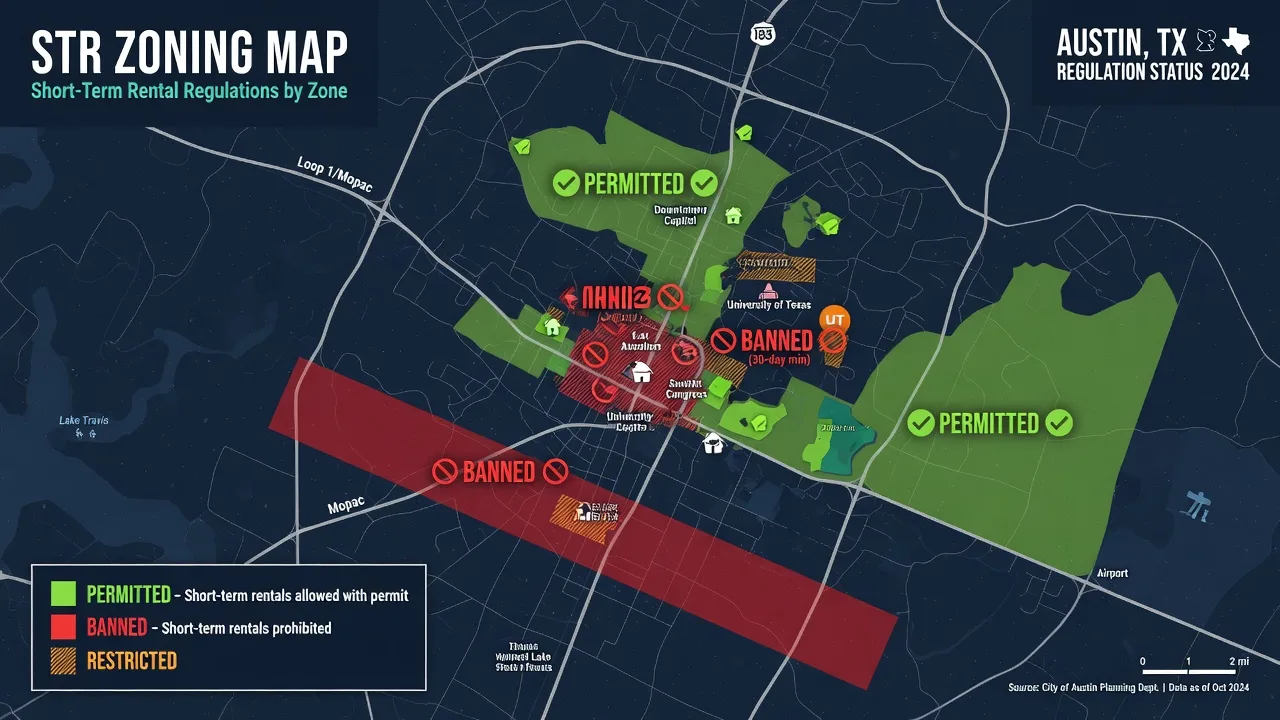
A property with a 10% projected cash-on-cash return is worth nothing as an STR if the city passes a ban after you close. And cities are passing bans. New York, San Francisco, Nashville, Austin, Scottsdale — every major STR market has faced some form of regulatory action in recent years, ranging from permit requirements and density caps to outright bans on non-owner-occupied short-term rentals.
The investors who got burned weren't careless. Many checked the rules at time of purchase and found them STR-friendly. The issue is that regulations change — and they tend to change in one direction.
The four layers of STR regulation
STR regulation in the US operates at four different levels, and you need to check all four:
1. City and county ordinances
The primary layer. Most STR bans and permit requirements originate here. Common restrictions include: requiring an owner-occupancy clause (you must live in the property for a minimum number of days per year), licensing and permit requirements, limits on the number of STR permits per neighborhood or per block, minimum night stays, and caps on occupancy.
2. Zoning
Even in cities that allow STRs generally, specific zoning districts may prohibit them. A residential zone in the same city that has a commercial STR district may have different rules. Always check the specific parcel's zoning designation, not just the city-wide policy.
3. HOA and condo association rules
This is the layer investors most commonly miss. Even if city law permits STRs, an HOA can prohibit them entirely — and HOA rules are contractual obligations that come with the property. A condo building can vote to ban Airbnb, and that ban applies to all owners regardless of when they purchased. Always request and read the full HOA CC&Rs before making an offer on any property in an HOA or condo association.
4. State law
Some states have passed laws limiting a city's ability to regulate STRs (pre-emption laws). Florida and Tennessee are notable examples where state law restricts how aggressively cities can ban STRs. Knowing the state-level landscape tells you how durable a permissive local regulatory environment is likely to be.
How to check regulations before buying
Use STRInvest for an instant first check
When you open a listing on Zillow, Redfin, or Realtor.com with STRInvest installed, the analysis panel shows the local STR regulation status — whether short-term rentals are permitted, restricted, or prohibited in that jurisdiction. This is your first filter. If the status is prohibited, move on immediately without spending more time on the deal.
Verify with the city directly
For any deal that passes the first filter, verify with the city's planning or licensing department. Search "[city name] short term rental permit" or "[city name] STR ordinance". Most cities publish their current rules online. Look for permit application pages — if there's a permit process, read the requirements carefully, including owner-occupancy clauses.
Request HOA documents before making an offer
Ask the listing agent for the HOA CC&Rs, bylaws, and any recent board meeting minutes before you submit an offer, not during the due diligence period. Board minutes often reveal pending votes on STR restrictions before they're formally enacted. This step can save your earnest money.
Check for pending legislation
Search the city council's meeting agenda and recent ordinance filings for anything related to "short-term rentals", "vacation rentals", or "Airbnb". Regulations that pass in 6 months affect a 30-year investment. A 15-minute search can reveal whether a ban is already in committee.
Markets with known regulatory risk in 2026
Regulatory pressure is highest in markets where STR density is high and housing affordability is a political issue. Cities where the local housing shortage is severe tend to have the most aggressive STR regulation, since officials can frame STR restrictions as housing policy. High-tourism markets with established hotel lobbies also face persistent pressure.
The safest regulatory environments are generally: smaller markets with less housing pressure, markets in states with pre-emption laws, and rural or resort markets where STR is seen as part of the local economy rather than a threat to it.
| City | Night Cap | License Required | Owner-Occupancy Required | Key Rule |
|---|---|---|---|---|
| San Francisco, CA | 90 nights/year (unhosted) | ✓ Required | ✓ Primary residence only | Must register with city |
| Los Angeles, CA | 120 nights/year | ✓ Required | ✓ Primary residence only | No whole-home if renter |
| New York City, NY | No cap (but 30-day min for whole home) | ✓ Required | ✓ Must be present | Effectively bans unhosted STR |
| Washington, DC | 90 nights/year (unhosted) | ✓ Required | ✓ Primary residence | Tiered license system |
| Chicago, IL | No cap | ✓ Required | ✗ Not required | Condo association rules vary |
| Denver, CO | No cap | ✓ Required | ✓ Primary residence only | Neighborhood restrictions apply |
| Austin, TX | No cap | ✓ Required | ✗ Not required | Non-owner STR license available |
| Nashville, TN | No cap | ✓ Required | ✗ Not required | Owner-occupied and non-owner licenses |
| Scottsdale, AZ | No cap | ✓ Required | ✗ Not required | State law limits city restrictions |
| Miami, FL | Varies by neighborhood | ✓ Required | ✗ Not required | Unincorporated areas more permissive |
What to do if regulations change after you buy
Grandfather clauses sometimes protect existing permits, but not always. Build a contingency into your underwriting: what does the property cash flow as a long-term rental if the STR permit disappears? If the long-term rental numbers are deeply negative, you're taking on regulatory risk that isn't priced into your cap rate. Make sure that risk is compensated by the upside.