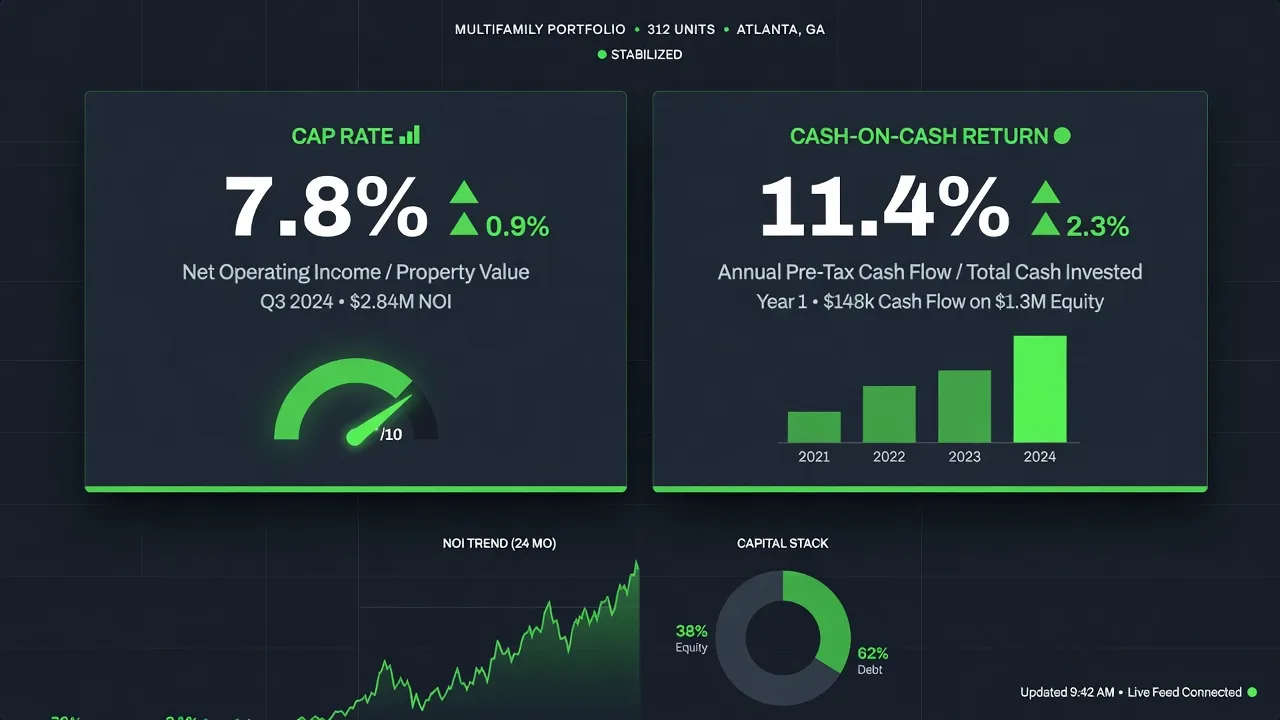
The quick answer
Cap rate tells you how efficiently a property generates income relative to its value — independent of how you financed it. Cash-on-cash return tells you the actual return on the cash you put in. For STR investors using financing, cash-on-cash is usually the more actionable number. But you need both to get a complete picture.
| Factor | Cap Rate | Cash-on-Cash Return |
|---|---|---|
| What it measures | Property income yield independent of financing | Actual return on cash invested |
| Includes debt service | ✗ No | ✓ Yes |
| Use case | Compare properties across markets | Evaluate a specific deal with your financing |
| Formula | NOI ÷ Property Value | Annual cash flow ÷ Total cash invested |
| Good benchmark (STR) | 5–8% | 8–15% |
| Affected by interest rates | ✗ No | ✓ Yes — significantly |
| Best for | Market-level comparison | Deal-level decision |
Cap rate explained
Cap rate (capitalization rate) is calculated as:
Cap Rate = Net Operating Income (NOI) / Property Value × 100Net Operating Income is your gross rental income minus all operating expenses — property management, maintenance, insurance, utilities, property taxes, and platform fees. It does not include mortgage payments.
Example: A property worth $400,000 generates $36,000/year in STR revenue. After $12,000 in operating expenses, NOI is $24,000. Cap rate = $24,000 / $400,000 = 6%.
Because cap rate excludes financing, it's a pure measure of how the property performs as an asset. Two investors can look at the same property and calculate the same cap rate regardless of how much they put down or what rate they got on their mortgage.
When cap rate is most useful
- Comparing properties across different price points
- Evaluating a market overall ("Nashville cap rates are averaging 7%")
- Assessing all-cash purchase scenarios
- Comparing STR performance to other asset classes
Cash-on-cash return explained
Cash-on-cash return (CoC) is calculated as:
CoC = Annual Pre-Tax Cash Flow / Total Cash Invested × 100Annual pre-tax cash flow is your NOI minus your annual mortgage payments (principal + interest).
Total cash invested includes your down payment, closing costs, and any upfront renovation or furnishing costs.
Example: Same $400,000 property. You put 25% down ($100,000) plus $8,000 in closing costs and $12,000 to furnish it for STR — total cash invested: $120,000. Annual mortgage payments at 7%: $19,800. Cash flow = $24,000 NOI − $19,800 = $4,200. CoC = $4,200 / $120,000 = 3.5%.
Notice how the same property that looks solid at 6% cap rate produces a 3.5% cash-on-cash return at today's interest rates. This is why many investors who bought in 2019–2021 at 3% rates have deals that no longer pencil at 7%.
When cash-on-cash is most useful
- Evaluating leveraged purchases (most investors)
- Comparing your return to other investments (stocks, index funds)
- Stress-testing different financing scenarios
- Deciding between deals when you have limited capital to deploy
What numbers to target for STR
Short-term rentals typically generate higher gross revenue than long-term rentals, but also higher operating expenses (cleaning fees, restocking, higher maintenance). Here's a rough benchmark framework:
Why STR investors need both
Cap rate catches deals where the property economics are weak regardless of how you finance it. Cash-on-cash catches deals where the financing makes an otherwise decent property unworkable.
A deal with a 7% cap rate and 4% CoC usually means you're over-leveraged or over-paying for financing. A deal with a 5% cap rate and 9% CoC usually means you put in a lot of cash (low leverage) — your money is working hard, but the property itself isn't a standout performer.
The best STR deals have both: a cap rate that reflects a property priced efficiently relative to its income, and a cash-on-cash return that rewards you for the capital and operational complexity involved.
How STRInvest calculates both
When you open any Zillow, Redfin, or Realtor.com listing with STRInvest installed, both metrics are calculated automatically using the listing price, projected STR revenue from comparable Airbnb listings, and your adjustable assumptions for down payment, mortgage rate, and occupancy. Change any input and both numbers update in real time — no spreadsheet needed.