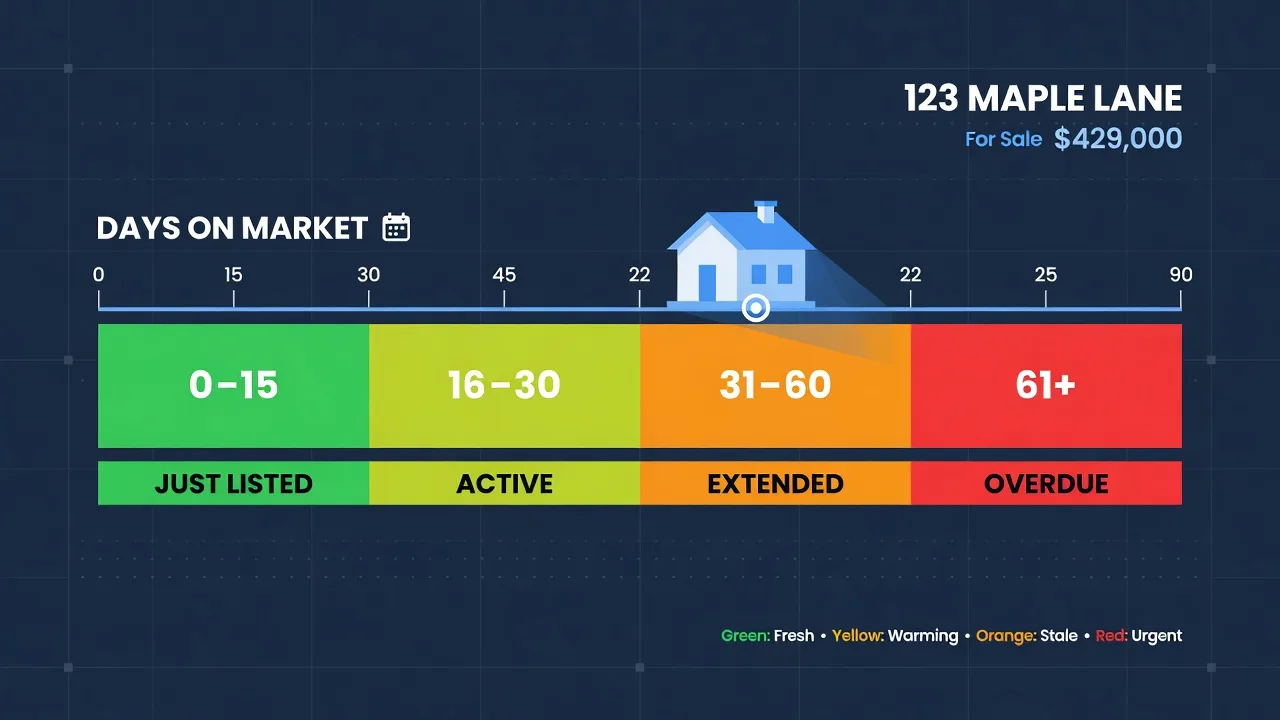
What days on market measures
Days on market (DOM) is the number of days a listing has been active on the MLS — from the day it was listed to today, or to the day it went under contract. It's a measure of how long a property has been trying to sell.
In a healthy, fairly priced market, most homes sell within the median DOM for that area. A home selling faster than median DOM had strong demand. A home sitting longer than median DOM has something working against it — price, condition, location, or timing. Understanding which is key to interpreting the signal correctly.
The four DOM zones and what they signal
Hot (0–7 days)
The home is generating immediate interest and likely has multiple offers. In this zone, list price is the floor, not the ceiling — competitive buyers often offer above list. Asking for concessions (closing cost credits, repairs, extended timelines) is unlikely to work. If you want the home, move fast and make a clean offer.
Active (7–21 days)
Normal market activity. The home is priced competitively and attracting interest, but hasn't generated a bidding war. Offering at or slightly below list price is reasonable. Minor concessions are possible. This is the most common zone for well-priced homes in a balanced market.
Cooling (21–45 days)
The home has been sitting longer than expected for its market. This usually signals one of three things: the price is above market, there's a condition or location issue buyers are reacting to, or it was listed at a slow time and just hasn't had enough showings. In this zone, negotiation is possible — 3–5% below list is typically on the table, and sellers are more open to repairs and concessions.
Slow (45+ days)
Significant time on market signals a motivated seller — or a problem. Homes in this zone often have already had one or more price reductions. Buyers have significant leverage: 5–10% below list is frequently achievable, and asking for closing cost credits, repairs, or contingencies is standard. The key question to investigate: why has it sat? The answer shapes how you approach the offer.
| DOM Range | Market Signal | Seller Motivation | Buyer Strategy |
|---|---|---|---|
| 0–7 days | Hot demand | Low — priced right | Offer at or above list; move fast |
| 7–21 days | Normal market | Moderate | Offer at list; standard contingencies |
| 21–45 days | Slight buyer advantage | Moderate–high | Offer 2–5% below; all contingencies |
| 45–90 days | Buyer's market | High | Offer 5–10% below; request repairs |
| 90–180 days | Stale listing | Very high | Offer 8–15% below; leverage price history |
| 180+ days | Problem listing | Very high or unique issue | Offer 8–15% below; investigate reason |
DOM relative to the local market, not absolute
DOM thresholds mean different things in different markets. In a hot urban market, a median DOM of 8 days means a 20-day listing is already stale. In a rural market with a median DOM of 45 days, a 20-day listing is still fresh. Always interpret DOM relative to the local median — not against a national standard.
HomePilot's market signal indicator (Hot / Active / Cooling / Slow) calibrates DOM against the local market context for the listing you're viewing, so you're comparing against the right baseline automatically.
DOM combined with price reductions
Days on market becomes a much stronger signal when combined with price history. A 40-day listing with no price changes may just be a slow season. A 40-day listing with two price reductions tells a different story — the seller has already moved twice and is likely willing to move again.
The number of price reductions and the total reduction amount are visible in HomePilot's price intelligence panel. A home originally listed at $750K that's now at $699K after two reductions is in a very different negotiating position than one that's been at $699K since day one.
What DOM doesn't tell you
DOM doesn't tell you why the home has sat. Common non-price reasons include: inherited property with estate complications, a seller who listed prematurely and isn't fully committed to selling, a known local issue (flight path, school boundary, flood zone), or simply poor listing photos. Some of these are negotiable. Some are permanent. Before assuming a high-DOM listing is just overpriced, investigate what else might be at play.