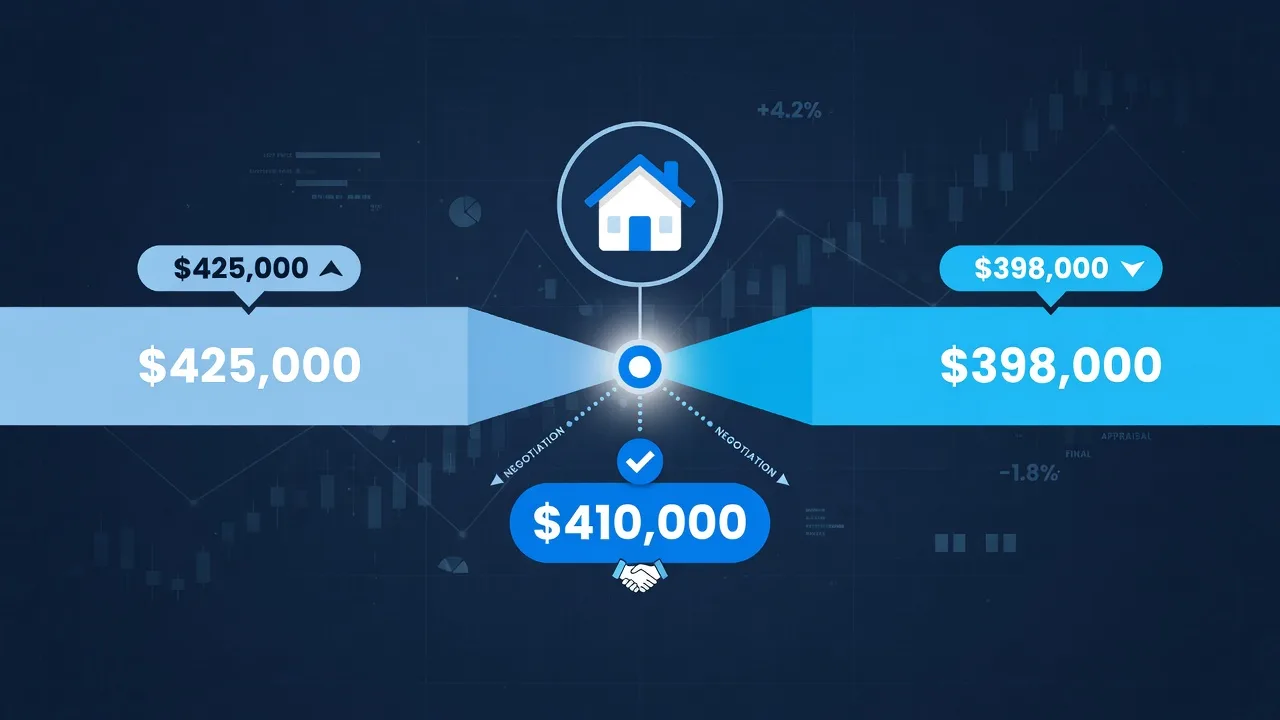
The information asymmetry in home buying
A listing agent has seen dozens of transactions in the neighborhood. They know what similar homes sold for, how long this listing has sat, what their seller paid and roughly how much equity they have, and what other offers (if any) have come in. Most buyers walk into a negotiation with none of this context.
The data to close this gap is largely public or calculable — it's just not surfaced conveniently on listing pages. HomePilot pulls it together: comparable sales, the Zestimate delta, days on market signal, price reduction history, estimated seller equity, and a deal score that synthesizes all of it into a starting position.
| Market Condition | Days on Market | Typical Discount Off List | Strategy |
|---|---|---|---|
| Hot seller's market | < 7 days | 0–2% (may need to offer over) | Offer at or above list; waive minor contingencies |
| Balanced market | 15–30 days | 2–5% below list | Offer 3–4% below with standard contingencies |
| Buyer's market | 30–60 days | 5–10% below list | Offer 7–8% below; ask for closing cost credit |
| Stale listing | 60–90 days | 8–15% below list | Reference comparable sales; price reduction history |
| Price-reduced listing | Any | 5–10% below reduced price | Reduction signals motivation; push further |
| Off-market / expired listing | N/A | 10–20% below estimate | No competition; leverage is highest |
The four data points that anchor your offer
1. Deal score (Great / Good / Fair / Above / Overpriced)
HomePilot's deal score synthesizes list price vs. Zestimate, days on market, price history, and comparable sales into a single signal. A "Great" score means the home is priced below where the data suggests it should be — move decisively and don't lowball. An "Overpriced" score means the listing is significantly above where comps and the automated valuation suggest — you have room to negotiate, and going in below list is well-supported.
2. Comparable sales
Recent sales of similar properties in the same area are the most defensible anchor for any offer. "Comparable homes in this neighborhood have sold for $X–$Y per square foot in the last 90 days" is harder for an agent to argue with than "I think it's worth less." HomePilot surfaces nearby comps so you can build this argument before you write the offer.
3. Days on market and price history
A home that's been listed for 45 days with two price reductions is in a fundamentally different negotiating position than a home that listed last week. The seller has already signaled twice that they'll move on price. Coming in at 4–6% below current list is a reasonable starting point — and asking for closing cost credits or repairs is well within normal territory.
4. Seller equity estimate
HomePilot estimates when the seller purchased, what they paid, and how much equity they likely have based on the purchase price, appreciation, and remaining loan balance. A seller with substantial equity has more flexibility — they can accept a lower offer without being underwater. A seller who bought recently at peak prices and has minimal equity may not have room to negotiate much on price (though they may be more flexible on terms).
Price vs. terms: often terms matter more
Buyers focus almost entirely on the price. In many situations, terms are equally or more valuable to sellers — and less costly to give up.
Closing timeline: A seller who needs to close quickly may accept a lower price for a fast close. A seller who's still searching for their next home may prefer a rent-back arrangement to a fast timeline. Ask the listing agent what the seller needs before you write the offer.
Contingencies: An offer with fewer contingencies is worth more to a seller than a higher-priced offer loaded with conditions. If you've done your due diligence with HomePilot and know the numbers work, you may be able to waive or shorten contingency periods in ways that make your offer more competitive without paying more.
Closing cost credits: Asking the seller to cover $10,000 in closing costs on a $600K home is essentially asking for a 1.7% discount — but it doesn't affect the appraised value or the loan-to-value ratio. For buyers who are cash-constrained at closing, this is often a better ask than a price reduction.
Building the negotiation before you make the offer
Run the HomePilot analysis before scheduling a showing
Check the deal score, DOM signal, price history, and comps before you visit. If the numbers don't work even at a reasonable negotiated price, visiting just creates emotional attachment that clouds the decision.
Ask the listing agent what the seller needs
Before writing any offer, call the listing agent and ask two questions: "Is the seller flexible on price?" and "What timeline works best for them?" The answers tell you where to focus your negotiation — price, terms, or both.
Use the offer calculator to confirm affordability at your offer price
HomePilot's offer slider lets you see how your monthly payment changes at different offer prices — from 85% to 110% of list. Confirm the payment works at your offer price and at list price (in case you need to counter up) before submitting.
Write the offer anchored to data, not feeling
Your offer letter or agent's negotiation should reference the comp data and market signal. "Based on comparable sales in the area and the current days on market, we feel $X reflects fair market value" is a stronger position than a bare number. Data-anchored offers are harder to dismiss.