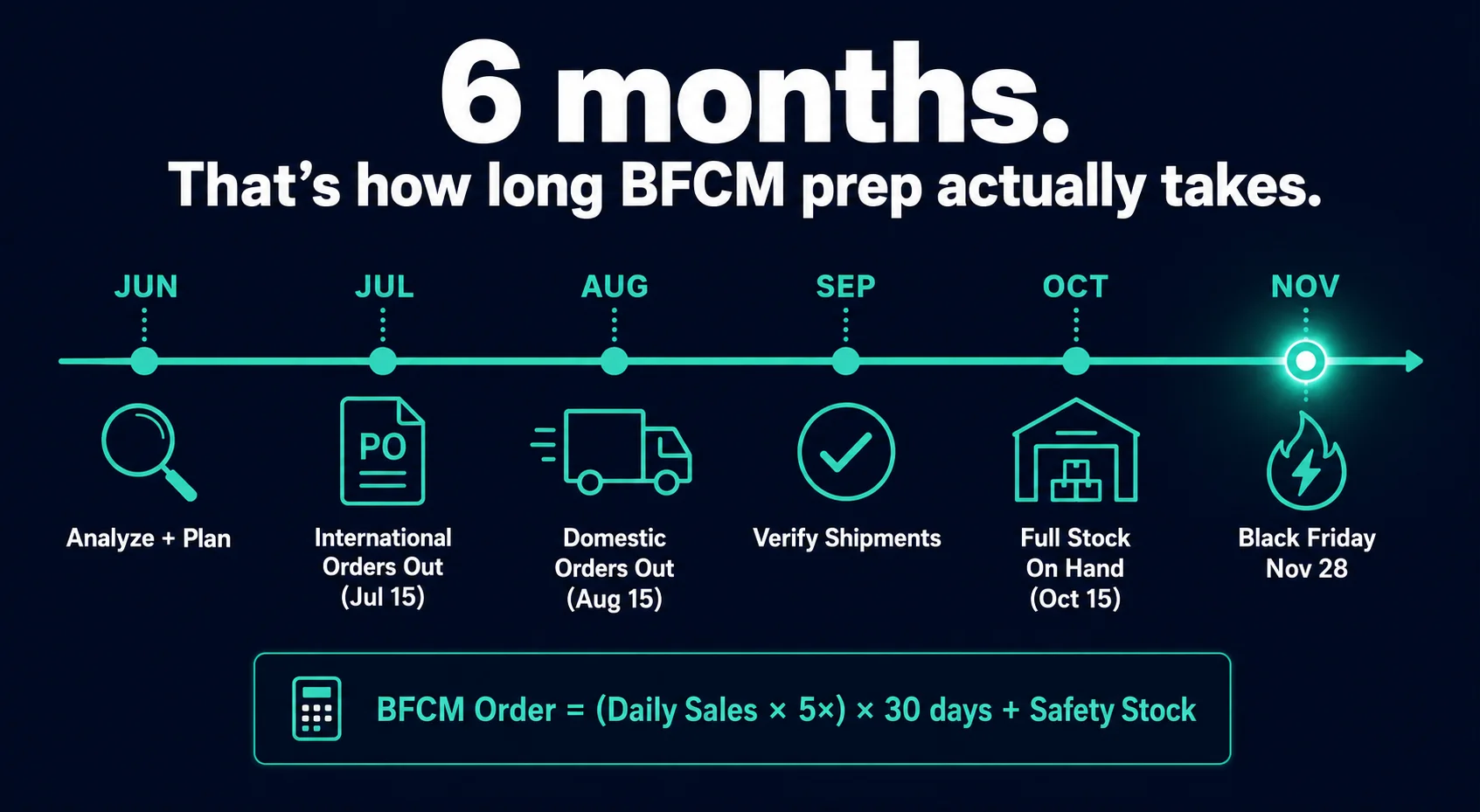
Black Friday 2025 generated over $11.5 billion in Shopify sales in four days. A significant chunk of that was left on the table by merchants who ran out of stock — not because their products weren't good, but because they ordered too late.
The math is simple. International suppliers need 60 to 90 days. Domestic suppliers need 30 to 45. You want stock physically in your hands by October 15 so you have time to prep listings, test bundles, and handle shipping buffers. That means purchase orders go out in July at the absolute latest. And to place accurate orders in July, you need to do your analysis now — in June.
This is that guide. No vague advice. Step by step, with formulas.
Why June Is Already the Deadline
Most Shopify merchants start thinking about Black Friday in September or October. By then, two things have already happened: their competitors locked in supplier capacity, and their best-selling products are sitting at minimum stock levels with no buffer.
Here's the timeline that actually matters:
June: Analyze and plan
Pull last year's BFCM sales data. Calculate your BFCM multiplier per product. Set target stock levels for November 1st.
July: Send international purchase orders
International orders go out by July 15. Domestic orders by August 1. Confirm quantities and delivery dates in writing with every supplier.
September: Verify and top up
Chase any late shipments. Place secondary domestic orders if primary quantities arrive short. Update reorder points for peak velocity.
October 15: Full stock target
All BFCM inventory should be on hand. You now have two weeks to organize, tag, and prep products before demand spikes.
November 28: Black Friday
You have the stock. Your competitors who started in October don't. That's the whole game.
Why it matters: According to the National Retail Federation, 63% of online shoppers say an out-of-stock item during the holidays pushes them to buy from a competitor — and they rarely come back. A BFCM stockout doesn't just lose a sale. It loses the customer.
| Product Category | BFCM Demand Multiplier | Order Deadline |
|---|---|---|
| Fashion & accessories | 4–6× baseline | Jul 15 (international), Aug 15 (domestic) |
| Home goods & decor | 3–4× baseline | Aug 1 (international), Sep 1 (domestic) |
| Electronics & tech accessories | 6–8× baseline | Jul 1 (international), Aug 1 (domestic) |
| Beauty & skincare | 3–5× baseline | Aug 15 (international), Sep 15 (domestic) |
| Toys & games | 5–7× baseline | Jul 15 (international), Aug 15 (domestic) |
| Food & supplements | 2–3× baseline | Sep 1 (domestic only — perishables) |
| Jewelry & accessories | 4–6× baseline | Aug 1 (international), Sep 1 (domestic) |
Step 1: Audit Last Year's BFCM Numbers
Before you order anything, you need to know what actually sold last year. Not what you think sold — what the data says.
Pull these numbers for November 15 to December 1, 2025:
- Units sold per product (not revenue — units)
- Daily sales velocity during the peak window (Nov 28–Dec 1)
- Stockout dates — which products hit zero and when
- Your normal daily sales for the same products in October
From these four numbers you calculate your BFCM multiplier per product.
Example: Product sells 3/day in October. Sold 15/day during BFCM 2025. Multiplier = 5×
This multiplier is the most important number in your BFCM planning. Everything else flows from it.
If a product sold out before December 1 last year, its real multiplier was higher than what you captured. Add 20% to the calculated multiplier for those SKUs — the demand was there, you just didn't have the stock.
If this is your first BFCM, use benchmarks: fashion and accessories typically see a 4× to 6× spike. Home goods run 3× to 4×. Electronics and tech accessories can hit 8× or higher. Start conservative on year one and focus your capital on your top 10 products.
EZStock tip: The sales velocity dashboard in EZStock shows exactly how fast each product moved over any 30-day window. Pull the BFCM window and you have your multiplier data in about two minutes — no spreadsheet needed.
Step 2: Calculate Exactly How Much to Order
You have your BFCM multiplier. Here's how to turn that into an order quantity.
Safety Stock = BFCM daily sales × supplier lead time × 0.2
Example: 3/day × 5× multiplier × 30 days = 450 units
Safety stock: 15/day × 30-day lead time × 0.2 = 90 units
Total order: 540 units
Run this formula for every product in your top 20%. Your top 20% of SKUs typically drives 80% of BFCM revenue. Don't waste cash flow over-ordering slow movers when your best sellers might run dry.
A few adjustments to make before you finalize quantities:
- New products launching at BFCM: Use industry benchmarks. Order 50% of what your gut says — and plan a domestic top-up order for late October if pre-launch signals look strong.
- Products that sold out last year: Add the 20% buffer to the multiplier, not just the final quantity.
- Bundles: Calculate component inventory separately. A bundle containing Product A and Product B is limited by whichever component runs out first. Plan each component at bundle demand × bundle proportion.
- Perishable or expiring products: Be precise. No safety buffer you can't sell through in January.
When you're done, you should have a document with every top SKU, its expected BFCM daily sales, its 30-day order quantity, and its safety stock number. This becomes the basis for your purchase orders.
Step 3: Build Your Purchase Order Timeline
You have quantities. Now work backwards from November 28, 2026 to figure out when each PO needs to go out.
Key dates:
- November 28, 2026: Black Friday. Stock must already be at your location.
- October 15: Target date for all BFCM inventory to be on hand.
- October 1: Last acceptable domestic arrival date (absorbs delays).
- September 15: Last acceptable international arrival date.
International suppliers (Asia, Europe)
Manufacturing: 20–45 days. Shipping: 20–35 days. Total: 45–80 days. PO deadline: July 15, 2026.
Domestic suppliers (US, Canada, Australia)
Manufacturing: 10–20 days. Shipping: 5–10 days. Total: 15–30 days. PO deadline: August 15, 2026.
Dropship / print-on-demand
No pre-ordering needed, but confirm peak capacity with your supplier by August 1. Set inventory caps to avoid selling more than they can fulfill.
Build a simple calendar with these deadlines per supplier. For most merchants, July is the critical month. Miss July for international suppliers and you're either paying air freight (3× to 5× the cost of sea) or running out of stock.
Add a buffer: Shipping delays during Q4 are the norm. Add 10 days to your estimated transit time for any orders arriving between September and November. Ports get congested, customs backs up, couriers get overwhelmed. Plan for it now instead of panicking in October.
In EZStock, you create a purchase order per supplier, add the products and quantities, set the expected delivery date, and send it as a PDF directly from the app. When the order arrives, you mark it received and inventory updates automatically across your Shopify store.
Step 4: Set Peak-Season Reorder Points
Your BFCM order gets inventory on shelves. But stock starts depleting in October before the sale even starts — from early shoppers, promotional campaigns, and social traffic you're running to build up the sale.
You need peak-season reorder points so the system flags when stock drops to a level that needs a top-up order — before you actually run out.
Example: 3/day × 5× multiplier = 15/day × 30-day lead time = 450 + 90 safety = 540 units
When stock hits 540, place an order immediately.
Set these in October — not in November. By the time Black Friday arrives, you want to be watching a green dashboard, not scrambling to place emergency orders with 3-day air freight.
In EZStock, reorder points are set per product or per product-supplier combination. When stock drops to the reorder point, the product gets flagged on your dashboard. One click creates a draft purchase order. Review, adjust if needed, and send. The whole cycle runs inside Shopify without touching a spreadsheet.
Set your peak-season reorder points now. EZStock handles the rest.
Sales velocity tracking, reorder alerts, PDF purchase orders, automatic inventory updates — all inside Shopify. Starter from $19/month · 14-day trial · no credit card required.
Install EZStock Free on Shopify →Step 5: Lock In Your Suppliers Now
The biggest mistake merchants make isn't the math. It's assuming their supplier has unlimited Q4 capacity.
Your suppliers are getting BFCM orders from every store they work with. The merchants who reach out in June get confirmed capacity and normal pricing. The ones who reach out in September get "we'll try our best" and Q4 surcharges.
Do this right now — before you finalize quantities:
- Email every primary supplier. Let them know you're planning a larger-than-normal order for BFCM. Give a rough quantity estimate and ask for capacity confirmation and lead time for July–August delivery.
- Lock in pricing in writing. Q4 price increases are common — especially packaging and raw materials. Confirm your pricing now if your supplier allows forward contracts.
- Identify a backup per category. Not every product, but your top 3. If Supplier A can't fill the order, you need someone who can. Qualify that backup now, not in October.
- Confirm payment terms. Some suppliers require a deposit for large BFCM orders. Know your cash flow and negotiate terms before the order is placed.
Relationships matter here: Suppliers prioritize merchants who communicate clearly and pay on time. A simple email in June saying "we're planning to double our usual order for Q4" builds trust — and often gets you better treatment when capacity is tight in August.
The Mistakes That Kill BFCM Revenue
The merchants who lose BFCM aren't the ones with bad products. They're the ones with predictable, avoidable operational failures. Here's the list:
Ordering the same amount as last year
If your store grew 30% this year, your BFCM demand will grow proportionally. Scale order quantities by your YTD growth rate — not last year's actuals.
Treating all products equally
Your top 20% of SKUs drives the majority of BFCM revenue. Put your cash there. Don't over-stock slow movers while your hero products run out.
Not accounting for pre-BFCM demand
Demand starts weeks early. Social ads, email campaigns, and early-access deals burn through October inventory fast. Your BFCM stock plan has to cover October too.
No stockout contingency
Even with perfect planning, a product might sell out. Have a plan: a comparable alternative, a waitlist, a rain-check email — something that keeps the customer in your ecosystem instead of sending them to a competitor.
Over-ordering "just in case"
Dead stock is cash locked in a warehouse. Over-ordering slow movers to avoid stockouts creates a January clearance problem. Be precise on slow movers. Be generous only on proven top sellers.
The merchants who win BFCM aren't the ones with the biggest marketing budget. They're the ones with stock on hand when everyone else runs out. You have six months. Use them.
