The App-Sprawl Problem Stocky Migrators Are About to Create
Stocky was tolerable for years because it was free and bundled into Shopify. Now that it's winding down, the instinct is to replace its one dashboard with a pile of specialized apps — plus a few more for the marketing jobs Stocky never touched. The result is predictable:
A slower storefront. Every storefront app that injects its own JavaScript competes with the others for load priority. Stack four unrelated apps and your mobile load time pays for it.
Conflicting numbers. When each app keeps its own copy of your catalog or inventory, they drift out of sync. Your inventory app says one thing, your urgency popup says another, and a shopper sees "Only 2 left!" on a product you actually have 40 of.
Four support queues. When something breaks at the seam between two apps, neither vendor owns the problem, and you're the one relaying messages between them.
Consolidating around fewer, coordinated tools solves all three. Not because of any magic integration — but because coordinated tools make fewer independent copies of your data and add less independent weight to your theme.
Four Apps, Four Non-Overlapping Jobs
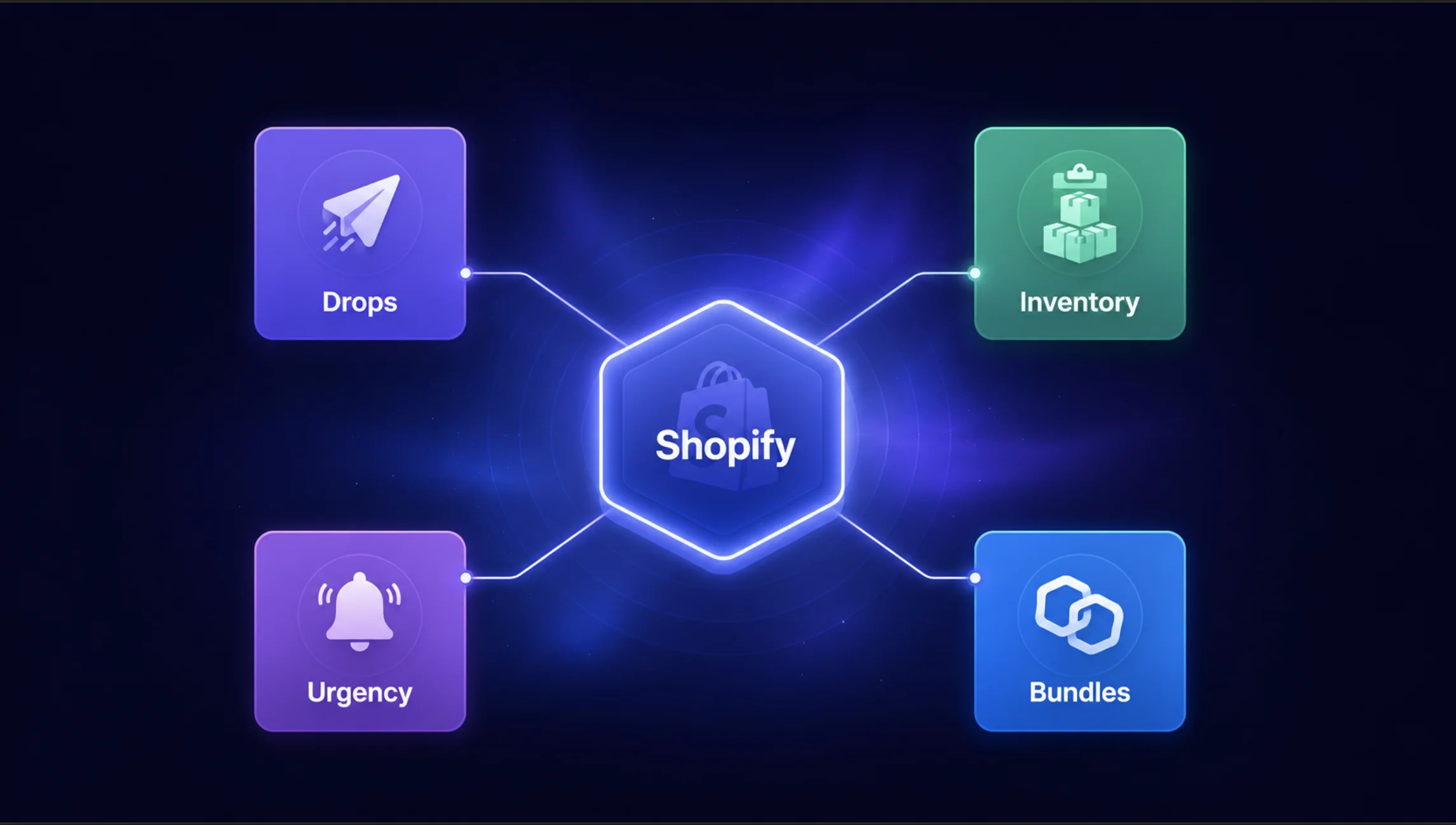
The stack maps cleanly onto the funnel, front to back. Each app does one job, and none of them competes with another for the same job — so there's no feature overlap and no duplicated billing for the same capability.
EZDrop — turn a launch into a waitlist
Before you commit cash to inventory, EZDrop lets you launch an upcoming product as a limited drop. Shoppers join a waitlist and move up the queue by referring friends, so you build hype and grow your email list ahead of the release. The practical payoff: you get a real read on demand from the size and momentum of the waitlist before you place the order — instead of guessing.
EZStock — the Stocky replacement
EZStock is the inventory workhorse and the app that most directly replaces Stocky. Create, send and track purchase orders from draft to received; forecast demand from real sales velocity so you know how many days of stock you have left; set reorder points that sort a low-stock dashboard by urgency; and scan barcodes with a handheld scanner or your phone camera to count stock and receive shipments. When you mark a shipment received, your Shopify inventory updates automatically.
EZBundle — lift AOV without theme edits
Once product is live, EZBundle raises your average order value with fixed and mix-and-match bundles. The bundle widget appears on product pages automatically — no theme editor setup or code — and discounts apply at checkout with no manual coupon steps. It reads your Shopify products and collections to build the bundles, so the options a shopper sees always match your real catalog.
PopBoost — social proof and scarcity that's true
PopBoost adds the on-site conversion layer: recent-purchase social proof, countdown timers, free-shipping progress bars, and low-stock badges. The scarcity is honest because the low-stock badge reads your live Shopify inventory — the same inventory EZStock manages — so "Only a few left" is only shown when it's actually true. All seven widgets ship as native Online Store 2.0 app blocks.
Why One Shared Source of Truth Beats a Frankenstack
Here's the part worth being precise about, because it's where a lot of "ecosystem" marketing overpromises. These four apps do not have a private data connection between them. There is no automation where finishing something in one app silently triggers another. What they have instead is better: they all read and write the same live Shopify data.
EZStock manages your Shopify inventory. PopBoost's low-stock badge reads that same Shopify inventory. EZBundle reads your Shopify products and collections. Because Shopify is the shared reference point, the apps can't show contradictory numbers to a shopper — not because they talk to each other, but because they all talk to Shopify. That single design choice is what kills the "Only 2 left" lie on a fully-stocked product.
On top of the shared-data foundation, the one-vendor part adds three practical wins:
One consistent interface
All four apps share the same design system, built on Shopify's Polaris framework. You learn one set of patterns, not four different admin experiences. Onboarding a teammate onto the stack is one lesson, not four.
One vendor, one bill, one human
One billing relationship and one support contact who understands how the whole stack fits together — instead of four queues that each blame the other when something breaks at a seam. You email a person, not a rotating funnel.
Less weight on your theme
The two storefront apps, EZBundle and PopBoost, use native Online Store 2.0 app blocks and embeds rather than each injecting its own competing script. Your storefront features load through Shopify's theme system instead of four unrelated apps fighting for priority. EZDrop and EZStock run in the admin and add no storefront weight at all.
What this is not: it is not a promise that the apps auto-sync, share a hidden database, or hand data off to one another. If a claim like that ever appears in someone's pitch, be skeptical. The honest version — one vendor, one Shopify source of truth, four non-overlapping jobs — is compelling enough on its own, and it's the one you can actually verify.
What the Stack Actually Costs
Every app in the stack has a real free plan, so you can install and run all four for $0 to start and only upgrade the ones that earn it. Pricing is flat per plan — it isn't banded to your store's revenue, so growing your sales doesn't automatically raise your bill.
| App | Job | Free plan | Entry paid | Top tier |
|---|---|---|---|---|
| EZDrop | Demand capture | 1 drop, 500 entries | Hype $19/mo | Brand $49/mo |
| EZStock | Inventory & POs | 5 POs / month | Starter $19/mo | Pro $99/mo |
| EZBundle | Bundles / AOV | 1 bundle | Starter $9/mo | Growth $19/mo |
| PopBoost | Urgency / social proof | All 7 widgets | — | Pro $19/mo |
Run everything at the top tier and the whole stack is about $186/month (EZDrop Brand $49 + EZStock Pro $99 + EZBundle Growth $19 + PopBoost Pro $19) — or roughly $136/month if EZStock sits on its Growth tier at $49. But most stores never need every app at its ceiling. The point of a free tier on all four is that you scale each one independently as it pays for itself.
Rebuilding your stack after Stocky?
Start with EZStock — the inventory and purchase-order app that maps most directly to what Stocky did. Free to install, no credit card required.
Install EZStock Free →Frequently Asked Questions
Do these four Shopify apps sync data with each other?
No — and they don't need to. EZDrop, EZStock, EZBundle and PopBoost each read and write your live Shopify data directly. Shopify is the single source of truth: EZStock reads your Shopify inventory, PopBoost's low-stock badge reads your Shopify inventory, and EZBundle reads your Shopify products and collections. Because they all reference the same Shopify data rather than a private connection between the apps, they never show conflicting numbers. There is no automatic hand-off of data from one app into another — each app talks to Shopify, and Shopify keeps everyone consistent.
How much does the full app stack cost?
Every app has a genuine free plan, so you can install and run the entire stack for $0 to start. If you move all four to their top paid tiers, the combined cost is about $186 per month (EZDrop Brand $49, EZStock Pro $99, EZBundle Growth $19, PopBoost Pro $19), or roughly $136 per month if you run EZStock on its Growth tier at $49. Pricing is flat per plan — it is not banded to your store's revenue, so growing your sales does not automatically increase what you pay.
Will running four apps slow down my Shopify theme?
The two storefront-facing apps — EZBundle and PopBoost — use native Shopify Online Store 2.0 app blocks and app embeds rather than injecting competing scripts. That means their storefront features load through Shopify's own theme system instead of fighting each other for resource priority the way a stack of unrelated apps often does. The two admin-facing apps, EZDrop and EZStock, run in the Shopify admin and do not add weight to your storefront theme at all.
Why use apps from one developer instead of best-in-class apps for each job?
The practical advantages are consistency and support. All four apps share the same design system, so you are not relearning a different interface for each tool. You have one vendor, one billing relationship, and one support contact who understands how the whole stack fits together, rather than four separate support queues. And because each app reads your live Shopify data, you avoid the mismatched-numbers problems that happen when unrelated apps keep their own copies of your catalog or inventory.
Which of these apps replaces Stocky?
EZStock is the inventory and purchase-order app in the stack, so it is the one that maps most directly to what Stocky did — creating and tracking purchase orders, sales-velocity based demand forecasting, low-stock alerts, supplier management, stocktakes, and barcode scan-to-receive. The other three apps cover jobs Stocky never did: EZDrop for demand capture and waitlists, EZBundle for product bundles and average order value, and PopBoost for on-site social proof and urgency.
Planning your Stocky migration specifically? Start with the Stocky alternative guide. For the inventory side in depth, see Shopify demand forecasting and how to create purchase orders in Shopify.