Most Airbnb hosts know their monthly revenue. Very few know their actual profit margin. The difference between the two — gross revenue and net profit — is where most STR businesses quietly bleed money, and where the right tools can recover thousands per year.
This guide covers the profit margin formula every host needs, the full list of expense categories that erode it, and the specific tools that help you calculate, track, and improve it.
The Airbnb Profit Margin Formula
Airbnb profit margin isn't complicated — but it requires accounting for costs that most hosts undercount.
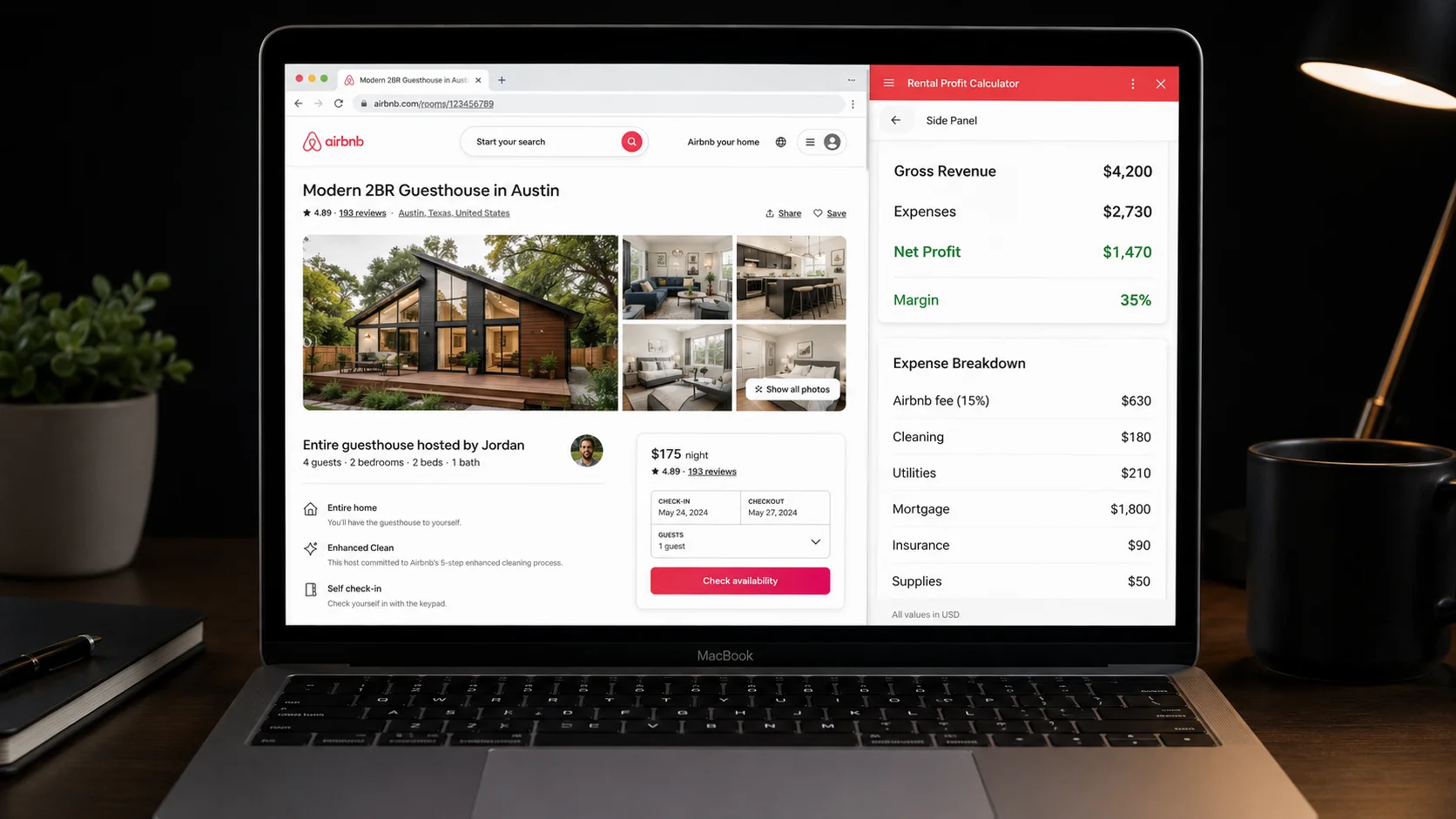
Net Profit = Gross Revenue − All Operating Expenses
Net Profit Margin = (Net Profit ÷ Gross Revenue) × 100
Example: $4,200 gross − $2,800 expenses = $1,400 net profit = 33.3% margin
The critical word is "all" in "all operating expenses." Most hosts calculate mortgage, cleaning, and supplies — and stop there. They miss insurance adjustments, maintenance reserves, platform fees on every booking, tax set-asides, and the cost of their own time managing the listing. When you include every real cost, the margin picture looks very different.
Every Expense Category That Affects Your Margin
Here is the complete expense inventory for an Airbnb property. Many of these are non-obvious or easy to forget:
| Expense Category | Typical Range | Notes |
|---|---|---|
| Mortgage / rent | Fixed | Largest fixed cost; determines your break-even occupancy |
| Airbnb host service fee | 3% of booking total | Deducted automatically before payout |
| Cleaning costs | $50–$200/turnover | Scales with every booking; kills margin on 1-night stays |
| Supplies restocking | $30–$80/month | Toiletries, coffee, paper products, linens replacement |
| Utilities | $100–$350/month | Electricity, water, internet — often higher than expected |
| Insurance (STR policy) | $100–$300/month | Standard homeowners doesn't cover STR use |
| Property management | 10–30% of revenue | If using a co-host or management company |
| Maintenance reserve | 1% of property value/yr | $300K property = $250/month reserve |
| Furnishing depreciation | $50–$150/month | Amortize furniture/appliance replacement cost over lifespan |
| Platform tools / software | $20–$100/month | Pricing tools, PMS, channel manager |
| Self-employment taxes | 15.3% of net profit | Often missed by hosts not set up as an LLC |
The most commonly missed expense: maintenance reserve. Most hosts don't budget for appliance replacement, HVAC servicing, or furniture wear until something breaks. At 1% of property value annually, the reserve for a $350,000 property is $292/month — a significant margin impact that should be built into every profitability calculation.
Profit Margin Benchmarks by Property Type
What's a "good" Airbnb profit margin? It depends heavily on your property type, location, and ownership structure:
| Scenario | Typical Gross Revenue | Typical Expenses | Net Margin |
|---|---|---|---|
| Owned property, self-managed, top market | $5,000–$10,000/mo | $2,000–$3,500/mo | 35–55% |
| Owned property, self-managed, secondary market | $2,500–$5,000/mo | $1,500–$2,500/mo | 25–40% |
| Owned property, management company | $3,000–$7,000/mo | $2,500–$5,000/mo | 15–30% |
| Rental arbitrage (renting to sublet) | $3,000–$6,000/mo | $2,500–$4,500/mo | 10–25% |
| Room in primary residence | $800–$2,500/mo | $200–$600/mo | 40–70% |
If your actual margin is below the low end of your scenario, you're almost certainly underpriced, overspending on cleaning, or carrying too high a management fee. All three are fixable.
The Best Profit Margin Tools Compared
No single tool handles every aspect of Airbnb profit margin calculation. Here's what each category of tool does best:
AirPrice — Market Rate Benchmarking
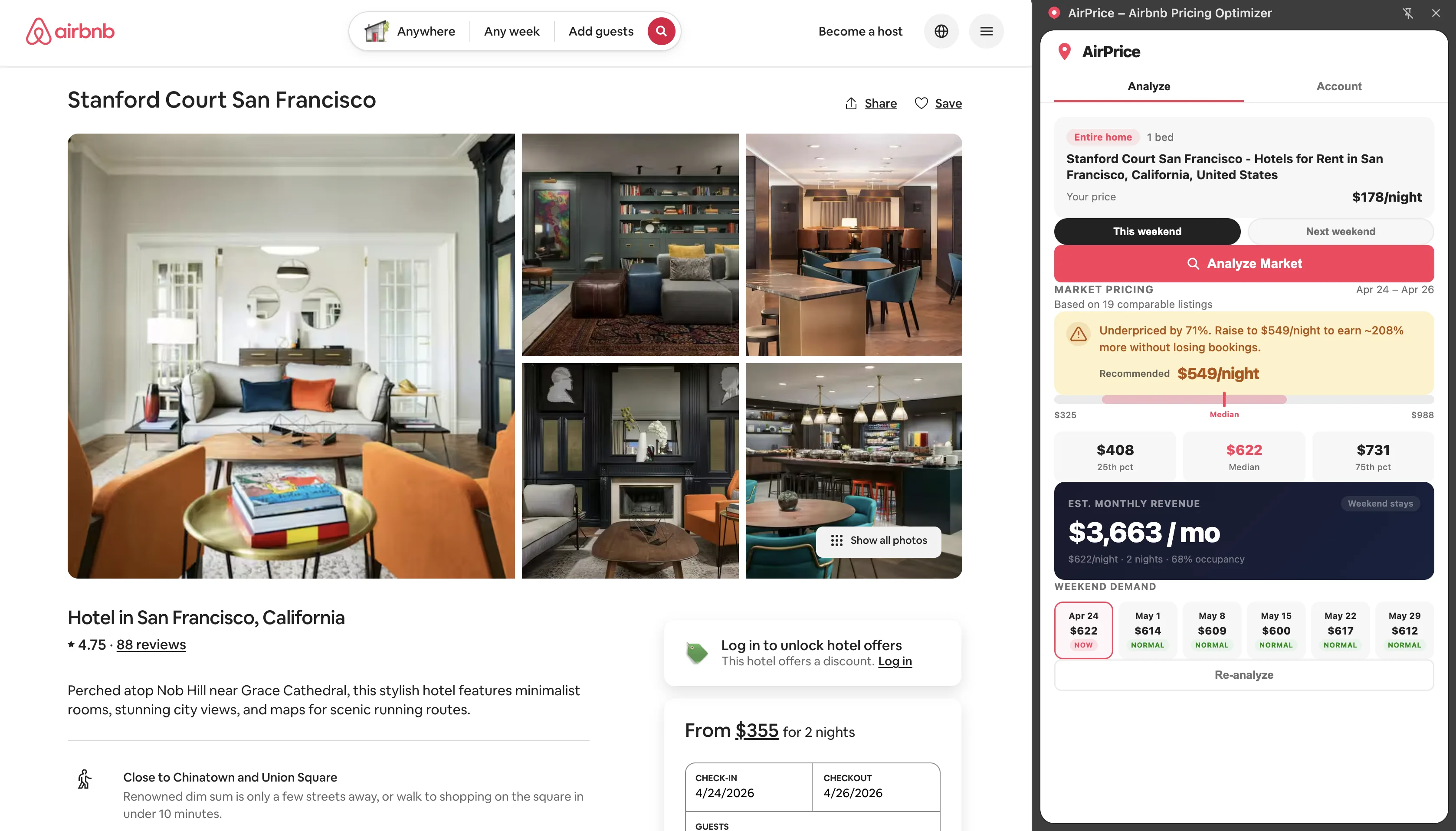
What it does: Pulls live pricing data from Airbnb search results for your market, bedroom count, and property type. Shows P25/P50/P75 of what comparable listings are charging this weekend and the next 6 weekends. Built-in Revenue Calculator lets you model gross revenue at any rate + occupancy combination.
Margin relevance: Gross revenue is the numerator in your margin calculation. If you're charging $140/night when the market median is $175, you're leaving $35/night on the table — that directly compresses your margin. AirPrice closes the information gap that causes most hosts to underprice.
Price: Free (5 analyses/month), Pro at $9.99/month for unlimited.
Hostaway / Lodgify — Property Management with P&L
What it does: Full property management systems with booking calendars, guest messaging, and financial reporting. Both have built-in P&L statements that track revenue and expenses per property across multiple channels.
Margin relevance: Ideal for hosts with 2+ properties. Tracks all income and major expense categories automatically. Does not benchmark rates against market — that's where AirPrice fills the gap.
Price: $50–$200/month depending on property count.
Google Sheets / Excel — Custom Margin Calculator
What it does: A well-built spreadsheet is the most flexible profit margin tool available. You can model any expense combination, run scenarios, and track actual vs. projected across months.
Margin relevance: Best for hosts who want full control and are willing to maintain it manually. Pair with AirPrice to populate the revenue side of the model with real market data rather than estimates.
Price: Free.
Quickbooks Self-Employed — Tax-Ready Expense Tracking
What it does: Connects to your bank accounts, categorizes income and expenses, and produces Schedule C-ready reports. Tracks mileage if you drive to the property, which is deductible.
Margin relevance: Critical for hosts who want accurate after-tax profit margin. The self-employment tax rate (15.3%) is a major real cost that a spreadsheet often ignores. Quickbooks surfaces it automatically.
Price: $17/month.
How AirPrice Fits Into Margin Optimization
Profit margin has two sides: revenue and expenses. Most margin improvement tools focus on the expense side — track costs, cut waste, negotiate better cleaning contracts. That's valuable but limited. The faster path to a higher margin is usually increasing revenue, which means knowing exactly what the market is willing to pay.
AirPrice is specifically built for the revenue side. When you open any Airbnb listing page with AirPrice installed, you see:
- Live comp pricing — what the market is charging right now for similar listings
- Revenue Calculator — model gross revenue at any nightly rate + occupancy combination
- Weekday vs. weekend split — so you can price each period correctly rather than using one flat rate
- Occupancy score per comparable — see which nearby listings are filling up and at what price
- Trend badge — is the market trending up or down vs. last weekend, so you can adjust proactively
The practical workflow: run AirPrice to see your market rate, use the Revenue Calculator to model your gross revenue at that rate and your target occupancy, then plug that number into your spreadsheet or Quickbooks to calculate net margin. Market-accurate revenue inputs make your margin calculation useful rather than optimistic.
5 Ways to Improve Your Airbnb Margin Today
Benchmark your rate against real comps
The single fastest margin improvement for most hosts is discovering they're underpriced. Run AirPrice on your listing. If your current rate is below the P45 of comparable listings in your market, you can raise your rate without meaningful occupancy loss — and directly improve your margin with no additional effort.
Raise minimum stay during peak periods
Each cleaning is a fixed cost. Four 2-night bookings cost 4× as much to clean as one 8-night booking, but generate similar revenue. During peak season, a 3–4 night minimum reduces cleaning frequency and improves net margin without changing your nightly rate.
Audit your cleaning cost per occupied night
Divide your monthly cleaning cost by the number of nights booked. If cleaning cost per night is above 15% of your average nightly rate, you either have too many short stays (raise minimum night requirement) or your cleaning vendor is overpriced (get a second quote).
Set a proper STR insurance policy
Hosts running Airbnb on a standard homeowners policy are underinsured. Airbnb's AirCover is supplemental, not a substitute for a proper STR policy. Getting correctly insured eliminates the massive unplanned expense risk that can destroy a year of profits in a single incident. STR insurance typically costs $100–$250/month — far less than a liability claim.
Budget a monthly maintenance reserve
Appliances break, furniture wears, decks need sealing. Hosts who don't budget for this treat repairs as surprise expenses that look like margin disasters. A monthly reserve of 1% of property value annually — even in a savings account — means repairs come from a planned budget, not your operating profit.
Bottom line: The hosts with the highest Airbnb profit margins consistently do three things: they price accurately against real market data (not gut feel), they minimize cleaning frequency through smart minimum-stay policies, and they plan for maintenance rather than being surprised by it. AirPrice handles the pricing side; the rest is operational discipline.
For more on maximizing your Airbnb income, see our guides on the complete Airbnb revenue optimization framework and how to set your nightly rate using real market data.