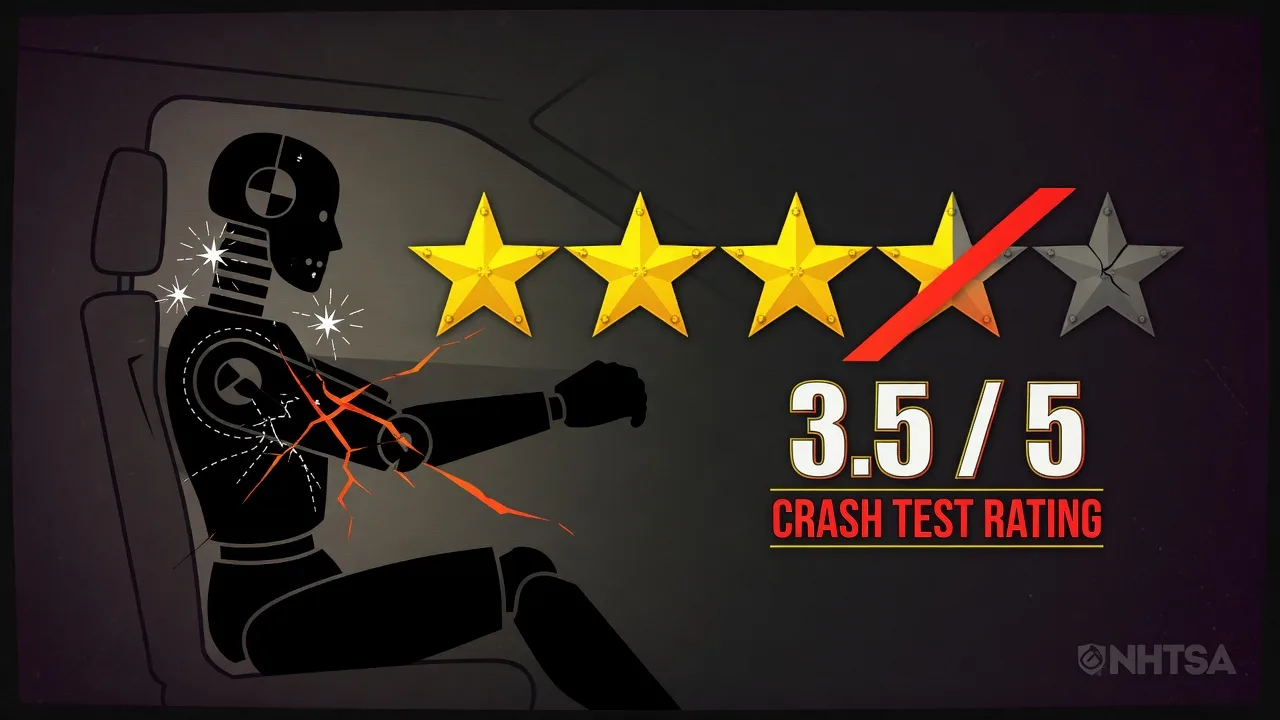
What NHTSA's Five Star Safety Ratings program tests
NHTSA's Five Star Safety Ratings are the result of a standardized physical crash testing program — not computer simulations. Vehicles are purchased by NHTSA from dealers or manufacturers and crashed under controlled conditions at a test facility. The results are published publicly and never paid for or influenced by automakers.
The program tests three crash scenarios that represent real-world collision types:
- Frontal crash: A head-on collision test at 35 mph into a full-width rigid barrier, simulating a collision with another vehicle of similar size
- Side crash: A moving deformable barrier strikes the side of the vehicle at 38.5 mph, simulating being T-boned at an intersection
- Rollover resistance: A dynamic driving maneuver test combined with a static stability factor (the ratio of track width to center of gravity height) — not a physical rollover crash
Each test produces a star rating from 1 to 5. An overall vehicle rating is also calculated as a weighted composite of all three tests.
| Star Rating | Risk Level | Buying Guidance |
|---|---|---|
| ⭐⭐⭐⭐⭐ (5 stars) | Lowest risk | Excellent — safest choice in class |
| ⭐⭐⭐⭐ (4 stars) | Low risk | Good — acceptable for most buyers |
| ⭐⭐⭐ (3 stars) | Moderate risk | Caution — check which specific tests scored low |
| ⭐⭐ (2 stars) | High risk | Avoid for families; consider alternatives |
| ⭐ (1 star) | Very high risk | Do not buy; safety risk is severe |
| Not rated | Unknown | Request independent crash test data; proceed cautiously |
| Test Category | What It Measures |
|---|---|
| Frontal crash (full width) | Head-on collision protection for driver and front passenger |
| Frontal crash (offset, small overlap) | Partial front impact — most common real crash type |
| Side crash (moving deformable barrier) | T-bone collision from another vehicle |
| Side crash (pole) | Narrow-object side impact (tree, pole) |
| Rollover resistance rating | Likelihood of rolling over in a swerve maneuver |
What the stars mean in practice
NHTSA defines the star thresholds as probability of serious injury in the tested crash type:
- 5 stars: 10% or less probability of serious injury
- 4 stars: 11–20% probability
- 3 stars: 21–35% probability
- 2 stars: 36–45% probability
- 1 star: Greater than 45% probability
A 5-star overall rating means the vehicle performed well across all three tests. A 4-star overall can mask a lower score in one specific test — which is why reviewing the individual category scores matters.
Which rating to focus on for your situation
Frontal crash — most important for highway driving
Frontal collisions account for roughly 55% of crash fatalities. If you drive on highways regularly or are concerned about high-speed collisions, prioritize the frontal crash rating. Look for 4 or 5 stars in this category specifically.
Side crash — most important for urban and suburban driving
Side-impact crashes are most common at intersections — a daily risk for city and suburban drivers. Vehicles vary more in side crash performance than frontal, partly because door structure and side airbag coverage differ significantly across makes and years. A 5-star frontal with a 3-star side score is a common pattern on older vehicles.
Rollover — most important for SUVs and trucks
Rollover ratings matter most for taller vehicles: SUVs, crossovers, pickups, and vans. A low rollover score on a sedan is less concerning (sedans rarely roll); a 2-star rollover on an SUV you're buying for a family is worth taking seriously. The rollover rating is heavily influenced by the vehicle's height relative to its wheelbase — physics that don't change with year or trim.
What NHTSA ratings don't cover
NHTSA's program has limitations worth knowing:
Not all vehicles are tested. NHTSA tests a selection of vehicles each model year — low-volume models or older vehicles may have no rating at all. "Not rated" doesn't mean unsafe; it means untested.
NHTSA and IIHS are different programs. The Insurance Institute for Highway Safety (IIHS) runs its own crash tests with different scenarios (smaller overlap frontal, roof strength, headlight ratings). A vehicle can have strong NHTSA ratings and poor IIHS scores, or vice versa. For a complete safety picture, check both — CarWise surfaces the NHTSA data; for IIHS data, check iihs.org directly.
Ratings don't account for maintenance. A 5-star-rated vehicle with worn tires, degraded airbag sensors, or a frame that's been poorly repaired after a prior accident doesn't perform like a 5-star vehicle. Safety ratings describe the vehicle as tested when new.
Using CarWise to check ratings on any listing
CarWise surfaces the NHTSA overall, frontal, side, and rollover ratings for the exact vehicle on any listing page — without you needing to look up the VIN on NHTSA's site separately. Open the listing, read the panel, and you have everything you need in one place alongside the price data.