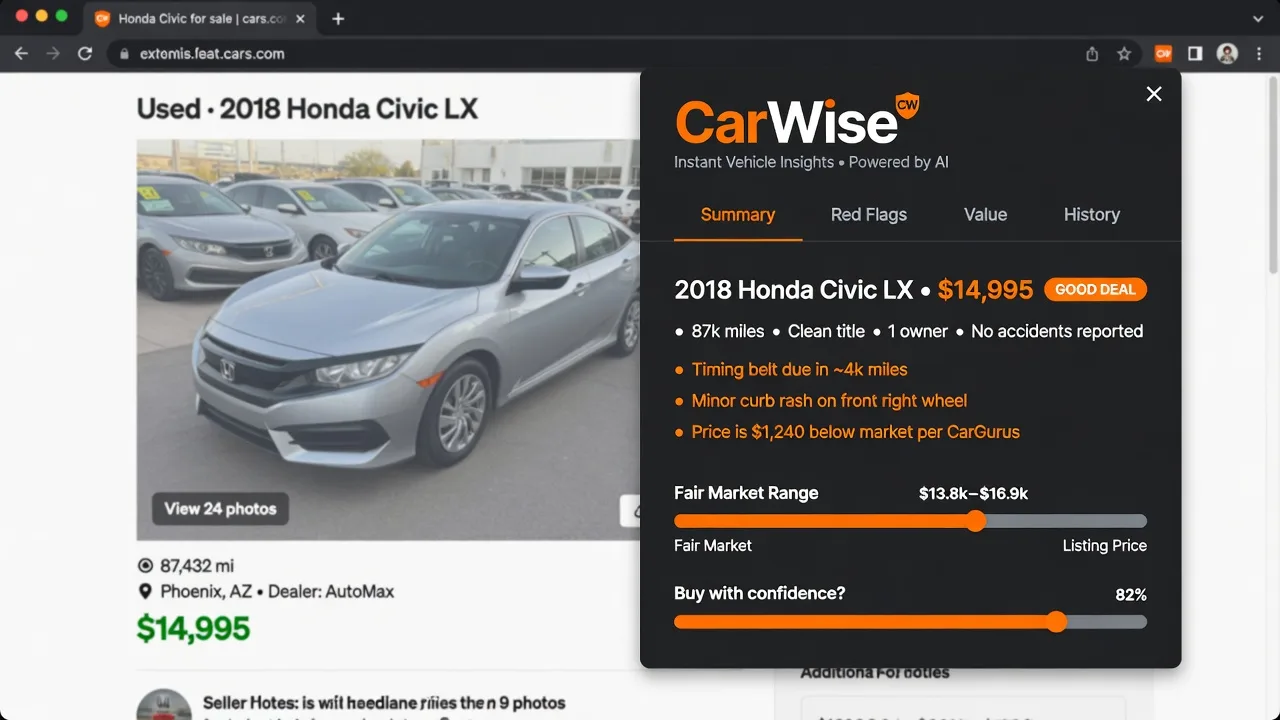
Why a visual inspection isn't enough
Used cars look fine. That's the problem. A vehicle can have three open NHTSA recalls, a crash test rollover rating of 2 stars, and a dealer asking price that's $4,000 above private party market value — and you'd have no idea from a walk-around and a test drive.
The information exists. NHTSA maintains a public database of every recall ever issued. Crash test ratings are published for every tested vehicle. Market value data exists for every make, model, trim, and mileage combination. The issue is that pulling it all together used to require visiting four separate websites and doing math. CarWise does it in seconds, right inside the listing you're already looking at.
| Check | What to Look For | Red Flag |
|---|---|---|
| VIN decode | Make, model, trim, drivetrain match listing | VIN doesn't match title or plates |
| Open recalls | Any unrepaired safety recalls via NHTSA | Takata airbag, brake, steering recalls open |
| Safety ratings | NHTSA 5-star overall; IIHS Top Safety Pick | Below 3 stars on crash test |
| Market value | Within 10% of KBB / CarWise estimate | Listed 20%+ above market with no justification |
| Title history | Clean title; no salvage/flood/lemon | Salvage, rebuilt, or flood title |
| Odometer | Matches service records and wear | Implausibly low miles for age; odometer rollback signs |
| Test drive | No warning lights, smooth acceleration, no vibration | Check engine light, transmission slip, pulling |
| Pre-purchase inspection (PPI) | Independent mechanic report | Seller refuses PPI |
What to check before contacting a seller
There are four things worth knowing before you invest time in a viewing or negotiation:
- What the car actually is — the VIN tells you the exact trim, engine, and factory specs, not just what the seller wrote in the title
- Whether it has open recalls — unresolved recall work can be a safety risk and a negotiation point
- Its crash test safety rating — particularly important for family vehicles or high-mileage buys where you're taking on more risk
- Whether the asking price is fair — market value data tells you what comparable vehicles actually sell for, not what sellers hope for
How to run a CarWise check
Install CarWise and open any listing
Add CarWise to Chrome. Then open any listing on CarMax, Carvana, AutoTrader, Cars.com, CarGurus, KBB, Edmunds, TrueCar, Craigslist, or Facebook Marketplace. CarWise detects the VIN on the page automatically — no copy-pasting required.
Read the VIN decode
The CarWise panel opens with a full VIN decode: make, model, year, trim, engine, body style, and factory equipment. Cross-check this against the listing title. Mismatches — a listing that says "Sport" trim but decodes to base — are red flags worth raising before viewing.
Check for open recalls
CarWise pulls current open recall status from NHTSA's database. If the vehicle has open recalls, you'll see what system is affected (brakes, airbags, steering, etc.) and whether the remedy part is available at dealers. Open recalls are free to repair — but unresolved ones are a legitimate reason to negotiate or walk away.
Review the safety ratings
NHTSA crash test ratings cover four categories: overall, frontal crash, side crash, and rollover. CarWise displays all four for the exact vehicle. A 4–5 star overall is solid; 3 stars is acceptable; 1–2 stars on any individual test warrants a closer look before buying.
Compare the asking price to market value
CarWise shows three market value ranges for the vehicle: private party (what it sells for between individuals), trade-in (what a dealer would give you for it), and dealer retail (what dealers charge). Compare the asking price to the private party range — that's your anchor for negotiation. A price above dealer retail on a private sale is a clear signal to push back.
What to do with what you find
Open recalls: Ask the seller if the recall work has been done and request documentation. If not, use it as a negotiating point — the repair is free at a dealership, but the inconvenience is worth something, and it affects resale value if left open.
Low safety ratings: Not necessarily a dealbreaker, but worth factoring into your decision if you're buying for a family or planning to keep the car long-term. A 2-star rollover rating on an SUV that's priced at a significant premium over a 5-star alternative is useful context.
Above-market pricing: Bring the market value data to the negotiation directly. "According to the market value for this trim and mileage, comparable vehicles are selling in the $X–$Y range" is a more effective opener than "I think the price is too high."
Trim mismatch: If the VIN decode reveals the car is a lower trim than advertised, walk away or insist on a price correction. This is more common than most buyers expect, especially on private sales.