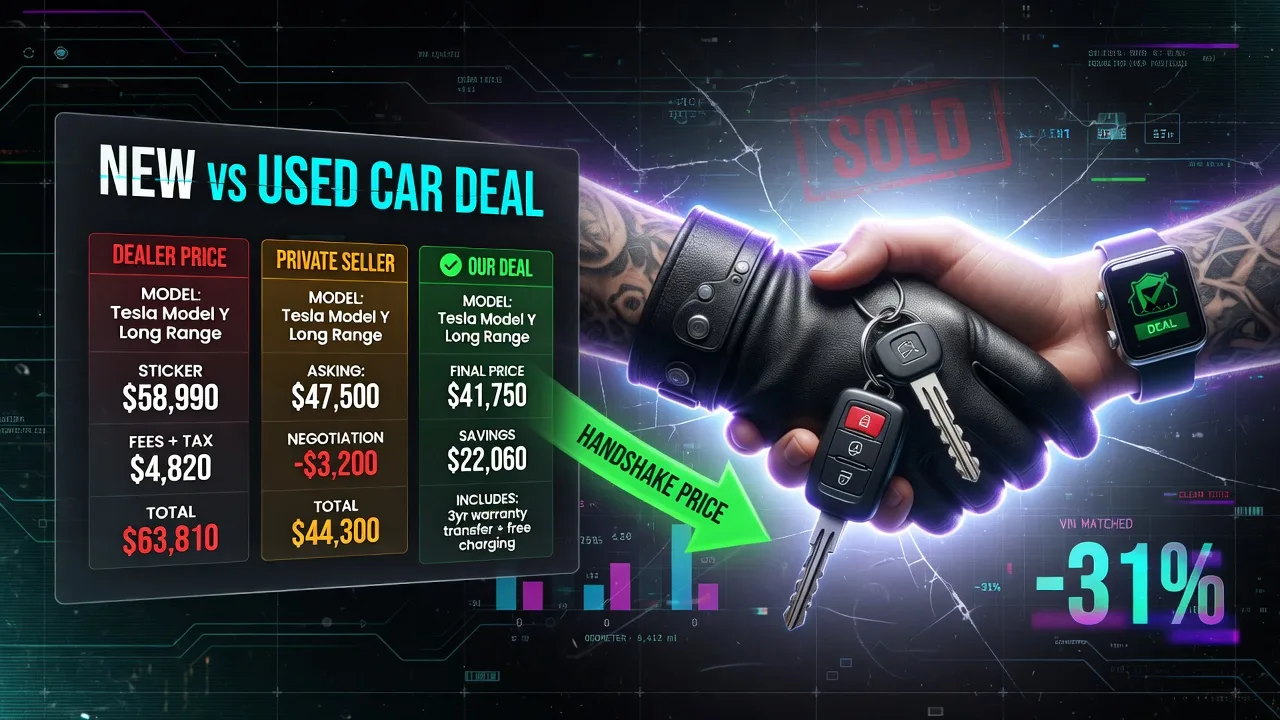
Why most buyers negotiate poorly
Most used car buyers go into a negotiation knowing only two numbers: the asking price and what they feel like paying. The seller — particularly a dealer — knows the vehicle's acquisition cost, the regional market demand, how long the car has sat on the lot, and exactly where their walk-away point is. The information asymmetry is enormous.
Data closes that gap. When you know the private party value, the dealer retail range, and the trade-in value for the specific vehicle you're looking at — and you can articulate that in the negotiation — you're having a different conversation than the buyer who says "is that the best you can do?"
| Listing Price vs. Market Value | Suggested Opening Offer | Realistic Target | Walk-Away Threshold |
|---|---|---|---|
| 15–20% above market | Market value - 5% | Market value | Walk away if >10% above |
| 10–15% above market | Market value - 3% | 5% below list | Walk away if >8% above |
| 5–10% above market | List - 4% | List - 7% | Market value is your floor |
| At market value | List - 3% | List - 5% | Only if truly at market |
| Below market value | List price (move fast) | List or slightly below | Don't lowball a deal |
Understanding the three market value numbers
CarWise shows three market value ranges for every vehicle. Knowing which to use when is as important as knowing the numbers themselves.
Private party value
This is what the vehicle trades for between individual sellers and buyers — no dealer margin, no lot overhead. Private party value is your anchor for any private sale negotiation. If a private seller is asking above private party value, you have a clear, data-backed basis for a lower offer.
Dealer retail value
This is what dealers charge on their lots — it includes reconditioning costs, overhead, and dealer margin. Dealer retail is the ceiling for private sale negotiations: a private seller asking above dealer retail for a car with no warranty and no CPO certification is pricing themselves out of the market.
Trade-in value
This is what a dealer would pay for the vehicle — the floor. Trade-in value is useful context for understanding total dealer margin, but it's not your primary negotiating anchor when buying.
How to structure your offer
Run the CarWise check before any conversation
Pull the market value data on the listing before you contact the seller or visit the lot. Note the private party range, the dealer retail ceiling, and any open recalls or safety issues that could justify additional discount.
Calculate your target price and walk-away price
Your target is the midpoint of the private party range (for private sales) or the lower end of dealer retail minus expected margin (for dealers). Your walk-away price is the top of the private party range — the point beyond which you're overpaying relative to market.
Make a specific, anchored opening offer
Lead with a number, not a question. "Based on the current private party value for this trim and mileage, I'd like to offer $X" is a stronger opener than "what's the lowest you'll go?" The first approach puts a number on the table anchored to data; the second invites the seller to defend their asking price.
Layer in any issues you found
Open recalls, low safety ratings, above-average mileage for the year, or known model-year reliability issues all support a lower offer. Present these factually: "The CarWise check shows two open recalls on this vehicle. Scheduling the dealer repair will take time and coordination — I'd like to factor that in."
Dealer-specific tactics
Negotiate the price before discussing trade-in or financing. Dealers make money on three transactions: the sale price, the trade-in spread, and the financing. Getting a good price on the car only to lose it on financing or an undervalued trade-in is a common outcome. Agree on the vehicle price first, in writing, before any other numbers enter the conversation.
Watch the F&I office. Finance and Insurance is where dealers recover margin they gave up on the sale price. Extended warranties, GAP insurance, paint protection, tire and wheel coverage — every add-on presented there is a profit center. CarWise's F&I protection guide explains which products have value and which are near-pure profit for the dealer.
The "if I could, would you" close works both ways. Dealers use it: "If I could get the price to $X, would you drive it home today?" You can use the same structure: "If I could confirm the open recall work is completed before delivery, would you hold the car for 48 hours?" Conditional language de-escalates pressure.
When to walk away
Walk away when the seller won't move below their asking price and that price exceeds the private party market ceiling — especially on a private sale with no warranty. There will be another car. The used car market is not scarce; most popular models have dozens of comparable listings within a reasonable radius.
Walking away is also a valid tactic. Sellers who won't move while you're in front of them sometimes call back. Even if they don't, you're not out anything — and you've protected yourself from a bad deal.