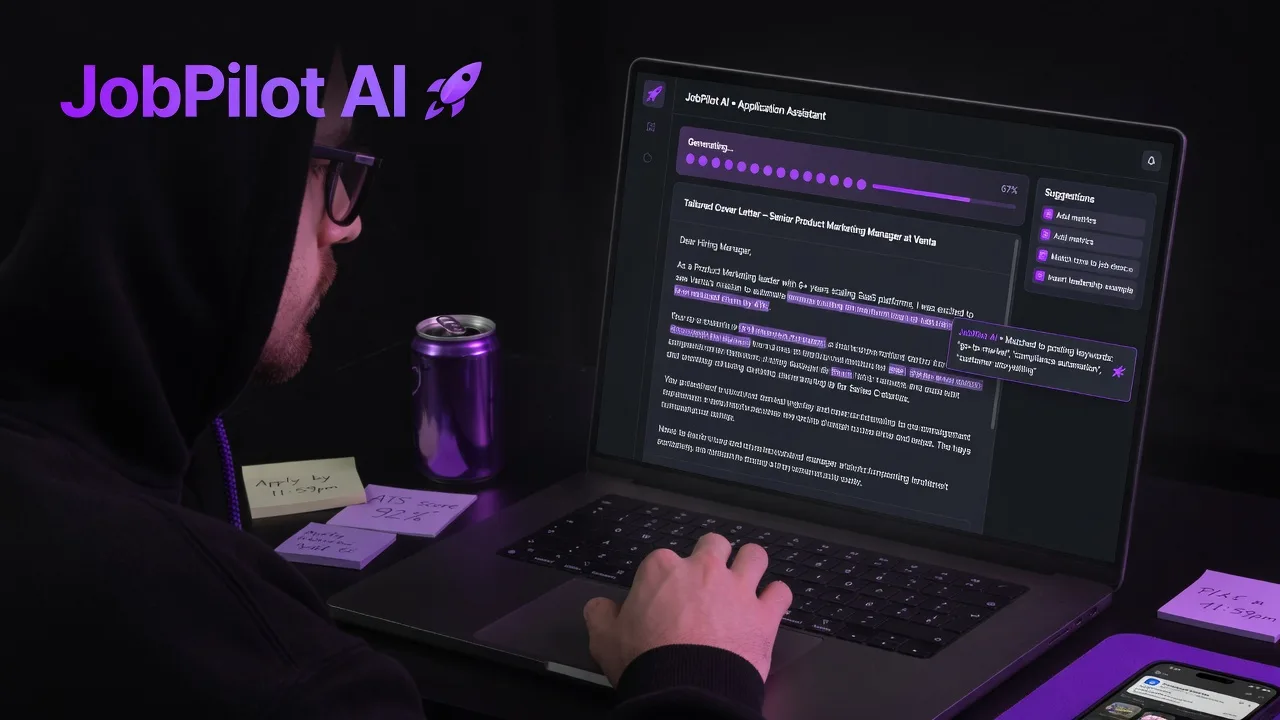
Why most AI cover letters fail
The failure mode isn't the AI — it's the input. An AI given a bare job title and a generic resume produces a generic letter. "I am excited to apply for the Software Engineer role at your company" is what happens when there's nothing specific to work with. The output is only as good as what you put in. If you already have a draft that reads as machine-written, here is how to make a cover letter sound less AI-generated.
JobPilot generates cover letters using the full job description it detects on the page, your complete resume, and any additional context you provide. The job description is the key ingredient most people skip when writing manually — and it's exactly what makes a tailored letter feel tailored.
What makes a cover letter feel human
Before you generate anything, it's worth knowing what you're aiming for. A cover letter that doesn't read like AI output has three things a generic one doesn't:
- A specific hook — the opening references something real about the company or role, not just the job title
- One concrete example — a specific achievement or project that maps directly to what the job is asking for
- A clear "why this company" — even one sentence that couldn't apply to every company they're interviewing with
JobPilot pulls the job description automatically — so the AI already has the specifics of what the role requires. Your job is to give it the material to work with on your side.
Setting up for a strong output
Upload a resume with specific achievements, not job duties
The most common resume mistake is listing what you were responsible for, not what you accomplished. "Managed social media accounts" produces a weak letter. "Grew Instagram following from 8K to 42K in 14 months through a weekly content series" gives the AI something specific to build around. Before you generate anything, make sure your resume has at least 2–3 quantified achievements per role.
Open the job listing before generating
JobPilot auto-detects the job title, company, and full description from the page. This is what lets it match your background to the specific requirements of the role. Don't generate from the extension popup without having the full job listing open — the specificity of the output depends on it.
Add a "why this company" note
In the additional context field, add one specific reason you want this job at this company. It can be brief: "They just launched a creator monetization product and my last role was in creator tools" or "I've used their product for two years and have opinions about where it should go." This single sentence is what makes the hook feel real rather than templated.
Read and adjust the output before sending
Don't send the first draft unread. Read it as if you were the hiring manager. If a sentence sounds like it could appear in any cover letter for any company, rewrite that sentence. The rest — structure, transitions, professional tone — the AI handles well. The specificity is your contribution.
| Element | Auto-Generate with AI | Personalize Manually |
|---|---|---|
| Opening hook | ✓ Role-specific first line | Add specific company achievement you admire |
| Skills match | ✓ Maps resume to JD requirements | Verify AI picked the right skills |
| Tone | ✓ Professional, direct | Adjust if company culture is casual or formal |
| Specific metrics | ✓ Pulls from resume if present | Add metrics not in resume |
| Company name / role title | ✓ Auto-filled | Verify correct spelling |
| Closing | ✓ Clear CTA | Optionally add specific availability |
| Entire letter | ✓ ~90% complete in < 2 min | Final read + light edit before submitting |
The sentences that immediately signal AI
If any of these appear in your generated letter, delete or rewrite them:
- "I am thrilled/excited/passionate about the opportunity to join..."
- "I believe my skills and experience make me an ideal candidate..."
- "I am a highly motivated and results-driven professional..."
- "I would be honored to contribute to your team..."
- Any sentence starting with "As a [job title], I..."
These phrases don't say anything. Replace them with a specific sentence about the role, the company, or a concrete thing you've done. One real sentence is worth more than five polished ones that are empty.
Length: shorter is almost always better
Recruiters spend 30–60 seconds on a cover letter. Three tight paragraphs — hook, relevant experience, why this company — is the right length. A fourth paragraph rarely adds value and usually dilutes the first three. JobPilot generates a standard three-paragraph structure; resist the urge to expand it.