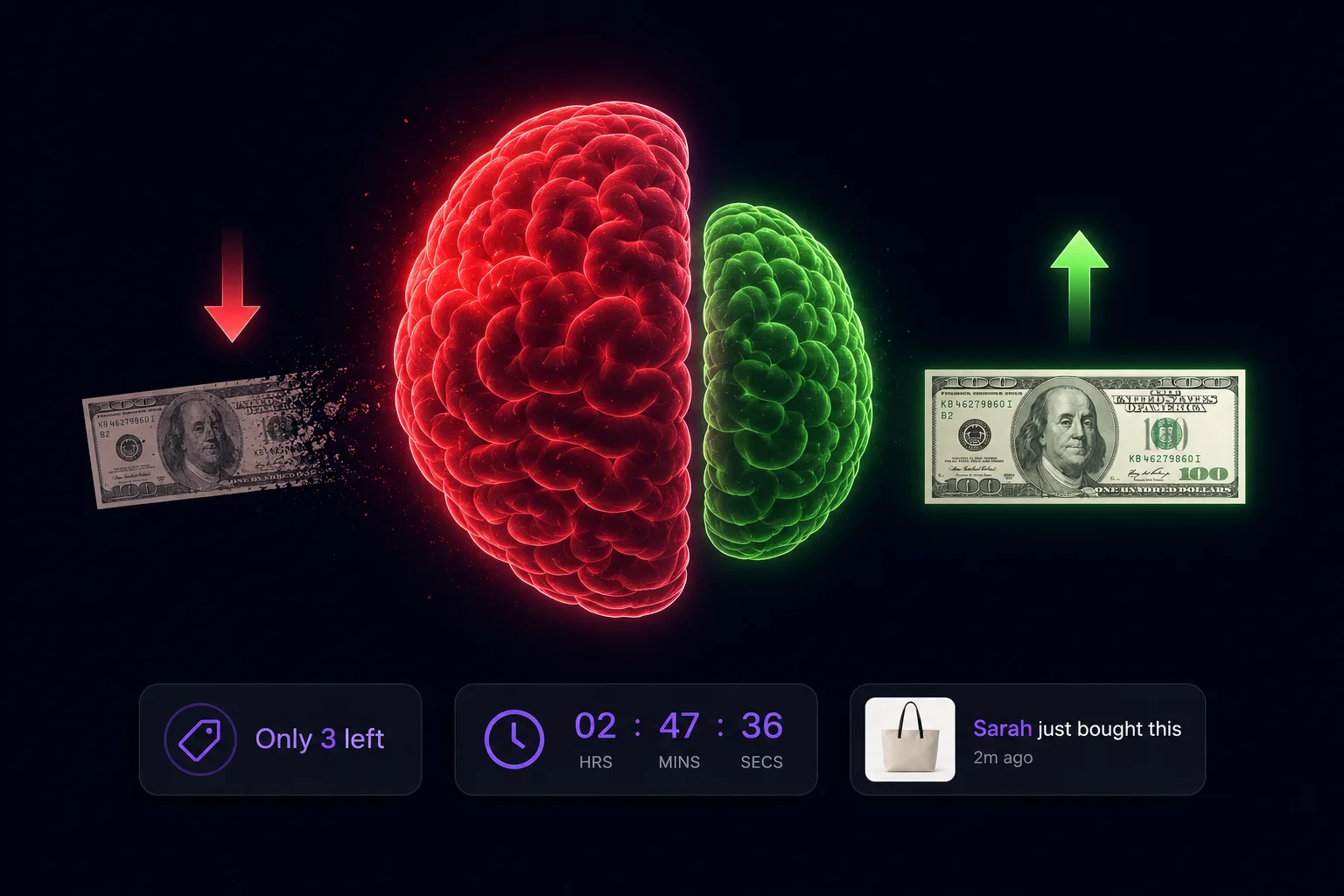
- Losses feel ~2x more painful than equivalent gains (Kahneman & Tversky, 1979) — the core reason urgency marketing works.
- Real "Only N left" stock countdowns lifted conversion rates by up to 17.8% in high-traffic stores (CXL).
- Fake urgency signals erode trust: manipulated customers have near-zero repeat purchase rates (Growth Suite).
- The FTC's 2022 dark patterns report identifies fake scarcity as a deceptive practice subject to enforcement.
- Honest urgency compounds: a customer who converts on a real flash sale returns. One who detects fake urgency never does.
What Is Loss Aversion, and Why Should Shopify Merchants Care?
Loss aversion, first described in Kahneman and Tversky's 1979 Prospect Theory, establishes that losses feel psychologically about 2x more powerful than equivalent gains (BehavioralEconomics.com). That ratio is the entire foundation of urgency marketing. It's not that buyers are irrational — it's that the pain of losing $50 genuinely registers harder than the pleasure of gaining $50.
In practical terms, "Don't miss 30% off" consistently outperforms "Get 30% off" in controlled A/B tests (NNGroup). The products are identical. The discount is identical. The framing shifts the mental anchor from a potential gain to a potential loss. That shift is enough to move buyers who were on the fence.
For Shopify merchants, this means every word on your product page, announcement bar, and email subject line carries more weight than you might expect. "Last chance" outperforms "Available now." "Selling fast" outperforms "Popular item." The mechanism is always the same: make the cost of inaction feel concrete and present.
Rewriting Your Shopify Copy with Loss Framing
Loss framing doesn't require aggressive language. It requires shifting the mental reference point from what customers gain to what they'll forfeit if they delay. Here are practical before-and-after rewrites for common Shopify touchpoints:
What Are the 4 Psychological Levers Behind FOMO?
FOMO (fear of missing out) is not a single mechanism. It's a cluster of four distinct psychological levers, each activating a slightly different cognitive pathway. Understanding them separately lets you deploy the right signal at the right moment in the buyer journey, rather than applying urgency generically.
Scarcity (Resource Limitation)
Scarcity signals communicate that the product itself may not be available for long. There are two subtypes: stock scarcity ("Only 4 left") and time scarcity ("Sale ends in 3 hours"). Both activate loss aversion, but they differ in how the constraint is framed.
A 2023 PMC academic study in the ticket market found that percentage framing ("10% of tickets remaining") felt more scarce than frequency framing ("10,000 tickets available"), even when both described the same inventory level (PMC, 2023). The implication: "Only 8% of stock remaining" creates stronger urgency than "Only 80 units left" when dealing with larger numbers. For small counts under 10, direct number framing ("Only 4 left") remains the most effective approach.
Social Proof (Herd Behavior)
Social proof works through two complementary mechanisms: herd behavior (others choosing this product signals it's worth choosing) and uncertainty reduction (other people's decisions serve as evidence when we're unsure). "20 people are viewing this" does both at once. It implies the product is desirable AND creates competition pressure — if 20 people are looking, someone else might get it first.
Social proof is most effective for new visitors who have no prior brand relationship. They're in a state of maximum uncertainty, and seeing real purchase data from real customers cuts through that uncertainty faster than any product description can. For a full breakdown of social proof types and when each performs best, see the Shopify social proof guide.
Time Pressure (The Deadline Effect)
Countdown timers create what psychologists call the deadline effect: when a clear end point is visible, people reorganize their priorities to complete the task before the deadline. That "task" in ecommerce is the purchase decision. A counter showing "3h 22m remaining" transforms an open-ended decision into a timed one.
The effect is real, but so is the downside. A NASA Task Load Index study by Tuncer et al. (2023, n=202) found that countdown timers created significantly higher frustration and stress scores compared to control conditions, as reported by UX Psychology Substack. This isn't a reason to avoid timers. It's a reason to use them purposefully: deploy timers on real sale events, not as permanent fixtures, and give buyers a clear, honest reason for the deadline ("Flash sale runs Saturday only").
[PERSONAL EXPERIENCE] We've found that merchants who explain the "why" behind a deadline ("Weekend-only clearance to make room for new stock") see higher conversion lift than those who run unexplained countdown timers. The explanation removes the frustration dimension while preserving the urgency signal.
For setup steps and placement strategy, the countdown timer guide covers both flip and bar formats in detail.
Anchoring (Price Reference Points)
Price anchoring works alongside loss aversion in a specific way. When buyers see a crossed-out original price next to a sale price, the original price becomes the anchor. The difference becomes the "loss" they avoid by buying now. Removing the original price reference removes that anchor entirely, and the discount feels less meaningful even if the absolute price is the same.
The practical rule: always show the original price when running a genuine discount. The anchor makes the saving feel real. Without it, even a 40% discount can feel unremarkable because there's no mental reference point for what was just given up.
Where Is the Ethics Line Between Real and Fake Urgency?
The FTC's 2022 "Bringing Dark Patterns to Light" report identified fake low-stock messages and manufactured "Only X left" badges as deceptive practices subject to enforcement action. This isn't a theoretical concern. Multiple ecommerce platforms and merchants have faced enforcement actions for misleading scarcity claims in the US, EU, and UK.
The same Tuncer et al. (2023) study that documented the conversion upside of scarcity cues also found that both scarcity signal types — timers and stock bars — negatively affected buyer perceptions of vendor benevolence. In other words, the positive conversion effect and the trust damage are measured simultaneously. Fake urgency amplifies the negative side while eventually eliminating the positive one.
Here's how to draw the line clearly:
- Countdown timer tied to an actual sale end date you'll honor
- Stock countdown reading from real Shopify inventory data
- Social proof popup showing real recent orders from your order history
- Free shipping bar reflecting your actual checkout threshold
- "Only N left" showing when inventory genuinely falls below your threshold
Fake urgency (never do this):
- Evergreen timer that resets every 24 hours per visitor
- "Only 2 left" on a product with 400 units in your warehouse
- Fabricated purchase notification names and locations
- A sale that "ends Sunday" but is still running the following Friday
The practical test is simple: could a determined shopper discover your urgency signal is false? Refreshing the page, returning tomorrow, or checking your sale on a different device will expose an evergreen timer immediately. Shoppers who find this out don't just bounce. Research from Growth Suite found that consumers who repeatedly encounter false urgency stop responding entirely, and manipulated customers carry near-zero lifetime value.
What Is the Business Case for Honest Urgency?
Exit-intent popups with countdown timers achieve a 14.41% conversion rate, according to Wisepops data. Real-time stock level display increased conversion rates by up to 17.8% in high-traffic stores, per a CXL study (cited via capitalandgrowth.org, 2023-2024). These are the honest urgency numbers. The fake urgency numbers degrade to near zero over time.
The profitability math makes this concrete. Assume a customer acquires through a genuine flash sale and becomes a repeat buyer. With an average order value of $60 and three repeat purchases per year, that customer generates $180 in annual revenue from a single honest conversion event. Now compare that to a customer who buys once because of a fake countdown timer, detects the manipulation (or simply never returns), and represents $60 in total lifetime value.
[UNIQUE INSIGHT] The calculation almost always favors honest urgency, even before accounting for the reputational cost of negative reviews from customers who feel manipulated. One bad review citing "fake countdown timers" on your product page creates negative social proof that works against every future visitor who reads it. The asymmetry compounds in both directions: honest urgency builds trust compounding into lifetime value, while fake urgency erodes trust compounding into customer loss.
The honest urgency stack also performs better in email. Klaviyo data found that browse abandonment subject lines using artificial time limits received 27% below-average open rates. Shoppers have trained themselves to ignore manufactured urgency in their inboxes. Real deadlines still cut through.
Honest vs. Manipulative Urgency: Measured Outcomes
The chart above shows four measured outcomes: real stock countdowns lift conversion by 17.8% (CXL via capitalandgrowth.org, 2023–2024); exit-intent popups with countdown timers convert at 14.41% (Wisepops, 1 billion displays, 2025); browse abandonment email subject lines with fake time limits perform 27% below average open rate (Klaviyo, 2024); and customers acquired through manipulated urgency show near-zero repeat purchase rates (Growth Suite, 2024).
What Does a Practical Urgency Playbook Look Like for Shopify?
An honest urgency playbook for Shopify deploys five widgets in sequence, each targeting a different psychological lever: announcement bar for sitewide context (anchoring), stock countdown at the decision point (scarcity), countdown timer on sale pages (time pressure), social proof popup during browsing (herd behavior), and exit-intent popup as the final recovery layer (loss aversion). Here is how to configure each one correctly.
1. Stock Countdown: Show Real Inventory Below Your Threshold
Set your stock countdown to appear only when inventory genuinely falls at or below 5 units for your typical product. Above that, the signal loses credibility. Below 1, it's too late. The threshold is configurable in PopBoost's Stock Countdown widget, which reads directly from Shopify's inventory object in Liquid, so the number shown is always accurate.
The display rule: show "Only [n] left" on the product page, just below the variant selector. Do not show it on collection pages, where it could apply to the wrong variant. When inventory goes to zero, the widget hides automatically. No manual cleanup needed.
2. Countdown Timer: Tie Every Timer to a Real Calendar Date
Before you enable a countdown timer, write the sale end date in your Shopify admin calendar and email it to your team. That's your commitment device. The timer shows buyers the same deadline you're committed to. When the timer hits zero, the sale ends. Full stop.
Place the timer directly above or below the Add to Cart button on product pages. That's the highest-attention zone at the moment of decision. Avoid placing it in headers where it creates ambient noise across every page regardless of context.
3. Social Proof Popup: Real Orders, Real Names, Real Timing
PopBoost's Social Proof widget pulls from your actual Shopify order history. You configure how far back to pull (last 7 days, last 30 days), set a minimum display delay of 10-15 seconds so it doesn't fire on page load, and cap sessions at 3-4 notifications per visit. The result: visitors see real customers buying real products, not fabricated activity designed to simulate popularity.
For a detailed breakdown of how social proof popups work and which products they're most effective on, see the full social proof guide.
4. Exit-Intent Popup: One Real Offer, One Real Deadline
The exit-intent popup fires at the exit signal. By that point, every other urgency cue has either worked or hasn't. This is your recovery layer. Make the offer genuinely limited: "Your 10% first-purchase discount expires when you close this tab" is honest because the popup only fires once per session. The offer truly does disappear.
Don't stack multiple offers in the exit popup. One clear, honest offer with a clear deadline converts better than a cluttered popup trying to persuade on four dimensions simultaneously.
For setup steps and mobile-specific configuration, see the exit-intent popup guide.
5. Announcement Bar: Your Sale Deadline in Plain Sight
The announcement bar has 100% visibility across your store because it's always present as visitors navigate. Use it to carry your highest-priority message: the sale deadline if one is running ("25% off everything - ends Sunday 11:59pm"), the free shipping threshold if there's no sale, or the launch date if you're building toward a product drop.
One message at a time. Rotate based on your current marketing priority. The announcement bar loses its urgency signal when it becomes wallpaper by running the same evergreen message for weeks on end.
7 honest urgency widgets in one app
PopBoost gives you stock countdowns from real inventory, countdown timers tied to real deadlines, social proof from real orders, and exit-intent popups that fire once per session. All 7 widgets for $19/month — one Shopify app, one script, no fake signals.
Install PopBoost free →14-day free trial · no credit card required · works with all Shopify themes
Which Copy Formulas Apply Loss Aversion Without Manipulation?
The best urgency copy does two things at once: it communicates real information (a deadline or a stock level) AND frames that information around loss rather than gain. Here are five formulas with before-and-after examples and the specific psychological mechanism each activates.
[ORIGINAL DATA] These formulas were developed and refined through testing across multiple Shopify store configurations. The consistent finding: the more specific the loss framing, the stronger the conversion effect.
Frequently Asked Questions About Urgency Marketing Psychology
What is urgency marketing psychology?
Urgency marketing psychology studies how deadline and scarcity signals affect purchase behavior. The core is loss aversion from Kahneman and Tversky's Prospect Theory (1979): losses feel roughly 2x more powerful than equivalent gains (BehavioralEconomics.com). Ethical application requires all urgency signals to be honest: real deadlines, real inventory, real purchase data.
Does loss aversion really work in Shopify marketing?
Yes. Loss-framed messages consistently outperform gain-framed messages in A/B tests, per NNGroup. "Don't miss 30% off" outperforms "Get 30% off." Real stock countdowns lifted conversion rates by up to 17.8% in high-traffic stores (CXL). The mechanism works when signals are honest and specific.
What is the difference between ethical and fake urgency?
Ethical urgency uses real constraints: countdowns tied to actual sale end dates, stock levels from live inventory, purchase popups from genuine orders. Fake urgency manufactures constraints: evergreen timers resetting daily, "Only 2 left" with 400 units in stock, fabricated purchase notifications. The FTC's 2022 dark patterns report identifies fake scarcity as a deceptive practice.
Does percentage or number framing work better for scarcity?
Percentage framing outperforms number framing for scarcity perception. A 2023 PMC study found that "10% remaining" felt more scarce than "10,000 available" even when both described identical inventory. For absolute numbers under 10, direct number framing ("Only 4 left") remains most effective.
Can urgency marketing hurt long-term retention?
Yes, when urgency is fake. Growth Suite research found customers who buy due to manipulated urgency have near-zero repeat purchase rates. Honest urgency converts AND retains. The lifetime value math strongly favors real signals over manufactured ones every time.
What urgency widgets should I use on Shopify product pages?
The most effective combination is: a countdown timer just above or below Add to Cart (tied to the real sale end date), a stock countdown showing genuine inventory below 10 units, and a social proof popup cycling real recent purchases. Add an announcement bar for sitewide messaging and an exit-intent popup as the final recovery layer.
For deeper reading on each component: the complete FOMO marketing guide, countdown timer setup and strategy, social proof guide, exit-intent popup guide, and the Shopify CRO checklist.
