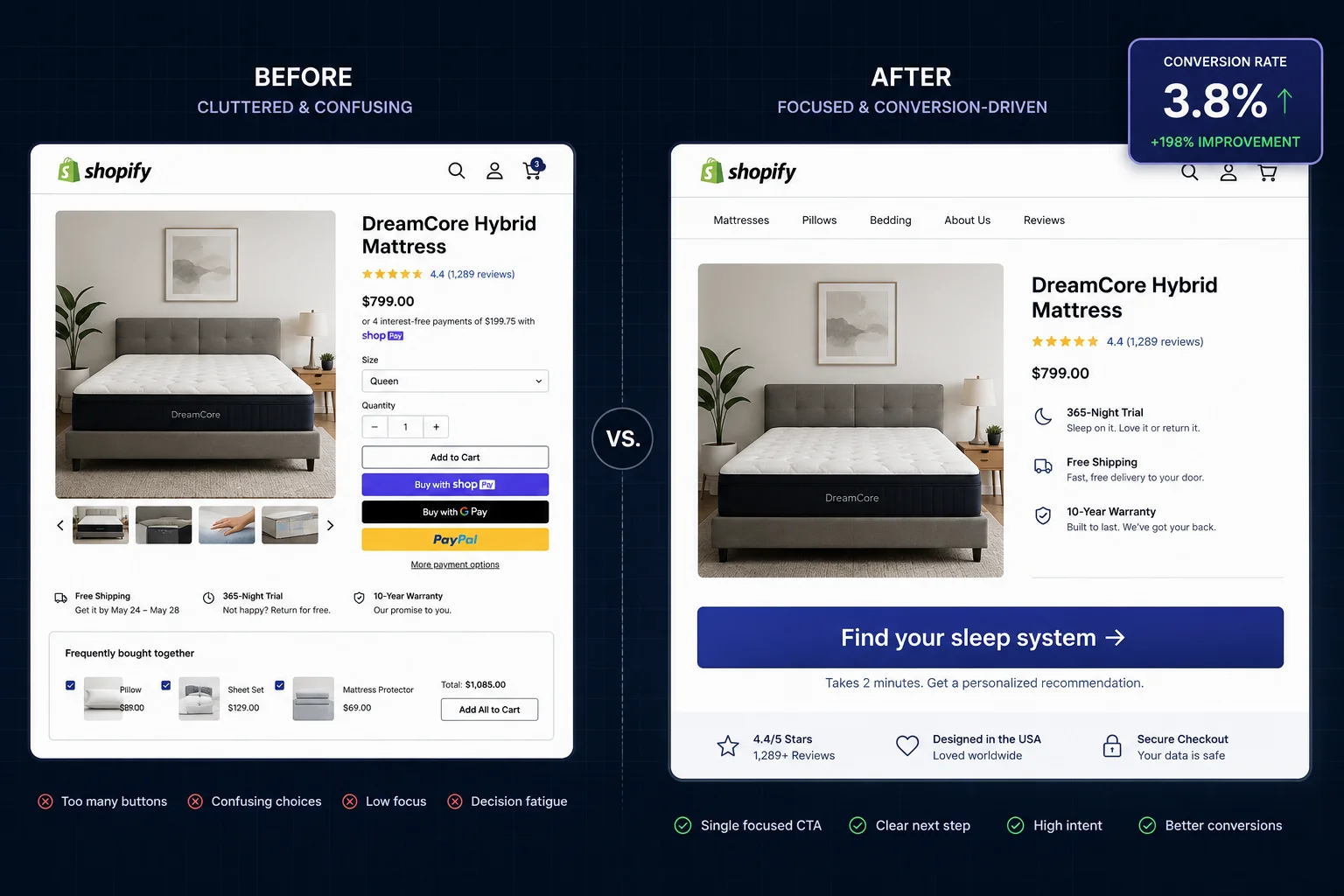
Most sleep store founders ask the same question: "My traffic is decent, but why won't people buy?" The answer is almost never pricing, design, or product quality. It's structure. Sleep is a high-consideration purchase — customers need guidance before they commit. Without that guidance, they browse, hesitate, and leave.
The seven tactics below are structural fixes. They don't require a rebrand or a developer. Each one addresses a specific dropout point in the purchase journey that's particularly acute for sleep stores, where the customer is making decisions about something as personal as how they sleep at night.
What Is a Good Conversion Rate for a Shopify Sleep Store?
The average Shopify store converts at 1.4% (Shopify, 2024). Top-quartile sleep stores hit 3–5% by combining guided selling — a personalized sleep quiz — with an automatic bundle incentive at checkout. Without these two elements, sleep stores typically convert at 1.2–1.8% due to the high-consideration nature of the purchase.
| Store Type | Avg CVR | Top Quartile CVR |
|---|---|---|
| All Shopify stores | 1.4% | 3.2% |
| Sleep & bedding DTC | 1.6% | 4.1% |
| Wellness supplements | 2.1% | 5.8% |
| Apparel | 1.2% | 2.9% |
Sleep DTC starts slightly above the all-store average because buyer intent is higher — someone searching for a sleep product has already identified a problem. But the ceiling is much higher than most stores achieve. Quiz-driven personalization compounds with bundle incentives in a way most categories can't replicate, because the functional dependency between sleep products is prescriptive, not aspirational.
A customer who tells you they sleep on their side and run hot has given you enough information to recommend a specific pillow, a specific topper, and a cooling variant of both. No other category gives you that level of purchase-relevant signal from a 5-question flow.
Tactic 1: Replace Category Browsing With a Guided Sleep Quiz
Quiz completers convert at 4–8% vs. 1–2% for browse-and-buy visitors (Sleepmaxing internal data). That's a 3–4x lift from one structural change — replacing a passive navigation experience with an active guided flow.
Why does browsing underperform so badly for sleep? Category browsing forces the customer to make multiple sequential decisions: which product type, which variant, which combination. Each decision is a potential dropout point. A customer who has to choose between 14 pillow options and doesn't know what firmness they need will click away. It's not that they don't want to buy. It's that you've handed them a problem instead of a solution.
A quiz inverts this dynamic entirely. One flow, five questions, one recommended output. Choice paralysis drops from a browsing problem to a solved problem. The customer doesn't choose between products — they answer questions about themselves, and the quiz tells them what they need.
The Sleepmaxing quiz captures sleep position, temperature preference, firmness, fill type, and budget in five questions — roughly 90 seconds of the customer's time. The output is a tailored product recommendation, or a full sleep system, rather than a filtered category page. That distinction matters: a filtered page still shows 6–8 products. A recommendation shows 2–3, pre-matched to the customer's answers.
For a deeper look at the conversion mechanics, see how a Shopify product quiz doubles conversion rate.
Tactic 2: Surface the Bundle Discount Before Checkout
Most merchants show the bundle discount in the cart or at checkout. The better placement is the quiz results page, immediately after the recommendation — when the customer is at peak engagement.
A "Build your sleep system — add one more item and save 15%" prompt on the quiz results page drives 22% higher multi-item attach rates than showing the discount only at checkout. The psychology is straightforward: the customer has just received their personalized recommendation. They're engaged. That's the moment the bundle offer is most persuasive — not three minutes later when they're reading a checkout summary and second-guessing the total.
Late-stage discounts feel like a last-ditch upsell. The customer notices, and it reads as desperation. An early-stage bundle prompt feels like a natural extension of the recommendation: "You've got the pillow — the topper pairs with it and you save 15% together." That's a genuinely helpful framing, not a sales tactic.
For the technical mechanics of how automatic discounts fire without coupon codes, see how automatic bundle discounts work on Shopify.
Tactic 3: Add Social Proof at the Product Decision Moment
Generic homepage reviews convert less effectively than specific proof at the exact decision point. "4.9 stars, 1,240 reviews" in the site header is background noise. A review from someone with the same sleep profile as the quiz-taker, shown at the moment of decision, is active persuasion.
Position-specific reviews on quiz results
Show reviews from customers with the same sleep position as the quiz-taker. "As a side sleeper who runs hot, this cooling topper completely changed my sleep" is worth 10x a generic five-star review to another side-sleeping hot sleeper. The specificity creates instant identification. The customer recognizes themselves in the reviewer's situation.
Most review platforms let you tag reviews by customer attributes or filter by keyword. Pull side-sleeper language, hot-sleeper language, and outcome-specific language ("I stopped waking up at 3am") and surface those reviews on the matching quiz result variants.
Volume signal on the quiz CTA
"2,400 people built their sleep system this month" on the quiz entry point adds social pressure to participate. It positions the quiz as a popular, trusted path rather than a sales mechanism. Most brands put volume signals on product pages ("1,200 sold"). Put it on the quiz CTA instead. You're telling the customer that taking the quiz is the thing everyone does — not that a product is popular.
Sleep-outcome language in reviews
Sleep-specific reviews that describe outcomes convert better than product-quality reviews. "I finally stopped waking up at 3am" lands differently than "great material, fast shipping." Outcome language speaks to the customer's actual purchase motivation. If you have outcome-language reviews in your database, prioritize surfacing them on the quiz results page and product pages over quality-language reviews.
Tactic 4: Speed Up the First Decision With a Single Quiz CTA Above the Fold
A homepage with a single primary CTA — "Find your perfect sleep system" pointing to the quiz — outperforms a multi-CTA homepage by roughly 18% CVR for first-time visitors. The mechanism is removing the meta-decision that precedes every other decision.
Most sleep store homepages offer four to six competing CTAs: Shop Now, Best Sellers, New Arrivals, View All Products, Build a Bundle, Take the Quiz. Each option dilutes conversion. Before a customer can decide what to buy, they have to decide which path to take. That's an invisible friction point most store owners never measure — and it compounds with every additional navigation option you add.
A homepage with a single primary CTA removes the meta-decision entirely. First-time visitors hit one clear path. The word choice matters: "Find your perfect sleep system" implies a personalized outcome, not just a navigation option. "Shop Now" tells the customer nothing. "Find your perfect sleep system" tells them they're going to get something tailored.
Secondary CTAs — collections, best sellers — can live below the fold for customers who prefer to browse. Returning customers or customers with a specific product in mind will find them. But first-time visitors who don't know what they need should hit one clear, single conversion path. Give them that.
Implementation note: Test the single-CTA homepage against your current homepage for 7–14 days before making it permanent. Even a 10–15% improvement on first-visit CVR compounds significantly at scale. Use Shopify's built-in A/B test framework or a tool like Google Optimize if you need statistical confidence before committing.
Tactic 5: Use Urgency That's True for Sleep Products
Sleep brands are built on trust. The customer is literally talking about their sleep quality — something personal and vulnerable. Manufactured scarcity backfires more severely in sleep than in most categories because it undermines exactly the credibility the brand is trying to build.
Countdown timers that reset, fake "only 2 left" badges on high-stock products, and artificially urgent copy — all of these work against you in sleep. Customers who notice manufactured urgency don't just ignore it. They lose trust in the brand. And in a category where the purchase decision is slow and considered, lost trust means the customer doesn't come back.
What urgency signals actually work for sleep stores:
- Real low-stock counts pulled from Shopify inventory on quiz-recommended products. If there are actually three left, say so. Customers who've completed a quiz and received a specific recommendation respond to real scarcity signals because they've already invested in the purchase decision.
- Shipping deadline urgency tied to actual carrier cutoffs. "Order in the next 4 hours for delivery by Friday" — when that's factually true — converts because the customer understands the mechanism. It's not a sales trick. It's logistics.
- Seasonal bundle availability for genuinely limited bundles. A "Summer Sleep System" bundle available only through August 31 is legitimate scarcity because it's real. Build limited bundles that have a real end date and communicate that clearly.
The test for any urgency signal: "Would this make me angry if I found out it wasn't true?" If yes, don't use it. Sleep customers notice, and the trust cost is much higher than the short-term conversion lift.
Tactic 6: Optimize the Quiz Results Page as Your Product Detail Page
The quiz results page is where the conversion decision happens. Most stores treat it as a simple list output. It should function as a dedicated product detail page for the recommended sleep system — with the same sales-page rigor you'd apply to your highest-converting PDP.
The quiz results page needs four specific elements to maximize CVR. First, benefit-specific copy per product: not the product name and price, but what it solves for this specific customer. "This side-specific pillow keeps loft stable all night" is more effective than "Premium Down Pillow - $89." The customer has already told you their sleep position. Use that information in the copy.
Second, a bundle savings calculator: "Your sleep system: $195. Bundle discount: -$29. You pay: $166." Make the savings visible and concrete. Customers who see explicit math on their savings convert at higher rates than customers who have to calculate it themselves.
Third, a prominent add-to-cart button visible without scrolling on mobile. This sounds obvious, but most quiz result pages require a scroll to reach the ATC on a phone. That single friction point costs real conversions. Check your quiz results page on mobile right now. If the ATC button isn't above the fold, fix it today.
Fourth, a one-more-item prompt with incremental pricing. If the customer is looking at a 2-item recommendation, show a third item — "Most side sleepers also add an eye mask — add it for $29 more" — with the incremental price, not the total. "$29 more" reads differently than "Total becomes $224." Incremental framing reduces the mental friction of adding another item.
Tactic 7: Recover Quiz Abandoners With Email Segmentation
Customers who reach question 3 or later in a sleep quiz have declared their sleep problem and their intent to solve it. They're not generic abandoners. They're high-intent prospects who got interrupted. Treat them that way.
Segment quiz abandoners separately from general site abandoners in Klaviyo or your email platform. The recovery email copy should be completely different from a standard cart abandonment email. A general abandoner email says "You left something in your cart." A quiz abandoner email says "You were 2 questions away from your sleep recommendation — we saved your progress."
The quiz abandoner re-engagement rate is 2.3x higher than general cart abandonment recovery because the copy is specific to the action the customer took, not just the cart state. The customer remembers starting the quiz. The reference to their progress creates continuity — it's not a cold retargeting message. It's a reminder to finish something they started.
If your quiz captures an email address before question 5 — which Sleepmaxing supports at step 2 of the quiz flow — you can send this email even if the customer never reached the results page. That's the highest-value segment in your entire abandonment flow: high-intent, personalization-interested, and just one click away from their recommendation.
For a comparison of quiz-driven and static recommendation approaches, see quiz vs. static recommendations on Shopify.
CRO Priority Stack for Sleep Stores
Not all seven tactics carry equal weight or require equal effort. The table below ranks each tactic by expected CVR lift, effort to implement, and how quickly you'll see results in your analytics. Implement in the recommended order — structural changes first, optimization layers after.
| Tactic | Effort to Implement | Expected CVR Lift | Time to See Results |
|---|---|---|---|
| 1. Replace browsing with quiz | Low | 2–4x | 48 hours |
| 2. Bundle discount on results page | Low | +18% attach rate | 48 hours |
| 3. Position-specific social proof | Medium | +12–20% on results page | 1–2 weeks |
| 4. Single quiz CTA homepage | Low | +18% first-visit CVR | 1 week |
| 5. True urgency signals | Low | +8–12% checkout CVR | 48 hours |
| 6. Quiz results page optimization | Medium | +25–35% results to ATC | 2 weeks |
| 7. Quiz abandoner email recovery | Medium | 2.3x email recovery rate | 2–4 weeks |
The recommended implementation order is 1, 4, 2, 5, 3, 6, 7. Start with structural changes — the quiz and homepage — before optimizing the components within those structures. Adding position-specific social proof to a quiz results page that doesn't exist yet is putting the cart before the horse. Get the quiz live and converting first, then layer in the optimization tactics.
Tactics 1 and 2 together are responsible for the majority of CVR lift most sleep stores will ever see from CRO. The remaining five tactics are meaningful incremental improvements. Don't let pursuit of perfection on tactics 3 through 7 delay getting tactics 1 and 2 live.
Add a sleep quiz that converts at 4–8%
Sleepmaxing installs a 5-step sleep quiz and automatic bundle discount on your Shopify store — no code required.
Install free for 3 days →$19/month after trial · cancel any time